The Clarinet BBoard The Clarinet BBoard
|
Author: Joseph LeBlanc
Date: 2008-05-17 22:51
Attachment: RPM1.jpg (200k)
Attachment: RPM2.jpg (143k)
Attachment: RPM7.jpg (165k)
Attachment: RPM8.jpg (220k)
Attachment: IMG_9746.jpg (174k)
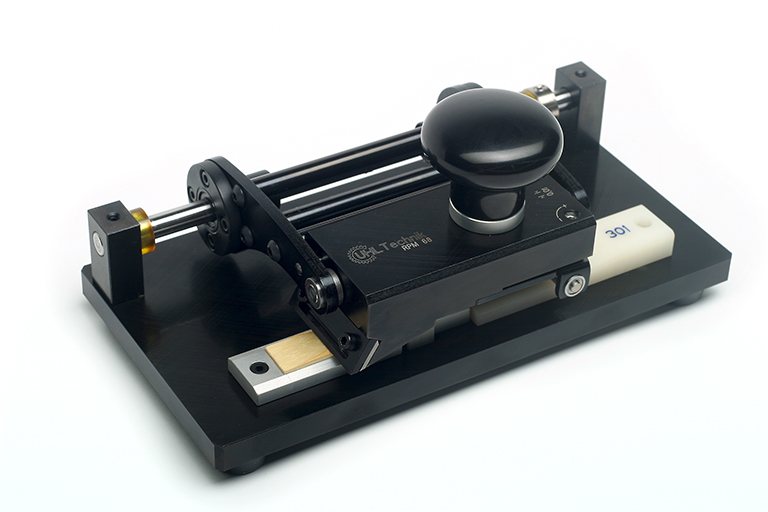
I've been fortunate enough to receive one of the first UHL Reed Profiling Machines(RPM 68). I've posted about this a few times on the bboards...It's finally here and I took some pics(photography is a serious hobby of mine) and would like to share my thoughts on the machine.
First a little background on my reed making. I got a reedual and some blank making tools in March of 2007. In the first week I made about 30 reeds...most were terrible but a few turned out great, actually sounding better than any V12 I had at the time. The next week I used one in a chamber concert and was very happy with the result. Since that time I have been hooked. My reedual profiled reeds have been consistently better and longer lasting than V12s but I grew frustrated with the idiosyncrasies of the reedual. I would ruin a percentage of my blanks because of the inconsistencies of the machine. Some of my reeds are visibly flawed when they come off the dual but due to the virtue of great cane they still play much better than commercial reeds. I could not help but think, if this vamp was more perfectly cut this amazing reed would be even better! I began searching for a more accurate profiler.
There are very few options in this country for reed making tools and also only a few 'reed mentors'. I found some information on the web about some German reed tools and profilers and was intrigued. Hermann Uhl posted some pics of a hand profiler he designed 1998. I contacted him and found he no longer made them however he had plans for a new design. I've been looking forward to it's release ever since and as far as I know....I'm his first customer!
First Impressions
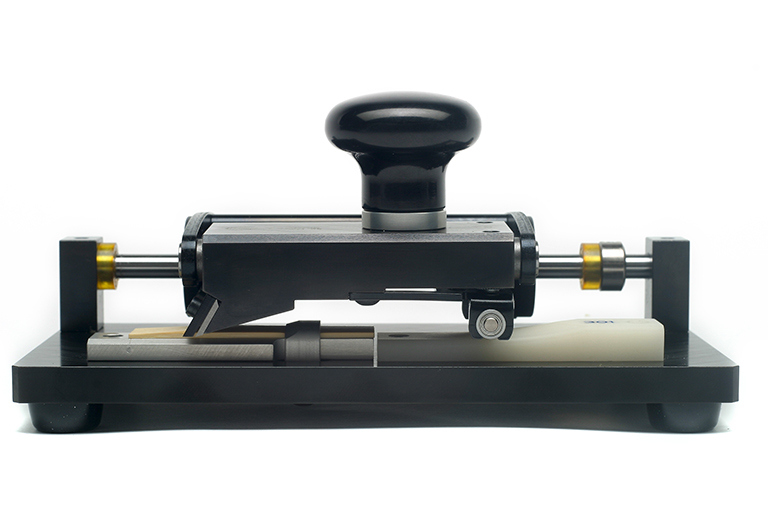
This thing is heavy! I was surprised at how heavy the machine is. It's about 7 lbs, which is heavy for something that is 10 by 20cm(yes it's pretty small). The RPM 68 is very solidly built. The arm swings easily and the back and forth motion along the rail is smooth fast and tight.
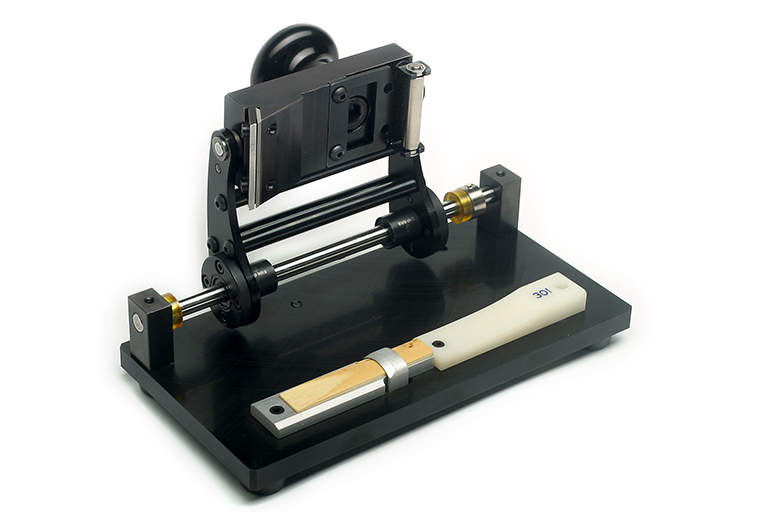
Some extra parts I got were two plastic reed guides. One is a model of a V12 and the other a model of a Rue Lepic. I also got an extra cutting blade. Also included is a plate to hold a cane model reed and three allen wrenches to replace removable parts and make adjustments to the reed thickness. Many parts are replaceable and removable. Exchanging parts is very simple. Hermann Uhl recommend changing the blade every 600 reeds(the blade is double sided, so it might yield 300 reeds per side).
Basic use
The principles under which this machine operates are very simple. It's very similar to most bassoon profilers.
On the guide side you have a cane model reed or a plastic guide. A bar rolls over the guide reed(or plastic guide) and tracks the guide side and the blade cuts the cane to shape. It operates much like a key copier. To cut the reed you simply move the blade from side to side. The side to side cutting motion is very smooth and tight, no play or wiggle at all. The block that comes down over the reed is quite heavy and the blade is very sharp so you don't need any additional downward pressure to cut the reed. I was surprised at how easily it cuts through the cane. After a few passes side to side you rotate the cutting block on its axis to create the curvature over the width of the reed. A great design feature of this machine is that, the blade axis will not move until you adjust it. This is very important because it allows you to make a few passes at exactly the same angle and then rotate it just a tiny bit and continue. It allows you to be very methodical and not 'miss' any spots. The bar that the cutting arm slides back and forth on has rubber stoppers on either end, there is no guess work on where to start the vamp. A full stroke will yield the proper vamp length(about 35mm).
The clamp that holds the reed down holds the reed down firmly without torquing it out of shape. It is easy to center the reed and does not skew the reed to one side as you tighten it. The blank is placed directly on the base plate. It does not rest on a protective strip to protect the base plate from getting cut, it does not need one. The plastic guide reed has no shaped tip, it extends straight out and is the same length as the base plate, thus ensuring that on the base plate side(where the blank is being cut) the blade hovers safely above the surface of the base plate. If you choose to use cane as a model, no problem. The base plate the cane model rests on has an offset at the tip end that raises up to meet the edges of the tip of the model reed. The elimination of a protective layer beneath the blank may seem like a minor convenience, but when you are trying to be accurate to the hundredth of a millimeter, eliminating those kinds of variable is a big deal.
Thickness adjustment
One of the stunning design features on this machine is the way thickness is regulated. As you can see from the photos there is a bar that tracks the guide reed as you cut. You can raise or lower that bar, adjusting the thickness of the reed with the two adjustment screws on the top. You can adjust either side individually which is nice. What I didn't realize until I got the machine was that when you turn the adjustment screw, it clicks and locks. Each click adjusts by one hundredths of a millimeter. That amount of fine control is a big headache saver! For example, if you like reed tips that are 0.11mm and you are getting 0.15 on the left and 0.16 on the right you would adjust 4 clicks on the left and 5 on the right. With the reedual and reedmachine, the thickness is also adjusted by a screw, but there is no click and lock, so it's difficult to know exactly how much you are changing the thickness. After making many reeds on the RPM68 I can say that the clicks do correspond to real world measurements, and once you have the correct settings there is no need to reset it from reed to reed, or adjust it as you are making a reed.
The Results
In talking to many clarinetists about this machine, many had trouble believing a blade machine could create a reed that is completely smooth. Knowing Hermann Uhl's expertise, and also having seen the wonderful results of some bassoon profilers I had high hopes for this machine.
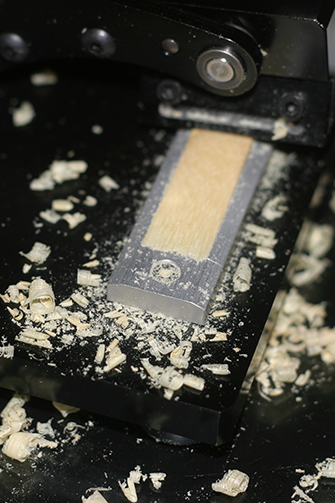
I'm happy to report that the results are simply amazing. Perfectly smooth reeds...easily mistaken for commercially made reeds. Near the end of the profiling process you are removing just a light dust. When you are done, no more material will come off. If you decide to reduce the thickness even just by 2 hundredth of a millimeter, you will see a tiny amount of dust coming off. I've demoed the RPM 68 to a few of my colleges and it's been fun to see skepticism turn to amazement.
With my reedual my reeds may vary in thickness up to maybe 0.05 of a millimeter from reed to reed(sometimes even more). That may not sound like much, but there is a big difference from a 0.10mm tip(about right) and 0.15mm(too thick, requires a rerun on the dual or some hand finishing). On the UHL, I'm seeing variation of no more than 0.01mm, all of my reed are coming out around 0.10 to 0.11.
I've included some pictures of finished reeds to show how good the results are. What astonished me is how quickly I was able to get these results(those pictures are the forth and fifth reeds I made on the machine). Even my first reed turned out fantastic. I get the best results by removing a little bit of cane(one or two passes), turning the angle of the blade, remove a tiny bit more, turn again etc. This removes a tiny layer at a time from the entire surface of the reed and then you repeat until the reed is done. In the beginning I made the mistake of removing as much material as I could before moving the angle of the blade. This method led to removing wider strips of cane at a time and would tend to rip out small patches. Another mistake I made at first was pressing down while cutting. With this machine it's not necessary to press, the weight of the cutting block is enough to cut smoothly. So keeping those factors in mind, I've been able to get beautiful looking reeds.
But how do the reeds play?
The reeds are fantastic. As good as the best reeds off my reedual...but my percentage of success has gone way up. Also the tips(and rest of the reed) are more even and symmetrical, so they respond better especially in the upper register. They also require less hand work to balance them(keep in mind, even perfectly symmetrical reeds might need some balancing).
If the measurements are accurate to 0.01 is every reed the same strength? No, this is a reed myth. Measure V12s of different strengths, you will find all the tips are around 0.10. Cane density determines strength. I make my reeds with the tip of the blank about 2mm past the tip line, thus making a longer tip. Almost all of these reeds come off feeling a little soft, then I clip to the desired strength. If a reed comes off too hard I generally don't adjust the settings of the machine, I put the blank back on and move it past the tip line a tiny bit more, and rerun. This moves the heart slightly back and makes the tip slightly longer, yielding a softer reed.
Does every reed off of the RPM 68 play the same? No, and some I might never use, but that is the nature of cane. Even if every reed is made to the same exact dimensions they will still all play differently because each piece of cane is different. But having consistent dimensions from reed to reed is a good place to start from. Before the RPM 68 I was compensating for cane variables and measurement variables, so it was hard to know where to start fixing the problem. I would often get a reed that could do almost everything well but was lacking in some area(response, or articulation etc). I feel the RPM 68 consistently yields more versatile reeds that are not lopsided in their strengths and weaknesses.
Final thoughts
This RPM 68 is well thought out in every aspect and is impeccably designed and machined. It exceeded the high expectations I had for it. With other profilers I've used it can take weeks or months to learn the idiosyncrasies of the machine or reverse engineer a model reed to compensate for inaccuracies built into the design of the profiler. You hear a lot of talk from reed makers on how they have their finally have a good 'system' going. The RPM68 eliminates that headache, it simply works the way it should.
My sincere thanks to Hermann Uhl for keeping me updated throughout this process and for designing such a fabulous machine. I believe Uhl's RPM 68 is the new standard in clarinet profilers and will become a valuable tool for any serious clarinet reed maker.
Post Edited (2008-05-18 16:13)
|
|
Reply To Message
|
|
Author: Ryder
Date: 2008-05-18 00:01
I have the same question as DavidBlumburg. The website doesn't seem to have a price. It looks as though it has yet to be updated. They must be to busy maing them to update the site. Im really intrigued. It looks simple yet effecive, and judging from your description its a hit for you.
Nice pics by the way. A hobby? Those are art!
|
|
Reply To Message
|
|
Author: Joseph LeBlanc
Date: 2008-05-18 00:25
Here's a cut and paste from the price list on the website:
Reed Profiler 'RPM 68'
1.170,00 €
Plastic guide, Standard model
No. 101: Vandoren White Master, Bb-Clar., German Cut
No. 301: Vandoren V12, Bb-Clar., French Cut
No. 302: Vandoren 56 Rue Lepic, Bb-Clar., French Cut
129,00 €
Plastic guide, custom model
249,00 €
Cutter blade
12,90 €
-Joe
|
|
Reply To Message
|
|
Author: redwine
Date: 2008-05-18 01:04
Hello Joe,
(Disclaimer: I am the North American importer of Canyes Xilema reeds)
Congratulations on your purchase! While I have never met Mr. Uhl, the Xilema people (all of their machines are made by Mr. Uhl) have nothing but over-the-top things to say about his work, and he's apparently an incredibly nice person. I do hope to meet him one day.
Just to keep all this in perspective, with my rough calculations, you'll have about $5 in each reed, once you have made 600 of them. The price goes down, obviously, the more you make. Of course, making them yourself has got to be rewarding (I've never made a reed myself), and when you are in control of the quality, the reeds must "fit" you better.
Knowing something about tooling costs, etc., I don't doubt for a minute that the pricing is right on for this tool (perhaps even on the low side of fair market value), and if one is inclined to purchase one of these machines, there will be no arguments from me, however, the cost per reed is higher than buying a commercial reed. Will commercial reeds surpass that price? Perhaps...perhaps more than likely (especially if someone I know decides to get into reed making, a venture that, honestly, I'm surprised he hasn't already)!
Please keep us posted on your progress!
Ben Redwine, DMA
owner, RJ Music Group
Assistant Professor, The Catholic University of America
Selmer Paris artist
www.rjmusicgroup.com
www.redwinejazz.com
www.reedwizard.com
|
|
Reply To Message
|
|
Author: Ryder
Date: 2008-05-18 01:47
I'd have to agree with Ben Redwine. Actually considering how many good reeds do or don't come from a box of commercial reeds, the cost is not that much more. The sense of accomplishment and playing something good that you made is worth the cost to me. Now to go search in my couch cusions for change...
|
|
Reply To Message
|
|
Author: Joseph LeBlanc
Date: 2008-05-18 02:22
Ben,
Good observations. I definitely agree that the price is fair. And the fact that Uhl designed the product himself and has extensive knowledge on how to machine a product to these specs probably brought the cost down even more had something of similar quality been produced by someone else. Similar quality bassoon gear is as much or more.
The irony here is...I could be getting box reeds for free every month from the Marine Band!!!! I have purchased all these tools on my own and I have to say, it's been worth every penny. This tool should be able to last me for as long as I play clarinet(20 more years in the band at least).
For me, the quality is just that much better. For my Marine Band audition I opened up 6 boxes of reeds and 2 were contenders for the audition. I made four reeds yesterday and one out of the four was definitely better than my MB audition reed. The other three were great rehearsal and practice reeds. These reeds will also easily last me 3-4 times longer than a Vandoren. I won't hesitate to do run of chamber rehearsals and the concert on the same reed...something I never felt comfortable with on a Vandoren.
Also every single reed is the perfect strength. It has changed my concept of playing, the reed comes to me now. As my playing subtly changes so does my reed making.
Since I have started making reeds I haven't ever been 'stuck' with no good reeds. Even in practice sessions and rehearsals I'm able to use reeds that I actually ENJOY playing on and for that reason alone it's been worth the cost so many times over.
-Joe
|
|
Reply To Message
|
|
Author: Daniel Frazelle
Date: 2008-05-18 02:42
There's really not much that I can add to Joe's review of the RPM 68 because he basically covered everything. I did have a chance to use it today and was blown away. After exceptionally inconsistent results with other reed machines, I was surprised just how easy it was to get this to work properly right from the start. What was most important, however, was that the dimensions were all very precise and consistent. Unlike with the Reedual, all the reeds I made had the same measurements. With the Reedual I was often not even in the same ballpark with some reeds, even though they would still work because of the cane or because I clipped it to the length that was just right. With the Uhl machine, the reeds have very rational vamps and tips that allow for a greater flexibility than I got with my best Dual reeds.
Also, I thought I'd respond to the observation made that it looks like the Dilutis Reed Machine. This has been noted before and it is definitely true. There's a reason for this, and it's not that it is a copy or imitation. This is the same basic concept that bassoon profilers have used for a long time. I believe the Reed Machine was based on this basic concept, but it failed in so many areas to take into consideration many design elements that could be taylored to the making of clarinet reeds. The Uhl product is much better designed, made with much better materials, and executed properly so that it actually works the way it's supposed to. This machine is not a mystery to use or something that requires an aquired touch. It simply profiles the reed in a way that is consistent with the concepts bassoonist have been using for a long time.
It's an excellent product that took only minutes to convince me to get one myself.
Daniel Frazelle
US Navy Band
Post Edited (2008-05-18 02:44)
|
|
Reply To Message
|
|
Author: Dileep Gangolli
Date: 2008-05-18 11:56
I, like others on this thread, have used a Duall (prior to having my kids and not having time to even practice!) to mixed success. I agree that good cane can make up for bad cuts.
The Duall is a very old invention at this time and really is quite crude given advances in technology. The fact that someone has made a better system for making reeds is not surprising.
I am glad that people are investing money in trying this device and sharing their results. It would seem that this tool is a large improvement in what we have had in the past.
Anything that can break the Reed Oligopoly is good news.
Power to the People!!!
|
|
Reply To Message
|
|
Author: William
Date: 2008-05-18 15:53
Reed Profiler 'RPM 68'
1.170,00 €
I'm not familiar with this figure--how much is this in US $$'s??
|
|
Reply To Message
|
|
Author: redwine
Date: 2008-05-18 15:56
Hello,
€ is the symbol for Euro. Today's conversion is 1=1.55531.
Ben Redwine, DMA
owner, RJ Music Group
Assistant Professor, The Catholic University of America
Selmer Paris artist
www.rjmusicgroup.com
www.redwinejazz.com
www.reedwizard.com
|
|
Reply To Message
|
|
Author: spartanclarinet
Date: 2008-05-18 16:00
Hey Joe,
Long time no see.....hope you're doing wonderfully. Terrifically interesting post! After this season's reeds, I feel it is time for me to investigate this for myself. The shipping cost on that thing from Europe must be huge.
What is the source for your cane?
JCO
Justin O'Dell
http://web.mac.com/clarinetquintet/iWeb/MSUClarinetStudio/MSU.html
http://www.music.msu.edu/people/detail.php?id=83
Post Edited (2008-05-18 17:06)
|
|
Reply To Message
|
|
Author: Joseph LeBlanc
Date: 2008-05-18 16:34
Justin!!
It weighs 7 pounds. I see the reason for confusion, I edited the post with a space between the number.
It's definitely worth checking out, might be a great investment for a clarinet reed room at MSU.
Backun is going to be the North American Distributor, but did have mine shipped from Germany because I was anxious to get it asap.
I've been using Glotin tube cane. The seem to have gone out of business and I haven't found it for sale anywhere in a while. I've had success with RDG and Ghys cane as well. I just made a reed with an Oliveri blank yesterday and was intrigued...I may try more of those.
For me good cane has been a critical factor, I've probably tried about 10 different brands and I continue to try new stuff as I find it. I've been amazed at the extreme differences between them all...they each have a personality. It's all about finding the perfect marriage of vamp shape and cane type.
I think Vandoren got it right with the V12 vamp shape, but their cane is just bad. One problem is, they get their cane from three different sources and use all 3 types to make all of their reeds...no wonder most people get only three they like out of a box.
Certain cane types work better at different blank thicknesses as well. For me RDG is terrible as a thick blank(think rue 56) but improves greatly as a thinner blank(think blue box). It's all about trial and error and find what works best for you.
It's been great to get away from the one size fits all mentality of commercial reeds. It's definitely a journey, finding what works best but having a profiler that can deliver a consistent cut eliminates so much headache.
Take care!
-Joe
|
|
Reply To Message
|
|
Author: spartanclarinet
Date: 2008-05-18 17:12
Joe,
Yes, it seems Vandoren cane is extremely variable in quality. It has been especially frustrating this year. I visited the Uhl Technik website and this reed profiler sounds like an intriguing possibility. What do you use to make blanks out of your cane tubes?
JCO
Justin O'Dell
http://web.mac.com/clarinetquintet/iWeb/MSUClarinetStudio/MSU.html
http://www.music.msu.edu/people/detail.php?id=83
|
|
Reply To Message
|
|
Author: Joseph LeBlanc
Date: 2008-05-18 17:36
Right now I use the Dilutis tools for blank making. However, I have an order with Greg James of Canada for a new planer and shaper.
Theoretically, if the planer is good enough, blanks should come off so flat that they don't need sanding to further flatten the back. My goal is to only have to use sanding as a means to smooth and seal the back. With this new planer I hope to achieve that goal...time will tell, and I'll post my thoughts here on the bboard.
My current shaper has served me well. It's similar to a V12 taper. I'm going to experiment a shaper that has a faster taper...more along the lines of a Gonzalez. This will keep all of the reed on the table of the mouthpiece which should result in improved response...again, time will tell.
I use an RDG Bassoon cane guillotine to cut the cane to length after it's split. I find it's a time saver and its easier to pick out the exact part of the cane that is the straightest.
-Joe
Post Edited (2008-05-18 18:31)
|
|
Reply To Message
|
|
Author: jcfasanar
Date: 2008-05-19 11:55
Hi Joseph, im a dilutis machine user and i have ordered the uhl machine today. I have some questions for you:
- This machine works better with dry or wet reed blanks? How you are using it?
- The blade not break the sides and tips of the blank when you are finishing?
- How long takes to make 1 reed?
- Making "reed to reed" copies, the machine ruins the model reed like the dilutis? How many copies can you make from a model reed?
|
|
Reply To Message
|
|
Author: Joseph LeBlanc
Date: 2008-05-19 15:04
jcfasanar wrote:
>
> - This machine works better with dry or wet reed blanks? How
> you are using it?
Dry only. No need to wet the reed to make it easier to cut
> - The blade not break the sides and tips of the blank when you
> are finishing?
No. The tip can fray a little bit, but the part the fraying only occurs above where you will need to clip.
>
> - How long takes to make 1 reed?
For me it takes 3-5 minutes, that time might improve as I make more reeds.
> - Making "reed to reed" copies, the machine ruins the model
> reed like the dilutis? How many copies can you make from a
> model reed?
So far I have only used the plastic guide. If you are going to spend the money on the profiler, I highly recommend a plastic guide, it's expertly made and the dimensions seem very symmetrical.
When I first got the machine I did mess around a little with rolling the guide bar over a vandoren reed just to see how it would hold up. Since the bar actually rolls and you don't need any pressure I think the reed will hold up pretty well. It certainly won't destroy the cane model as often happens with the Dilutis. Over time, the cane model may need to be changed...I'd have to do some experimenting, I just haven't had the need to try it since the plastic guide is yielding such great reeds!
Congrats on your order, and good luck!
-Joe
|
|
Reply To Message
|
|
Author: jcfasanar
Date: 2008-05-19 16:23
I ordered the V12 guide too. (And a extra blade, complete equipment)
Im only curious about the "reed to reed" copies because i prefer V12 cut, but i would like to experiment with other cut/cane combination like gonzalez cut, Ricos or Alexander cut... or something else, and do not want to spend more money in each custom guide only for this "curious experiments".
If a model reed last for about... 20-30 perfect copies before ruin... i think its sufficient for cut/cane combination experiments.
|
|
Reply To Message
|
|
Author: Daniel Frazelle
Date: 2008-06-13 05:10
I received my machine this week, so I thought I'd give an update of sorts.
The RPM 68 is incredible. That's all there is to it. I've made a bunch of reeds already using different types of cane. I also experimented with blanks I made from the tube alongside commercial pre-made blanks. Every reed I made was workable and one I'd feel comfortable using in rehearsal. As it stands, I have five that blow away all of the commercial reeds I have. After already using a reed I made on Joe's machine for my last concert, I can say with complete certainty that I will be using one of these new reeds on my concert next week.
I believe the best reeds are the ones I make from the tube. I don't know exactly why, but these just seem to be better even when factors such as blank thickness, length, and taper are just about equal. Still, I think making reeds on this machine from commercial blanks is a very viable option, with relatively little lost in quality. Of course, the greater value is in making the blanks from the tube.
I mention all this only because my point is that this machine really produces a quality reed from any suitable blank. It's so easy to use that I have no concerns as I put another blank on and go to work. I'm not overstating anything when I say that it will completely change my playing and my day-to-day approach to practicing and preparation. I know the price will be prohibitive for many, but I feel as if this is an investment along the lines of what bassoonists make. After seeing, using, and now owning the machine, it's hard for me to say that it isn't worth it for just about any serious player.
I should also note that Hermann Uhl has been wonderful to deal with. I understand he will be passing off the North American distributing at some point, but for the time being he's a pleasure to work with.
Daniel Frazelle
US Navy Band
Post Edited (2008-06-13 05:17)
|
|
Reply To Message
|
|
Author: atasic
Date: 2008-06-13 21:10
i have also receved mine 3 days ago ...........I am so sutisfied with the result I get ........worth every Euro and beyond....after review Joe and Daniel wrote I can not add anything....just simply can say that everybody should own one.....
|
|
Reply To Message
|
|
Author: jcfasanar
Date: 2008-06-13 22:14
I received mine 2 weeks ago... i agree with the comments. The machine is incredible.
But im having problems getting good reeds. I thinks the problem is not the machine.
I think its the flat side of the reed... i use sandpaper and bastard files, but i think my reeds warps.
Other problem is the material and the reed strength im getting.
Im using Neuranter cane, and i have Silvacane, Rigotti and Ghys.
Which cane you prefer and what aproximated strength are you geeting?
And what reed measurements are you using? Im cutting V12 style 3,15 with 0.10 on the tip, but all the reeds are soft or very soft for me (i need 4 - 4,5)
Any tricks to get the reed table perfectly Flat?
|
|
Reply To Message
|
|
Author: Ed Palanker
Date: 2008-06-13 23:13
I was over Joes’ place last week and tried the machine, I came home and immediately ordered one from Backun, delivery expected some times this summer. I’m buying it because I intend to make my students reeds in rep. class every week or two. It was too difficult to do that in mass on my reedual. The Uhl is much faster when making a whole bunch. Of course cane is like fine wine, there are good years and bad. Too much sun, too much rain, not enough of either and a $100 bottle of Burgundy one year is $6 the next. The same with cane, the only difference is that they don’t charge less when the cane is inferior like they do with wine. There is actually quality control for wine; apparently we can’t say the same about making reeds, any brand. You can drink the $6 Burgundy but it sure isn’t the same as the $100 bottle. You may be able to play all the reeds in a box but at what quality? ESP www.peabody.jhu.edu/457 (Listen to a little Mozart)
|
|
Reply To Message
|
|
Author: Remi
Date: 2008-07-09 13:52
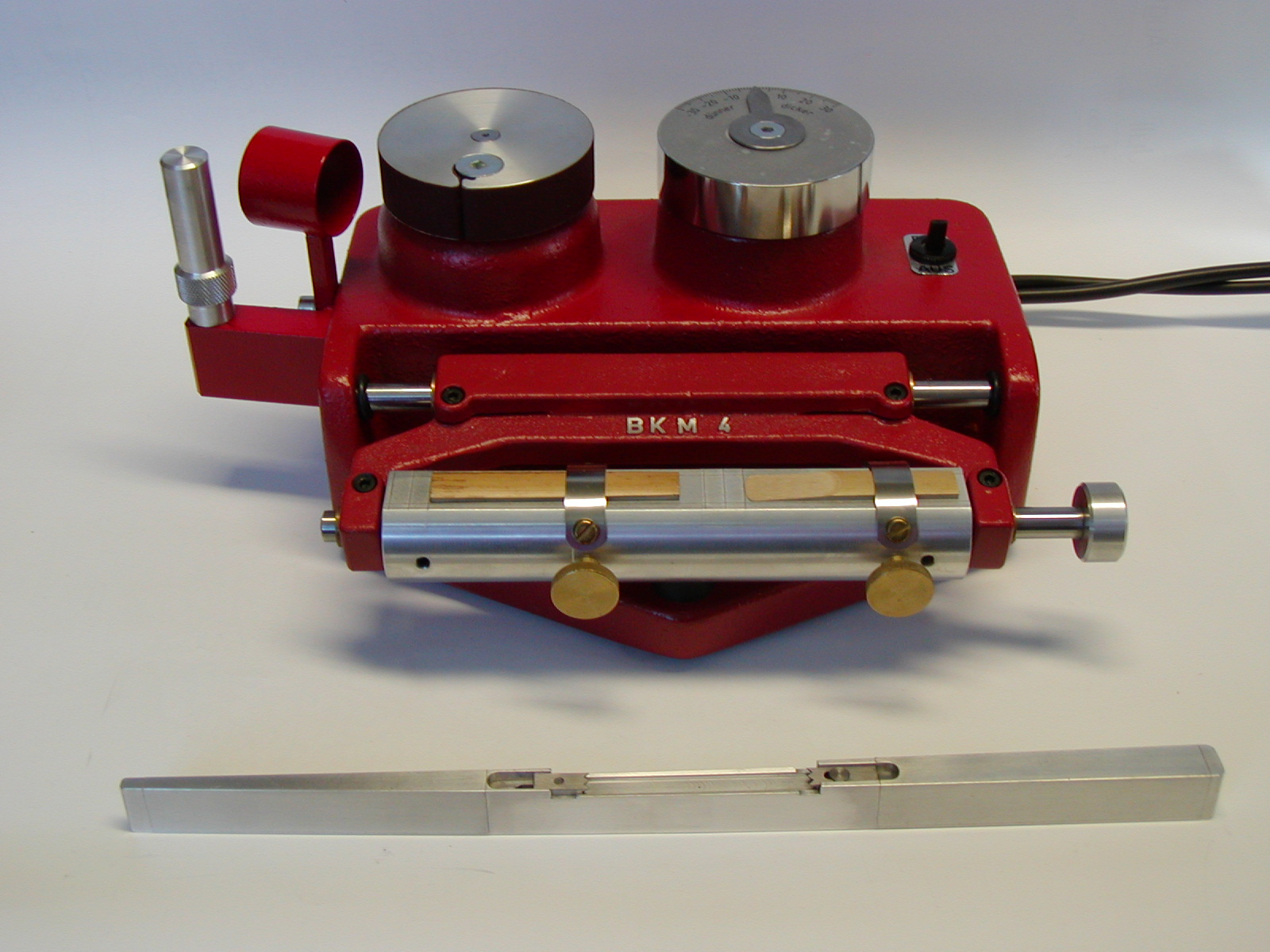
Has anyone used the BKM 4 reed machine made by Wilfried Schmidt Maschinenbau (see attached photo)? I learned about it
|
|
Reply To Message
|
|
Author: Remi
Date: 2008-07-09 13:58
Attachment: BKM 4.JPG (422k)
Has anyone used the BKM 4 reed machine made by Wilfried Schmidt Maschinenbau (see attached photo)? I learned about it from Dan Gilbert. I tried his and it works great. I put in an order almost a year ago and am still waiting.
I'm wondering how it compares to the Uhl machine being discussed? As they are comparable in price (I actually think the Uhl is cheaper), and I haven't yet paid for the machine that has taken so long, and given the great reviews of the Uhl product, I'm thinking of going with the Uhl. Any advice would be greatly appreciated. Thanks!
|
|
Reply To Message
|
|
Author: mnorswor
Date: 2008-07-09 15:38
Hi Remi and Joseph,
I'm wondering, since you have these two machines, if you could tell me how they deal with the rails (meaning the extreme left and right sides) of the reed. In my experience with a DuAl, the big flaw in the design is that the rails are not shaped properly because the sanding wheel simply cannot get to them. I think this happens because the table that the reed sits on is too wide. From the looks of it, the same is true of the BKM4.
The Uhl seems to be better designed in this regard with a tapered edge that I can see in one or two of the pics. I also think the Dilutis machine deals better with the rails and is more similar in design to the Uhl.
Can either of you, or others, comment on this?
Thanks!
Post Edited (2008-07-09 15:40)
|
|
Reply To Message
|
|
Author: Remi
Date: 2008-07-09 16:49
Hi Michael,
Yes, I also like the idea of the tapered edge of the Uhl. I don't actually own the BKM4 so I only have minimal experience with it, but it seemed to cut the rails properly. Also, though the BKM4 has a vacuum hook-up, it can make quite a mess. Not having to plug anything in or change sandpaper every few reeds also seems like a plus. Hopefully I'll get a chance to try out one of these before I commit to the BKM4.
Remi
|
|
Reply To Message
|
|
Author: Joseph LeBlanc
Date: 2008-07-09 17:03
Remi,
Thanks for posting the pic of the BKM4...I had wondering what it looked like.
So the BKM is still being made? Interesting...I located a used one in Germany a while back for the price of 800 euros...but I never went through with the purchase.
One huge advantage of a machine like the Uhl is....way less mess. With a belt style profiler you also need a vacuum(the machine and vacuum going can also be quite noisy). Also, you need an electric outlet. With the Uhl you can use it anywhere, easily take it with you on trips, and just brush the mess into a waste basket when you are done.
Michael,
As far as I can tell, and my reed gauge will allow me to measure...the Uhl makes an EXACT copy. My thinking is....since even a swipe of sandpaper can make a big difference, and the fact that, that swipe is basically not measurable with something like the perfectareed, if you can see or even measure inconsistencies...then the machine is not consistent or accurate. Accurate measurements are not the end all...as cane can vary wildly in density even within the same blank. But I think accurate measurements are a good place to start.
I think there is more going on with the Dual than meets the eye. People often find problems in the tip and the rails of dual reeds. I think this is due mostly to the fact that those are the easiest places on a reed to measure. I suspect there are similar inconsistencies over the entire vamp, that are very hard to measure with something like the perfectareed.
That is not to say however, that the reedual can't make great reeds. I played dual reeds for a year and would go back to it if I had to. It's just a matter of putting in the time to set it up so it works for you, and then understanding that it will produce unplayable measurements from time to time.
-Joe
|
|
Reply To Message
|
|
Author: Remi
Date: 2008-07-09 17:38
Hi Joe,
Yes, I completely agree with the noise/mess issue. I sent you an email about possibly trying yours while I'm in the area, or maybe you know of someone else in the Baltimore area that has one that could let me take a look?
Thanks again,
Remi
|
|
Reply To Message
|
|
Author: Ken Shaw ★2017
Date: 2011-03-12 21:48
Backun's site doesn't list the UHL equipment. I'm not sure it ever did. Does anyone know if he carries it?
Ken Shaw
|
|
Reply To Message
|
|
Author: jparrette
Date: 2011-03-14 00:09
To you tube cane users -
Where do you get good cane, and where did you get the tools to make them into blanks?
I have a UHL RPM 68, and it is magnificent.
Thanks -
John Parrette
CLARION MUSICAL SERVICES
john@clarionmusical.com
914-805-3388
|
|
Reply To Message
|
|
Author: Ed Palanker
Date: 2011-03-14 01:24
I own one myself, I've made about 80 reeds on it. It is very good but I've gone back to commerical reeds, I just don't have the patients anymore to make them, though I still have about a dozen good ones that I use. If anyone is interested in buying it from me contact me off of the forum and we can "talk". I paid about $1800 with an extra blade, shipping and taxes. Make me a "reasonable offer and I'll sell it. ESP http://eddiesclarinet.com
Sold!
ESP eddiesclarinet.com
Post Edited (2011-03-15 17:04)
|
|
Reply To Message
|
|
Author: Brad Behn
Date: 2011-03-15 14:04
I have a Dual I use on a daily basis. I got in in 1986 and haven't looked back. It is a wonderful tool. And to argue a little with Dileep, I don't think it is crude at all, I have wonderful success making reeds that are perfectly balanced right off the machine, but admittedly I did have a machinist go over it to make sure my machine produces accurate results.
If I were to get another machine, I would give the BKM a very serious look. I know of a couple people who own them and say that the BKM is a good machine.
I make reeds about 25% of the time, but generally I use the Dual to put a better shape (for me) on commercial reeds. It balances them and creates a very nice tip shape. Also the nice thing about the dual is that I can create my own model shape at will and at no cost. And finally, with no blades to get dull, all I had to invest in is sandpaper (which insures a perfect and consistent cutting surface when replaced for each reed) and a cutting board.
If I didn't have my Dual, I would be a far less happy player.
Ultimately however, a machine is only as good as the cane will allow it to be. And that is where commercial reeds are great, because one only need a few seconds to try a commercial reed and evaluate the cane's potential, whereas with homemade reeds one must first make a reed to determine the potential of the cane. And that process is far more time consuming.
When I make reeds from the tube I generally make one reed and determine if the source tube has good enough cane to make the remaining reeds. If not, I just throw it away, thereby saving a lot of wasted time producing reeds from a poor tube. For this potentially great time saving reason I only make reeds from tubes.
Brad Behn
http://www.clarinetmouthpiece.com
|
|
Reply To Message
|
|
Author: T.Wees
Date: 2011-03-18 08:52
Ken --
On the NEWS page on the Backun Musical Services web site is an item saying they do carry the UHL machines and giving a contact name for more information (Olivia, I think).
|
|
Reply To Message
|
|
Author: Ken Shaw ★2017
Date: 2011-03-18 21:02
Todd -
Many thanks. That's the one place I didn't think to look.
Ken Shaw
|
|
Reply To Message
|
|
Author: David Niethamer
Date: 2011-03-19 02:13
Just one brief issue with what Brad said in his post -
A colleague made the same assertion that he made one reed from a tube to see if the tube was of good quality. So I started to test that assertion, and discovered that each tube can have good spots and bad spots. So, if you happen to try one of the bad spots, you might discard a tube that has 3-5 good reeds in it. If you have a routine for splitting the tube, shaping the blank, and then cutting the reed, it doesn't take that much longer to do all eight reeds from each tube.
I replaced my ReeDuAl with a DeLutis "Reed Machine", which gives me more consistent results. I found that sandpaper varied somewhat from sheet to sheet, with the result that a new strip of sandpaper could suddenly unintentionally result in a softer or harder reed.
All that said, I've reverted to Vandoren V12, which for my mouthpiece, is the best commercial reed (for me). I wish I had the time and patience to make reeds every month, because the ones you make yourself are much better - last longer, etc.
And Brad is right about tubes. Making your own blanks from tubes is really the only way to go - you have a lot more control over the shape of the blank and the "curing" of the back before you cut the reed.
David
niethamer@aol.com
http://members.aol.com/dbnclar1/index.html
|
|
Reply To Message
|
|
Author: JHowell
Date: 2012-06-12 05:55
Found this thread looking for info on the BKM4. Glowing, but a few years old. Anybody have any updates on using the RPM68 or 82, or experience with the BKM4?
|
|
Reply To Message
|
|
Author: Ken Shaw ★2017
Date: 2012-06-12 11:51
Mucho razbuckniks for the DeLutis tools, and astronomical for the Uhl. Unless you're a professional player or have a big studio to keep supplied with reeds, they may not be worth it.
Ken Shaw
|
|
Reply To Message
|
|
Author: Joseph LeBlanc
Date: 2012-06-12 17:59
JHowell,
Fantastic timing on your question and interest in the UHL profiler. First I must offer a disclaimer- I have very recently become the North American distributor for UHL Technik and their reed tool line. He recently updated the design to his profiler and they went on sale yesterday. As you saw in the review above I was one of his first customers and I've been using his profiler ever since.
All of the points in my original review remain valid, but there have been a few small changes to the cutting arm that allow for even smoother cutting. Frayed tips were sometimes an issue in the older model(not a big issue as this area is usually clipped off), with the new model fraying the tips is practically impossible. This allows you to profile with more abandon- creating reeds even faster with no imperfections.
I've launched a new website to sell these profilers, but it also includes a ton of great information with in depth videos about the machine and about reed making in general.
Please follow the links in my signature for more information and to check out the video series.
Best,
Joe
http://reedworkshop.com
http://youtube.com/reedworkshop
Post Edited (2012-06-12 18:05)
|
|
Reply To Message
|
|
Author: morbius
Date: 2012-10-10 23:23
Does he have a templet for the Gonzalez FOF reed? It uses the templet of the old Morre reed, which I find superior to the V-12 templet. Who is the US distributer of the Uhl machine and what is the price?
John Dorch
|
|
Reply To Message
|
|
Author: morbius
Date: 2012-10-11 15:06
I would be interested in a comparison of the Uhl machine vs. the DeLutis machine. Price wise, from what I understand, the Uhl machine is about $1800 US.... that puts it out of range for most Clarinetists.
John Dorch
|
|
Reply To Message
|
|
Author: Daniel Frazelle
Date: 2012-10-12 01:59
Morbius,
Relatively early in this thread, I addressed the Dilutis Reed Machine in my praise of the Uhl. Without going into much more detail, let me just reiterate that the Uhl is a far, far superior product. At the risk of sounding like I'm overstating things, there is simply no comparison between the two machines. Quality design and engineering does come at a cost and you just don't see bassoonists using tools that are below $1000. The uhl might not make sense for everybody. If the cost of it is hard to justify, then I suggest not compromising and spending money on the Reed Machine. It is unlikely you will get results that are satisfactory. Out of nearly a dozen clarinetists I know personally who have purchased the Uhl, none of them have regretted the purchase.
|
|
Reply To Message
|
|
Author: Dileep Gangolli
Date: 2012-10-12 18:27
While expensive in initial cost, the UHL device can only save money in the long run, provided one is committed to making reeds.
This involves sourcing good cane, having the patience to age it properly, and then spending time learning the craft of making reeds.
Of course, if one is already working and has limited time, then there is the question of opportunity cost.
Raw materials for making reeds is minimal. So it is really the time and learning curve involved.
Once one knows how to make a reed, and uses a device as accurate as the UHL, my guess is the cost per reed would amount be minimal.
Assuming that the investment of time to make 10 reeds (of which 8 will play much better than those in a box of commercial reeds), then 2 reeds cost $26 (retail price).
If one can make 8 reeds that are excellent out of 10 (not unheard of), then you have saved 4x$26 or roughly $104 US.
If it takes you two hours to produce these 8 reeds and you make less than $52/hour then it makes sense to make the reeds.
If your time is worth more than that, then you can pay for commercial reeds and accept the 2 good reeds in a box of 10 ratio.
Over time, you will capture the initial investment of buying the device through your captured savings not having to purchase reeds.
That is how an economist will think of it anyway.
|
|
Reply To Message
|
|
Author: michele zukovsky
Date: 2017-08-06 07:03
hello mr. leblanc,
i am very interested in buying a uhl reed profiler.
do you have any for sale?
either new or used?
with all best wishes,
michele zukovsky
michelezukovsky@gmail.com
|
|
Reply To Message
|
|
Author: michele zukovsky
Date: 2017-08-06 07:05
thanks for all the information on the UHL.
i have bought these before for my reed makers, for i no time to sit down and make them.
now i have the time.
could you give me a price??
with all best wishes,
michele z
michelezukovsky@gmail.com
|
|
Reply To Message
|
|
Author: WhitePlainsDave
Date: 2017-08-06 08:27
Ms. Zukovsky:
Not that I am by any means this board's official greeter, but please allow me to welcome you and wish you nothing but the best and healthiest retirement from a legendary performance career.
Your new found time has rekindled an interest you have had in making reeds that your schedule up until now didn't provide.
Buy the tools, experience the process, have great success or at least fun, learn something, share it with us.
=========
But with that said, allow me to share something with the rest of us, and it starts with a simple completely unrelated question: why do we have currency--you know money?
Well, as most people know, if not truly appreciate, back before governments issued the stuff and the populous recognized it as representing value, back before gold, we'd exchange goods rather than money with others. People had to be more "jacks of all trades" than master of a few and make the things they needed because it wasn't always easy to buy things in markets, so you had to make more things yourself.
With money, even gold, people could start specializing in certain goods and services, becoming more proficient at making them than if they had to spend their time making many of the things they need. They could sell the products for money, and use it to buy things they weren't as good at making from other specialists. So emerged the Village tailor, the blacksmith, the farmer, etc.
And if the "bread maker" needed meats and the "meat maker" needed metal, the "bread maker" didn't have to first buy metal with his bread to get meats.
And resultingly, the world became a better place because free trade makes each side richer, ergo anything that facilitates trade is good, all while the quality of goods rose while the cost to make and sell them dropped from specializing and economies of scale.
With the emergence of the industrial age, the idea of running your own vulcanization plant to make tires, over buying them from a tire maker became absurd.
====
And yet, I can't help think that some of us (not all, not the hobbyist) are "vulcanizing our own rubber" in making our own single reeds versus buying them.
(100 people stand poised to differ---hear me out first.)
No machine you buy, no matter how elegant, no matter how much better than others, no matter how freshly sharpened its knives, is going to cut reeds with the human hair accuracy of say Vandoren.
Not that this precision, by the way, is anything but a mere starting point.
Frankly, I think its miraculous when a professional cane reed actually does play well out of the box. Why on earth would you expect it to? The uniform cutting of a highly non uniform substance, (even excellent cane can have inter-reed lack of uniformity) yields high degrees of lack of uniformity in *play* (if not cut) that a good reed needs.
So, unless you have access to amazing cane, (which given its inter-tube variability will still necessitate you to work on the reed once the basic pattern is cut) I just don't see you saving much time or money making reeds from scratch, a get a product for the more time you put in to making it.
Now maybe my mindset comes from the idea that I need to work on factory reeds with ATG like methods beyond most people's patience level, but doing so yields me a very large percentage of pretty good reeds (sure, there's reeds that won't play no matter what you do) at lower cost and time than "vulcanizing my own rubber."
I have to laugh. Ed Palanker, who's opinion I respect, wrote here in '08 of the time in using this, and more recently on other posts that with his excellent cane supply gone, factory reeds made even more sense.
The UHL may be a phenomenal home reed making machine. But on its best day its not a computer controlled, quality assured, $20 million diamond reed cutter machine at 56 Rue Lepic, or Aria, Steuer, Gozalez or D'addario Reeds, etc.
Post Edited (2017-08-06 08:31)
|
|
Reply To Message
|
|
Author: kdk
Date: 2017-08-06 18:17
It's interesting to see an old thread like this one revived.
First, the RPM 68 profiler (and its cousin, the RPM 82 for the larger single reeds) is now apparently distributed by AW (price on their website is $1,660.13). I couldn't find a URL for Uhl. Has Uhl itself been bought out, or is AW a renaming of the same company?
Second, the current descriptions of the plastic guides don't identify them as "V12" or "56 Rue lepic" models, they just have model numbers. But, apart from Dave's questioning of the ability of a small hand profiler to improve on the accuracy of a commercial CNC-based assembly line, I wonder something simpler. If you're happy with the profile of a V.12 or a 56 Rue lepic, why would you want to start with a cloned version of it made on a home machine? Why not start with the real thing, which is what players who adjust and use commercial cane reeds do normally? Even if the profiler produces perfect imitations of a V.12, what do you gain over a V.12 from Vandoren's factory? How much more useful would it be to have the ability somehow to reproduce your own set of dimensions from the beginning?
Third, the blanks for sale at AW are only classified by instrument and national "school" (German, Austria, Boehm, etc...). They are not separated by hardness. So there is still the much-discussed problem of trying to reliably produce reeds of specific dimensions using cane of completely unpredictable hardness and hoping for a consistent result. The cane AW sells is about 80 cents per blank - and not all of them will be of a hardness to produce good reeds. Are there reliable hardness gauges available that will test the cane before it has been cut? I have a Uhl gauge that I bought several years ago, but it's made to test already cut reeds by measuring tip flexibility.
Karl
|
|
Reply To Message
|
|
Author: michele zukovsky
Date: 2017-08-06 23:37
dear sir,
actually, i agree with you. if vandoren had not changed the profile of the white master a few years ago, i would still be playing them, and NOT looking to make reeds.
unfortunately, the reed profile is now so different, and i cannot remake them, i am now up a stream without a paddle.
the only good thing about "homers" is that they last for months, and not days.
michele zukovsky
michelezukovsky@gmail.com
|
|
Reply To Message
|
|
Author: donald
Date: 2017-08-07 00:51
Kia Ora from NZ, Vandoren have revived the "old" white master reeds and these are now available as "White Master Traditional". They did this after getting many complaints that the changes to the white master (terrible name!) were not satisfactory.
|
|
Reply To Message
|
|
Author: atrain
Date: 2022-03-19 20:48
Does anybody have AW Tools/Hermann Uhl Reed Profiler 'RPM 68' they would like to sell?
Post Edited (2022-03-19 20:51)
|
|
Reply To Message
|
|
Author: atrain
Date: 2023-07-09 23:09
The new AW Winds (Hermann Uhl) REED PROFILER RPM68-2 is now available at:
https://www.aw-woodwinds.eu/shop/en/7-reed-profiler
The price is EUR 1,650 (USD 1809.88 as of 7-9-2023)
|
|
Reply To Message
|
|
Author: atrain
Date: 2023-07-09 23:26
I have created a new topic to discuss this:
'New 2023 Uhl RPM 68-2 Reed Profiler'
It's located at:
http://test.woodwind.org/clarinet/BBoard/read.html?f=1&i=505978&t=505978
|
|
Reply To Message
|
|
The Clarinet Pages
|
 |
.jpg)
.jpg)
.jpg)
.jpg)
.jpg)
.jpg)