The Clarinet BBoard The Clarinet BBoard
|
Author: Johnny Galaga
Date: 2026-08-08 22:57
Sometimes I see players with these big, oversized barrells that looks like a pear? And it's usually professionals plying those things. So exactly, what are these and what do they do? They're shaped almost like a pear. Do they make you sound better somehow?
|
|
Reply To Message
|
|
Author: farabout
Date: 2026-08-08 23:26
The outer shape actually does next to nothing. It's the inner geometry that counts.
|
|
Reply To Message
|
|
Author: Johnny Galaga
Date: 2026-08-08 23:54
Some of these barrels don't even have rings which looks odd like maybe it doesn't even fit properly.
|
|
Reply To Message
|
|
Author: kdk
Date: 2026-08-09 00:35
Johnny Galaga wrote:
> Some of these barrels don't even have rings which looks odd
> like maybe it doesn't even fit properly.
I think being ringless is meant to be a feature. In theory it requires thicker tenons and no metallic restrictions on the barrel's resonance (if indeed barrels resonate meaningfully), and all the extra mass is what is supposed to provide the dark richness those barrels are credited with.
Never mind about objective data. It's all up to the player's perception of the result, and it tends be hard to argue with someone who is convinced he sounds "darker" (whatever that means) on a fatboy.
Karl
|
|
Reply To Message
|
|
Author: farabout
Date: 2026-08-09 01:08
kdk wrote:
> Johnny Galaga wrote:
>
> > Some of these barrels don't even have rings which looks odd
> > like maybe it doesn't even fit properly.
>
> I think being ringless is meant to be a feature. In theory it
> requires thicker tenons and no metallic restrictions on the
> barrel's resonance (if indeed barrels resonate meaningfully),
> and all the extra mass is what is supposed to provide the dark
> richness those barrels are credited with.
>
> Never mind about objective data. It's all up to the player's
> perception of the result, and it tends be hard to argue with
> someone who is convinced he sounds "darker" (whatever that
> means) on a fatboy.
>
> Karl
For once, I wholly agree with Karl.
|
|
Reply To Message
|
|
Author: SecondTry
Date: 2026-08-09 01:47
Farabout:
I have no horse in this race.
That said, it would conceivably make sense that the density and thickness of the material a barrel is made of might allow it to absorb more or less of the sound energy, which could affect the sound.
Do me a favor, don’t criticize anyone’s lack of peer reviewed scientific studies here when your differing opinion didn’t have them. At least I quoted someone else.
Conflict of interest: I play a P & S adjustable barrel whose attributes don’t include thickness.
If history is any indication now’s about the time that you’ll respond in some foreign language few understand in an effort to sound ( no pun intended) intellectual when in reality “you got nothing’.”
|
|
Reply To Message
|
|
Author: Paul Aviles
Date: 2026-08-09 02:27
So, my opinion is based a little on just having a few that I've liked and playing on a version designed by Jonathan Copeland. What the greater density up at the top of the horn seems to do is promote more vibration of the air column FURTHER DOWN into the horn. For me it seems to allow greater volume to the sound. Yes, it is possible this effect is really only perceived by the player, but just on those grounds I have to say it is a positive outcome that we should be willing to embrace.
At one point, just for pure experiment's sake, Jonathan Copeland observed what the cross section of a barrel sawed in half length wise looked like. This way you plainly see that there is much less material at the top of the barrel and much more at the bottom. One may recall some of the problems some manufacturers had with ringless barrels cracking at the top........easy to see why that way. To further the experiment Jonathan designed some barrels that look "upside down" from the outside. They are bigger at the top than they are at the bottom. When you look at this in cross section, both top and bottom have the same amount of material. These barrels are great at allowing the player to achieve more volume of sound and I believe it is the "ideal" of what the fat boy manufacturers where trying to achieve.
...................Paul Aviles
|
|
Reply To Message
|
|
Author: SecondTry
Date: 2026-08-09 03:07
Paul Aviles wrote:
> To further the
> experiment Jonathan designed some barrels that look "upside
> down" from the outside. They are bigger at the top than they
> are at the bottom. When you look at this in cross section,
> both top and bottom have the same amount of material.
...any playing difference between the barrels with fatter tops than bottoms even though the innards were the same?
|
|
Reply To Message
|
|
Author: farabout
Date: 2026-08-09 03:32
SecondTry wrote:
> Farabout:
>
> Do me a favor, don’t criticize anyone’s lack of peer
> reviewed scientific studies here when your differing opinion
> didn’t have them. At least I quoted someone else.
>
> Conflict of interest: I play a P & S adjustable barrel whose
> attributes don’t include thickness.
>
> If history is any indication now’s about the time that
> you’ll respond in some foreign language few understand in an
> effort to sound ( no pun intended) intellectual when in reality
> “you got nothing’.”
With compliments to the 2ndTry & dogmatics (in plain lingua-franca-English):
https://pubs.aip.org/asa/jasa/article-abstract/36/10/1881/755252/Effect-of-Wall-Material-on-the-Steady-State-Tone?redirectedFrom=fulltext
|
|
Reply To Message
|
|
Author: Chris P
Date: 2026-08-09 03:46
Fatter barrels will retain heat better than skinny barrels once warmed up. You'll see a similar thing with Viennese oboes where they have a very wide baluster at the top end like a Baroque or Classical era oboe, compared to French style oboes which have a much smaller decorative crown, or not at all as some Rigoutat oboes had (like the old 'straight-topped' oboes of the Baroque era).
In all cases, regardless how thick walled the barrels may be, ALL wooden sockets need reinforcing with socket rings of either metal or carbon fibre as ringless or integrally carved wooden socket rings don't offer any extra strength when the outward pressure from the tenon and tenon cork inside the socket can still crack it along the grain lines.
Any makers wanting that ringless look or want decorative raised wooden socket rings without risk of the sockets cracking can always hide metal or carbon fibre socket rings underneath a wooden socket ring. With hidden metal socket rings, either make a metal socket ring that's between 0.5mm to 1mm shorter than the recess and machine a wooden socket ring with a step on the inside to fully encapsulate it, or make the metal socket rings the full height and leave them showing at the ends of the sockets once the wooden socket ring is fitted. Hidden carbon fibre banded sockets can be made flush with the recess and then a wooden socket ring slipped over and glued in place to hide them.
Former oboe finisher
Howarth of London
1998 - 2010
Independent Woodwind Repairer
Single and Double Reed Specialist
Oboes, Clarinets and Saxes
NOT A MEMBER OF N.A.M.I.R.
The opinions I express are my own.
|
|
Reply To Message
|
|
Author: SecondTry
Date: 2026-08-09 04:09
farabout wrote:
> With compliments to the 2ndTry & dogmatics (in plain lingua-franca-English):
> https://pubs.aip.org/asa/jasa/article-abstract/36/10/1881/755252/Effect-of- Wall-Material-on-the-Steady-State-Tone?redirectedFrom=fulltext
Two points.
The first is don't go trashing another person's lack of supporting research until after you've provided your own, not before.
Second...wow, hold your calls, we have a winner. You cited a study where a clarinet is played by a machine.
That's great for controlled studies but may be severely lacking for applicability, or do you know of machines that can make Harold Wright's sound? I don't.
I'm not going to spend my time finding evidence that suggests the contra. I'm sure if I worked at it I could.
Oh, and one more thing, if your going to speak clear English don't use some term like " lingua-franca" that people have to look up. It doesn't make you look smart, just obtuse.
Post Edited (2026-08-09 04:10)
|
|
Reply To Message
|
|
Author: farabout
Date: 2026-08-09 04:23
SecondTry wrote:
>
> You cited a
> study where a clarinet is played by a machine.
>
> That's great for controlled studies but may be severely lacking
> for applicability, or do you know of machines that can make
> Harold Wright's sound? I don't.
>
@ 2ndTry: Then the following kind of study would quite obviously agree more with your taste:
https://www.nature.com/articles/333816a0
https://en.wikipedia.org/wiki/Benveniste_affair#Further_study
|
|
Reply To Message
|
|
Author: farabout
Date: 2026-08-09 07:20
Thanks, Dan. Eric made a video comparing 4 Schwenk and Seggelke barrels that had the same bore but differed in shape and ring structure. While this was a good starting point, his readout was highly subjective. Instead, the sound spectrum analysis would have been the right method.
While listening to Eric's playing, I could not register any difference between these 4 Schwenk & Segelke barrels whatsoever.
|
|
Reply To Message
|
|
Author: Paul Aviles
Date: 2026-08-09 14:38
I may have not been clear above. The barrels with EVEN distribution of material for both the top and bottom appear to hold the energy of the vibrating column of air and allow for greater sound pressure levels........what I consider to be the aim of the "fat boy" design.
Also, I have NOT incurred problems of cracking with my Allen Segal "fat boy" or either of the two wooden Copeland barrels (I also have a third Copeland barrel that is synthetic and is really amazing).
The crack prone ringless barrels were the ones that tried to be the same look of a traditional Buffet barrel. Those had very little wood around the top tenon. They almost begged to have problems.
I believe the mechanical barrels were mentioned above. I have a Globus "zoom barrel" that has similar sonic properties to the fatter barrels. This reinforces the idea that any approach that PREVENTS loss of energy at the top of the horn helps the sound. I would further cite the high density mouthpieces for this as well. Not a new idea. Zinner had their orange colored, high density (read heavy) hard rubber many many decades ago.
...............Paul Aviles
|
|
Reply To Message
|
|
Author: Chris P
Date: 2026-08-09 17:01
Even loose fitting tenons in sockets can cause them to crack as when the joints wobble, the force applied to the inside of the socket is concentrated where the tenon ring makes contact with the inside of the socket at the lower end. That's why it's always best to have the most perfectly fitting tenons as possible even without the tenon corks fitted.
I still never trust ringless sockets and it's annoying having to make tenon corks an easy fit so they're not exerting any undue pressure whilst assembled and even worse still if the tenon isn't a good fit in the socket to begin with.
There's no benefit from ringless sockets besides looks. Some may shout from the rooftops that tenon rings alter the tone or response or some other hypothetical guff, but socket rings have always been fitted for a reason - to reinforce the weakest part of all woodwinds with separate joints. The socket is only as strong as the weakest point which is the natural grain pattern.
And then there's the trend in cutaway barrels with the recess for the overhanging heel of the reed on the socket being made paper thin so people can use bari sax reeds on an Eb clarinet as seems to be the other trend of using ill-fitting reeds for whatever reason. Yes that' an exaggeration, but it's still something some people are willing to endorse however impractical. Why make an already crack prone ringless socket even more crack prone by thinning it right down? The mind boggles ...
Former oboe finisher
Howarth of London
1998 - 2010
Independent Woodwind Repairer
Single and Double Reed Specialist
Oboes, Clarinets and Saxes
NOT A MEMBER OF N.A.M.I.R.
The opinions I express are my own.
|
|
Reply To Message
|
|
Author: Paul Aviles
Date: 2026-08-09 18:51
Chris,
Thanks for bringing that up about the notch for Bb reeds in Eb. I knew a player who used unmodified Bb reeds with great success. But I never thought about the weakening of the barrel. I'll have to look out for that and ask more folks how they are doing with that.
............Paul Aviles
|
|
Reply To Message
|
|
Author: kdk
Date: 2026-08-09 19:22
Dan Shusta wrote:
> I like kdk's response to TomS...
>
> http://test.woodwind.org/clarinet/BBoard/read.html?f=1&i=497473&t=497473
>
> kdk's summation: any tone difference that is heard by the
> player is not heard by the audience.
>
Well, my view has evolved just a little. I say in my earlier post this time around that if the player hears a difference, it tends not to matter to him/her if the difference is not heard by the audience. The player will remain convinced of the importance of the barrel's benefits.
Karl
|
|
Reply To Message
|
|
Author: SecondTry
Date: 2026-08-09 19:33
farabout wrote:
> SecondTry wrote:
>
> >
> > You cited a
> > study where a clarinet is played by a machine.
> >
> > That's great for controlled studies but may be severely
> lacking
> > for applicability, or do you know of machines that can make
> > Harold Wright's sound? I don't.
> >
>
> @ 2ndTry: Then the following kind of study would quite
> obviously agree more with your taste:
>
> https://www.nature.com/articles/333816a0
>
> https://en.wikipedia.org/wiki/Benveniste_affair#Further_study
Please, everyone. Visit farabout's links above. If you think his deliberate lack of English in posts is confusing you ain't seen nothing yet. I'll try to translate.
Your solution here farabout is to link an article I have to pay for no less, on the work of French immunologist Benveniste in, I kid you not (strap in everyone)....
how basophils: a particular type of human white blood cell, burst open, releasing histamines, I believe triggered by an antibody produced by the immune system that triggers allergic reactions, that stimulate antibodies on the surface of basophils, causing them to explode.
(You can't make this up.)
The second link details the "Benveniste affair" where peer scientists couldn't reproduce his work and how Benveniste's findings were published with express and rare disclaimers.
I'm not even going to attempt to draw conclusions on how this is even mildly relevant to this thread. I would suggest you not either; I think it will end badly for you.
The best I can surmise is that you are providing an example of calling into question the very scientific proof you asked (not me) to be provided, when that research is not peer reviewed.
|
|
Reply To Message
|
|
Author: Dan Shusta
Date: 2026-08-09 21:02
Johnny Galaga,
I feel quite certain that you're referencing the Backun Fatboy clarinet barrel.
If you're wondering if this specifically shaped barrel will change your tone, from all of my readings of players who use it or have tried it, the answer is no. (I provided a link above referencing a BB thread about the Backun Fatboy barrel.)
kdk, I like your "evolved" view. Thanks for sharing it.
|
|
Reply To Message
|
|
Author: Fuzzy
Date: 2026-08-09 21:56
I believe this (as almost all gear questions are) is answered by our own individual experiences, biases, and goals. I don't think there's a common "yes" or "no" answer to be had.
While I think many "improvements" discussed in the clarinet community fall into different categories, most "differences" discussed, are differences felt/heard only by the player, and not by the audience.
I feel that it cannot be stressed enough, that in all information and products related to clarinet - regardless of preferred style:
Do/buy/use whatever helps you produce the sound you want to produce, in a way that makes you most happy doing it, and helps you do it the easiest (and/or most enjoyable) way possible.
If your joy is found in overcoming difficulty, or conquering challenges, then do the opposite. Hahaha!
Fuzzy
;^)>>>
|
|
Reply To Message
|
|
Author: farabout
Date: 2026-08-09 23:01
2ndTry, enjoy basking in your own ignorance. Or maybe, just maybe, you'll see the light on the 3rd, 4th, or 5th try.
|
|
Reply To Message
|
|
Author: Slowoldman
Date: 2026-08-10 00:54
Fuzzy wrote:
Do/buy/use whatever helps you produce the sound you want to produce, in a way that makes you most happy doing it, and helps you do it the easiest (and/or most enjoyable) way possible.
That sums it up nicely! Thank you!!
Amateur musician, retired physician
Delaware Valley Wind Symphony, clarinet 1
Bucks County Symphony Orchestra, clarinet 2 (sub)
|
|
Reply To Message
|
|
Author: Dan Shusta
Date: 2026-08-10 02:07
Fuzzy,
IMO, what you wrote in your post above, I found to be very wise and quite profound.
However, your last sentence: "If your joy is found in overcoming difficulty, or conquering challenges, then do the opposite.", is a bit mysterious to me.
Would you care to expound upon it for me?
Thanks
Post Edited (2026-08-10 03:42)
|
|
Reply To Message
|
|
Author: farabout
Date: 2026-08-10 02:44
Slowoldman wrote:
> Fuzzy wrote:
> Do/buy/use whatever helps you produce the sound you want to
> produce, in a way that makes you most happy doing it, and helps
> you do it the easiest (and/or most enjoyable) way possible.
>
> That sums it up nicely! Thank you!!
>
Absolutely so, provided that dogmatic generalizations by gurus may be duly challenged.
|
|
Reply To Message
|
|
Author: stevesklar
Date: 2026-08-10 22:28
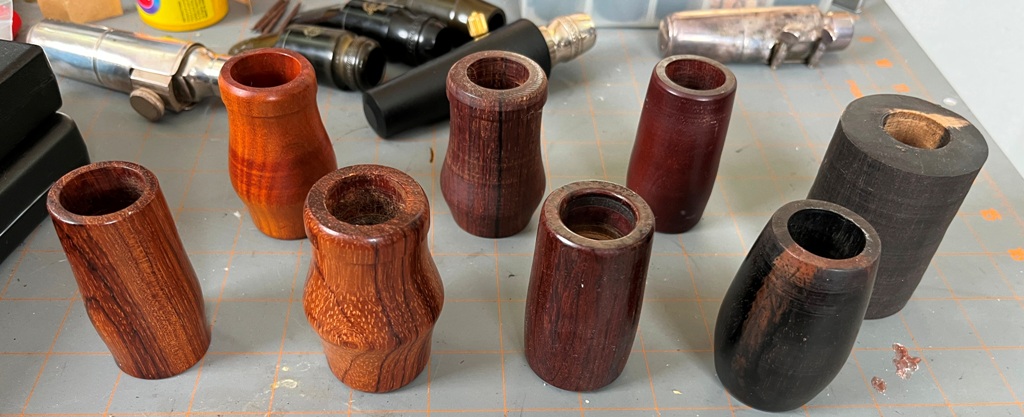
Attachment: barrel_examples_small.jpg (149k)
back when I was making and experimenting with barrels in the late 1990s and early 2000s I found some interesting results.
See the attached image.
The far right is an unshaped barrel and plays nicely. All the bores are shaped the same.
The 2nd from right is a "fat barrel" and plays very nicely like the unshaped one. The fatter barrels appear to keep warmth better to maintain intonation a bit longer than thinner ones. Mopane was great in any shape (3rd and 4th)
I tested other woods too from thick to thin.
The one on the far left is a lighter density wood - I've forgotten what now. But it sounded nice and "sweet" when I first was playing it and it was "fat". When I reshaped it from "fat" to "thin" and it lost it's sweetness and I wanted to glue back on the chips/dust hahaha. It just no longer sounded well.
So using high density woods will positively impact the tone.
The "fat" barrel maintains heat and intonation better.
The different shapes though, one still needs to maintain some support in the socket area. If too thin it may be more prone to cracking. The extra thick parts of the "fat barrel" add more material to be able to maintain that tenon pressure better. One may not have issues, but when you warranty your barrels you want to minimize returns/ replacements so making them fatter is less work as you have to remove less material, and fewer warranty replacements.
==========
Stephen Sklar
My YouTube Channel of Clarinet Information
Post Edited (2026-08-10 22:33)
|
|
Reply To Message
|
|
Author: Bog_Roll
Date: 2026-08-13 12:59
Chris_P wrote:
> ...so people can use bari sax reeds on an Eb clarinet...
Quote of the day! ![[happy]](http://test.woodwind.org/clarinet/BBoard/smileys/smiley12.gif)
Seems to me, any extra resonance provided by "fatboy" barrels is entirely proportional to the corresponding emptiness of one's bank account after the purchase thereof.
|
|
Reply To Message
|
|
The Clarinet Pages
|
 |
.jpg)
.jpg)
.jpg)
.jpg)
.jpg)
.jpg)