The Clarinet BBoard The Clarinet BBoard
|
Author: Reformed
Date: 2026-06-09 19:57
My Yamaha German Boehms have a double hole setup for the little finger F/C keys, as do most Reform Boehms. I have also read of this on some older Leblancs.
I am wondering why!
My thoughts are that the much common single hole would need to be much bigger and possibly cause acoustic problems when the German bore does not flare until just above the E/B hole.
The reason for asking is that I am trying to lower the pitch of the G/D slightly, so which F/C hole(s) should I fill a little? I've settled on both but would like to understand what is going on here to get the best solution.
A small amount of filler in both holes, such as easily removable "Blue Tack", seems to work OK and does not dull down the G/D unacceptably.
Pulling out the middle joint a 1/2 mm or so, also helps.
I am sure the problem occurs because the instruments are tuned to 443 and I need 440.
I've tried lowering the pads' height but that gets quite stuffy.
Post Edited (2026-06-09 21:17)
|
|
Reply To Message
|
|
Author: Chris P
Date: 2026-06-09 21:23
Attachment: debe.png (18k)
Attachment: debegerman.png (14k)
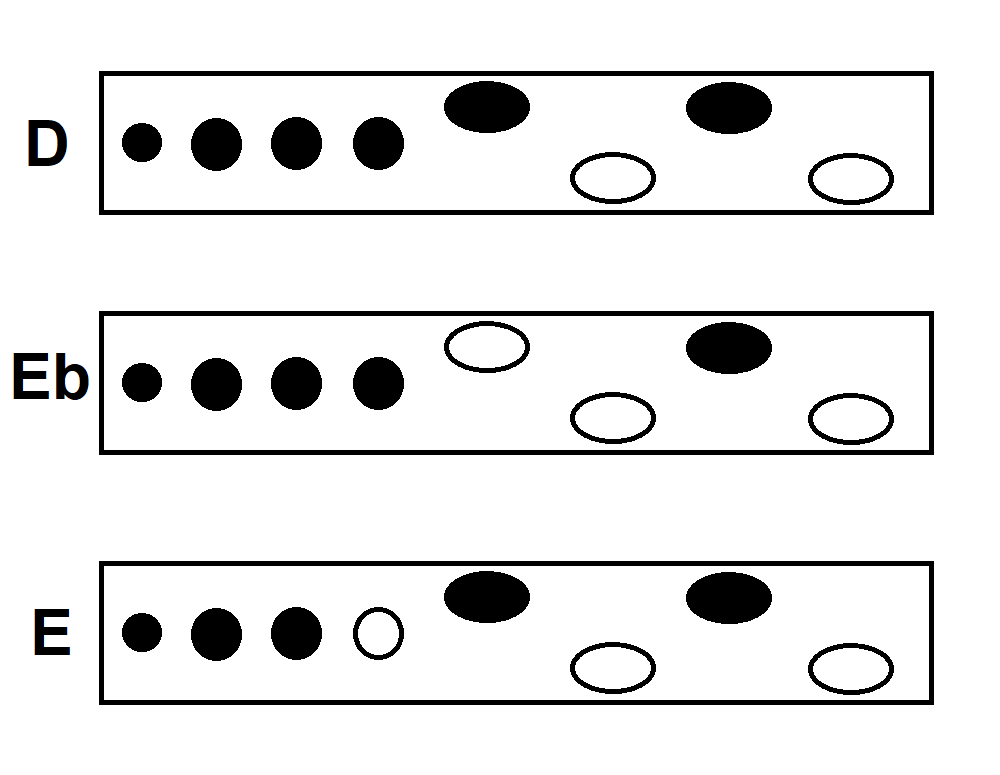
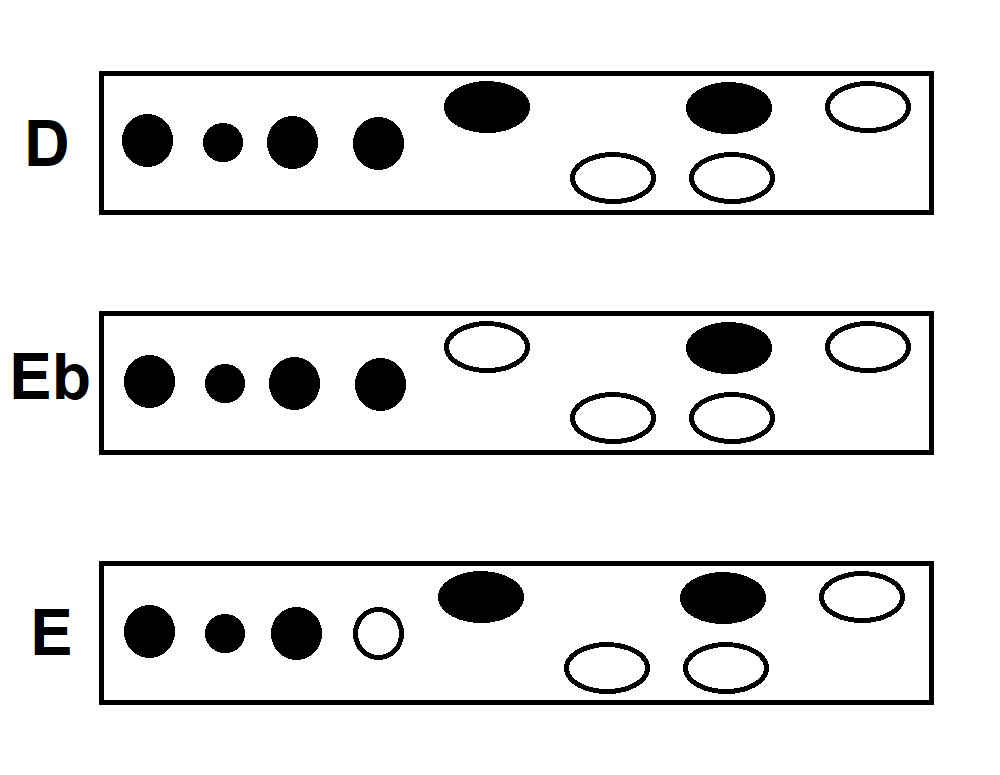
It gives the full venting for G/D (xxx|xxx) which is effectively a forked note on most Boehm systems.
1st attachment shows a typical Boehm system lower joint tonehole layout when G/D, Ab/Eb and A/E are played where the F#/C# tonehole remains closed.
2nd attachment shows the basic non-Boehm lower joint tonehole layout for the same notes - the lower of the doubled pad cups on the F/C key compensates for the F#/C# tonehole remaining closed.
The doubled pad cups on German Boehms and reform Boehms offers that same venting as German/Oehler systems (and Albert/simple systems) for those notes as well as emulating the Patent C# mechanism which is standard on German and Oehler systems, even though the same E-F#/B-C# trill can't be done on Boehm systems as they don't have the mechanism to do that (Selmer full Mazzeos have articulated F#/C# as well as being an option on some handmade German Boehms).
Also be aware these clarinets are built to play at 442Hz or higher - I made a 58mm barrel for my Yamaha 657-24 Oehler to help bring the throat notes down to around 440Hz (the stock barrel lengths being 54mm and 56mm).
Former oboe finisher
Howarth of London
1998 - 2010
Independent Woodwind Repairer
Single and Double Reed Specialist
Oboes, Clarinets and Saxes
NOT A MEMBER OF N.A.M.I.R.
The opinions I express are my own.
Post Edited (2026-06-11 01:48)
|
|
Reply To Message
|
|
Author: Reformed
Date: 2026-06-10 00:46
Chris
Thanks for that and the pictures to clearly explain.
The Yamaha Germans came with 56mm and 57mm barrels.
I recently got a 58mm barrel from Seggelke with a taper for Reform Boehm (14.75mm at the top and 15.0mm at the bottom). It brings the top joint 12ths near the throat into line nicely. Still needs a 1mm tuning ring to play at 440Hz.
I also have the P&S 59mm Zoom barrel which is also OK.
I already had a Seggelke 60mm with the taper, but it was too long for my Zinner 3MR mouthpieces.
|
|
Reply To Message
|
|
Author: Chris P
Date: 2026-06-11 02:01
Some German Boehm and Boehm system clarinets also have an A/E vent that's operated by RH3 to open/close a vent located at around the same level as the Ab/Eb tonehole, plus the Acton vent as mentioned above, as well as a D/A vent for LH3 that compensates for the C#/G# tonehole being closed and also an F# vent linked to the LH thumb ring or plate that compensates for LH1 being closed when that fingering is used for bottom space F#.
Buffet Prestige basset horns have nearly all of these extra vents making them nearly fully vented instruments, only they lack the Acton vent and instead have a perforated RH1 fingerplate to help increase the venting of B/F# when RH2 is held down.
Oehler systems also have a forked Bb/F vent to compensate for RH3 being closed when using the forked fingering which has two small side keys both operated by the RH2 fingerplate/Griffplatte - the upper one is the Bb/F tonehole and the lower one is the forked Bb/F vent which is also closed whe the Ab/Eb key is held down for the altissimo register (as well as closing down the small vent soldered at around 2 o'clock on the RH1 ring key).
Former oboe finisher
Howarth of London
1998 - 2010
Independent Woodwind Repairer
Single and Double Reed Specialist
Oboes, Clarinets and Saxes
NOT A MEMBER OF N.A.M.I.R.
The opinions I express are my own.
Post Edited (2026-06-11 13:44)
|
|
Reply To Message
|
|
The Clarinet Pages
|
 |
.jpg)
.jpg)
.jpg)
.jpg)
.jpg)
.jpg)