The Clarinet BBoard The Clarinet BBoard
|
Author: Micke Isotalo ★2017
Date: 2026-10-05 12:20
On my bass "middle" cis/gis is fuzzy. A method for clearing a fuzzy throat Bb is beveling the register key pad (smoothing the edges, especially on cork pads). Would this help the cis/gis as well? If so, how would this be best done on Valentino pads - like just filing or sanding?
|
|
Reply To Message
|
|
Author: Chris P
Date: 2026-10-05 16:53
Just have the C#/G# key venting set as high as it will physically and mechanically allow as the C#/G# tonehole itself is already a compromise being too small in diameter and placed higher up the lower joint to compensate, so it'll never give a good sounding note that matches the others around it, especially in the lower register.
Former oboe finisher
Howarth of London
1998 - 2010
Independent Woodwind Repairer
Single and Double Reed Specialist
Oboes, Clarinets and Saxes
NOT A MEMBER OF N.A.M.I.R.
The opinions I express are my own.
|
|
Reply To Message
|
|
Author: Chris P
Date: 2026-10-05 22:52
lydian wrote: "Never sand and fill pads."
Really? Why ever not?
When using cork pads, then you always have to prep them by grinding or sanding the face down so it's flat and flawless, also you'll often have to sand them down to the required diameter and file the backs down to make them the required thicknesses, as well as doing all the necessary tonehole prep to ensure they seat and seal against the tonehole bedplaces/crowns.
With cork speaker key pads, they're trimmed and sanded to bevel or dome the sides of them after being installed and seated.
Former oboe finisher
Howarth of London
1998 - 2010
Independent Woodwind Repairer
Single and Double Reed Specialist
Oboes, Clarinets and Saxes
NOT A MEMBER OF N.A.M.I.R.
The opinions I express are my own.
Post Edited (2026-10-05 22:52)
|
|
Reply To Message
|
|
Author: clarnibass
Date: 2026-10-06 10:05
>> Never sand and fill pads. <<
What do you mean by "fill"? How do you add something to a pad and why would someone do this...?
>> When using cork pads, then you always have to prep them by grinding or sanding the face down so it's flat and flawless <<
Yes but I wouldn't say "always".
I have cork pads from some sources that don't require any sanding to the face to seal perfectly.
In contrast I have some cork pads that are so rough, they are flat out unusable (pun?). They would need so much sanding and the cork itself is a bit rough, so sometimes sanding just reveals more rough texture...
|
|
Reply To Message
|
|
Author: Micke Isotalo ★2017
Date: 2026-10-06 11:46
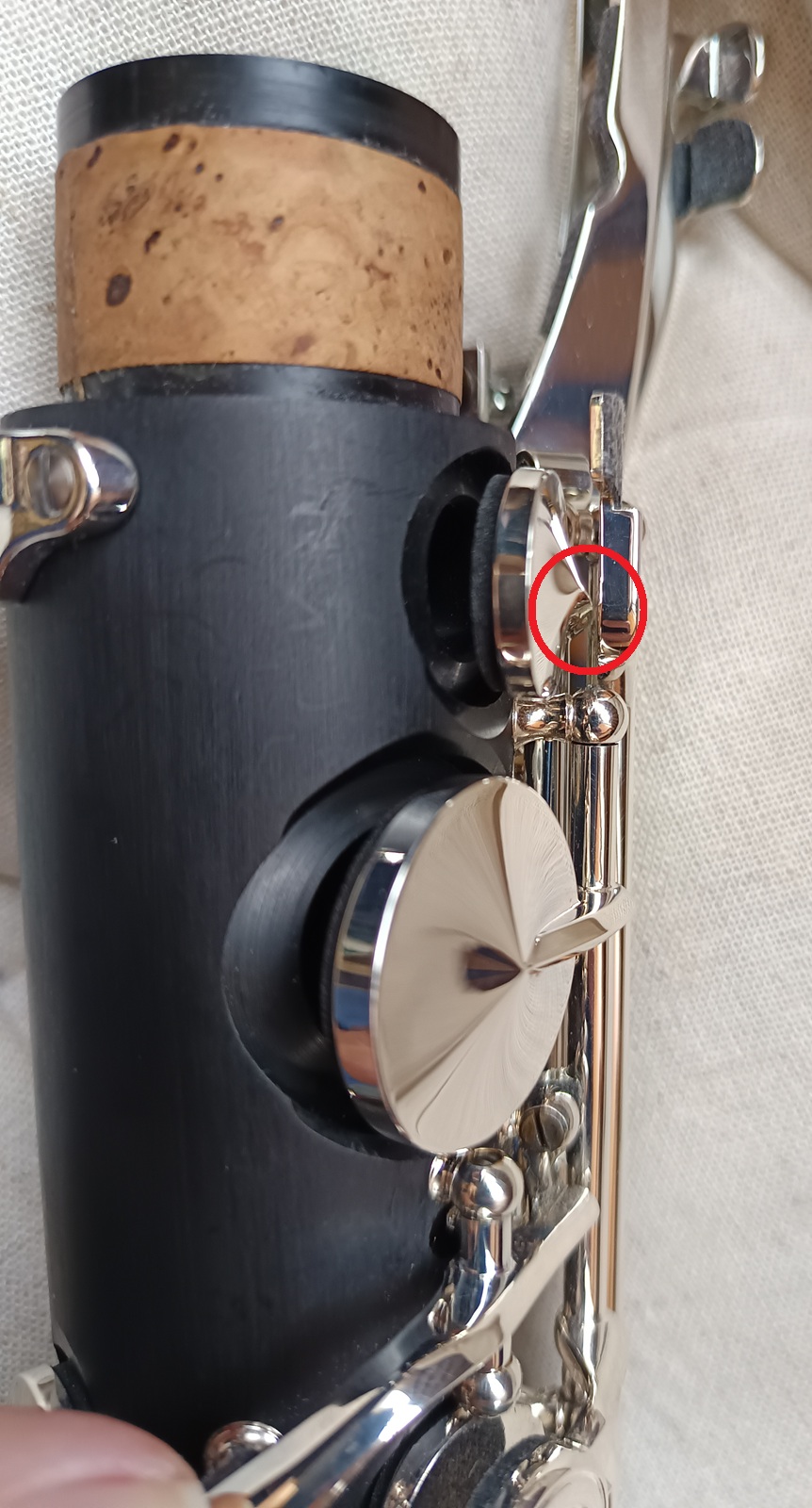
Attachment: Alpha, cis-gis clearance.jpg (320k)
Unfortunately increased venting isn't possible in this case, due to a minimal clearance of just 0.3mm between the open cis/gis pad cup and the closed bridge key above it (see picture). Perhaps the only way to increase that clearance would be by grinding a recess of say 1.5mm into that bridge, but don't know how much of a difference an increased venting of the same amount at that point would make for the fuzziness (the outer edge of the key/pad would open a bit more than the inner edge closest to the bridge).
Just as a test I removed the cis/gis key completely, which cleared all fuzziness and also improved the flatness of the cis. So probably also an increased venting of a few mm would at least improve things, though maybe not be a complete cure.
|
|
Reply To Message
|
|
Author: donald
Date: 2026-10-06 11:53
I think "fill" was a misprint/auto correct etc and he meant "file"
|
|
Reply To Message
|
|
Author: clarnibass
Date: 2026-10-06 12:26
Valentino pads don't feel like you could file or sand them which is why I've never even tried it. I was able to do this with a dental micromotor with polishing bits at very high speeds, but then be careful about heating them too much since they would melt.
However you could cut them. Use a very(!) sharp knife and cut a taper around, making sure to not go over the seat. It might not help, if the pad is even much larger than the tone hole... then there isn't necessarily anything to cut.
I assume it's a Backun Alpha. It already has these "valleys" outside the tone holes that are supposed to help with venting. It's a pretty good instrument but has a few small design issues...
Modifying the keys themselves to allow more venting is absolutely an option. If you don't mind the practically invisible change and/or the loss of plating (or the hassle of spot plating it) then it's completely fine to do this. On many instruments it is necessary to do things like this to get them to play the best, and in this case you only need your own consent.
Keep in mind that some keys require an absurd amount of venting to remove all the fuzziness. Meaning you might get the key to open so it's becoming uncomfortable to play and still have some of it left... but if it plays well with the key off then it should definitely possible to improve it significantly by a combination of the above methods.
|
|
Reply To Message
|
|
The Clarinet Pages
|
 |
.jpg)
.jpg)
.jpg)
.jpg)
.jpg)
.jpg)