The Clarinet BBoard The Clarinet BBoard
|
Author: ruben
Date: 2025-12-28 12:56
I don't mind the middle B-flat being a little bit foggy, but there is a limit. I use the side key, adding a finger or two on the holes of the upper body of the clarinet to bring down its pitch, whenever I can. Of course, you have to have time to get to this trill key. It works well for long, held notes. Surely, a clarinet maker could come up with a solution to make this note less fuzzy.
rubengreenbergparisfrance@gmail.com
|
|
Reply To Message
|
|
Author: SecondTry
Date: 2025-12-28 19:43
Ruben:
As has come up on the bboard before, the clarinet--as I suspect you realize--is a design of many compromises.
From the positioning of the tone holes to balance the intonation of the chalumeau and clarion registers, to the positioning of the C#/G# lever by some manufacturers right on the tenon that separates the sections (at least in the 99.99% of clarinets not built in one piece) there are few better examples of compromise than in how clarinets are designed with respect to maximizing overall intonation.
No less, in an effort to make the register key serve double duty as the key that also voices the throat Bb, we face compromises. I too finger this note, when held, as you do, but can also suggest that periodic cleaning of the register pipe can help a bit with the classic fingering and even the clarion notes.
If I am not mistaken, also as discussed here, in the evolution of the instrument some manufacturers have designed actuation of the register key to open different tone holes, rather than the register key itself, if the throat A was also engaged, so as to reserve the register key's hole solely for handling the 12ths and allow a dedicated tone hole to handle the B-flat instead.
The funny thing about this though is what might happen if one were to finger the full fingered B a semitone higher, and open the throat A vent: a common technique for producing a clearer held full fingered B. I imagine, with enough work, a mechanism could be designed to open the register key rather than a dedicated B-flat one if the throat A key *and* say, either of the right pinky keys for the "B" just above it in pitch were pressed, but this gets hairy, opens the instrument up for additional places requiring maintenance and may not be worth it the player in better sound quality or cost to purchase.
I also presume you've used similar resonance fingers on the standard B-flat fingering as you (and I) do to bring down the pitch of the one made by opening the side key instead of the register key.
|
|
Reply To Message
|
|
Author: David H. Kinder
Date: 2025-12-28 21:23
My Ridenour has great sounding throat tones that are very pleasing to the ear. It doesn't 'thin' out at all.
Ridenour AureA Bb clarinet
Ridenour Artist MT36 mouthpiece
Vandoren Optimum black ligature (plate 1)
Vandoren Traditional #3.5 reeds
Brad Behn HR adjustable barrel
|
|
Reply To Message
|
|
Author: Chris P
Date: 2025-12-28 22:18
1010s have a decent throat Bb with the regular fingering - provided you put some air into the thing and don't just breathe from your shoulders.
Former oboe finisher
Howarth of London
1998 - 2010
Independent Woodwind Repairer
Single and Double Reed Specialist
Oboes, Clarinets and Saxes
NOT A MEMBER OF N.A.M.I.R.
The opinions I express are my own.
|
|
Reply To Message
|
|
Author: SecondTry
Date: 2025-12-29 02:07
David and Chris:
How do the B-flats on the instruments your cited compare to other notes? Are they just good as B-flats go, or do you feel that these notes hold there own on your instruments as compared to any other notes on that instrument?
|
|
Reply To Message
|
|
Author: Tom H
Date: 2025-12-29 02:29
Use A key plus 2nd from the top RH trill key for the Bb. Great tone--clear. Yes, can be hard to get to that fingering. I use it as much as possible, at times to a fault.
The Most Advanced Clarinet Book -- Songburd Music (paper and digital)
Search title. Amazon.com (search Tom Heimer).
Boreal Ballad solo -- Songburd Music item -- search title.
|
|
Reply To Message
|
|
Author: NOLA Ken
Date: 2025-12-29 05:43
Both my Leblanc Pete Fountain (non-enhanced Boehm) and my early Ridenour Lyrique Libertas have great, clear pinch Bbs. So it's clearly possible. But yeh, this seems to be a common issue. I use the A key + second right hand trill key a lot on my other clarinets.
|
|
Reply To Message
|
|
Author: ruben
Date: 2025-12-29 13:36
Chris P: "provided you put some air into the thing". True!! That b-flat needs to be really blown and sung to be on level with the other notes.
rubengreenbergparisfrance@gmail.com
|
|
Reply To Message
|
|
Author: SecondTry
Date: 2025-12-29 19:35
Ruben:
As I alluded to in my prior post, your concern has been addressed, albeit with limited commercial success, in offerings like the Mazzeo System reformed Boehm clarinet.
This shortened link searches this bboard for posts on this.
https://tinyurl.com/2f2vfna3
Post Edited (2025-12-29 19:37)
|
|
Reply To Message
|
|
Author: Chris P
Date: 2025-12-29 21:08
The problem with Mazzeo system is you have to play open G with all your fingers off, so any intervals involving open G and any upper register note can end up 'lumpy' as you can't put any fingers down in advance for the upper register note as you'd normally do (except the LH or RH pinkies for upper B to D#/Eb).
Leblanc's throat Bb mechanisms are either like Vito/Noblet or pro level Leblanc altos and basses and the opening of the Bb vent determined if the left thumb is off or the throat A key is held open while the speaker key is held open.
That too can cause problems with some upper register or altissimo fingerings - if the throat A key opens the Bb vent, then that'll cause trouble with the A-B trill if playing upper register B with the throat A key nudged open and trilling with RH1.
If the Bb vent is open while the left thumb is off, then that'll cause trouble with altissimo Bb (if you've got an articulated C#/G# mechanism) where you use the upper register C(5) fingering with the thumb off the thumb tube.
Former oboe finisher
Howarth of London
1998 - 2010
Independent Woodwind Repairer
Single and Double Reed Specialist
Oboes, Clarinets and Saxes
NOT A MEMBER OF N.A.M.I.R.
The opinions I express are my own.
|
|
Reply To Message
|
|
Author: SecondTry
Date: 2025-12-29 21:18
Chris P wrote:
> The problem with Mazzeo system is
>
> Leblanc's throat Bb mechanisms are either like Vito/Noblet or
> pro level Leblanc altos and basses and the opening of the Bb
> vent determined if the left thumb is off or the throat A key is
> held open while the speaker key is held open.
>
> That too can cause problems
As far as you know, did anyone implement a system that to the player involved no different fingering than on a "standard Boehm" clarinet, including, even, the ability to hold open the throat "A" key while fingering the full fingered "B" a tone above it, so as to create a better resonating "B?"
|
|
Reply To Message
|
|
Author: rmk54
Date: 2025-12-29 21:24
even, the ability to hold open the throat "A" key while fingering the full fingered "B" a tone above it, so as to create a better resonating "B?"
---------------------------------------
Yes, it's called an "index finger". There is a video of the Boston Symphony playing Brahms 4 where you can see Harold Wright using this fingering in the second movement.
|
|
Reply To Message
|
|
Author: SecondTry
Date: 2025-12-29 23:24
rmk54 wrote:
> even, the ability to hold open the throat "A" key while
> fingering the full fingered "B" a tone above it, so as to
> create a better resonating "B?"
>
> ---------------------------------------
> Yes, it's called an "index finger". There is a video of the
> Boston Symphony playing Brahms 4 where you can see Harold
> Wright using this fingering in the second movement.
The tone of this post strikes me as arrogant. The need to explain what finger opens the throat "A" key, something obvious to a clarinet player, reads to me, by analogy, as someone saying, "what's that thing they serve at McDonalds again?"...a question not even by analogy posed here, and someone snidely responding, "it's called a hamburger."
Maybe I should explain where I was going with this point as I suspect--although I could be wrong--that you may be ignorant as to why I brought it up. Here goes:
For some clarinet makers attempting to dedicate a tone hold to throat B-flat, without involving change in the player's standard fingering of same with the left index and thumb fingers, pressing the spatula commonly associated on most clarinets with solely opening the register key pipe might involve a new key designed to be "cognizant" of whether the throat "A" key was also pressed, opening this special B-flat tone hole only in those cases, but the register pipe, as is standard, in other cases.
Of course this mechanism alone might preclude playing a long full fingered "B" with the resonance fingering of opening the throat "A" tone hole, as doing so might not open the register pipe in such design, and the B-flat tone hole instead, preventing the resonance finger "B" from being realized.
It was abundantly clear from context that I do not need guidance on how this done, and for the record, whether top clarinet players have done it.
Post Edited (2025-12-29 23:28)
|
|
Reply To Message
|
|
Author: paulyb
Date: 2025-12-30 01:35
The throat Bb is definitely a problematic note - even when the tone is acceptable, the dynamic range usually leaves something to be desired. Given that the trill key fingering is usually a significant improvement, I'm surprised that manufacturers haven't tried to make it more accessible. There is an aftermarket solution from Copeland Clarinets called the Deutero but I've not heard reviews from anyone who has tried it.
If a truly automatic throat Bb vent could be created then the speaker key could be moved up / made narrower which might improve some aspects of the clarion / altissimo. But by then we're taking about a major redesign which I suspect most manufacturers would be reluctant to invest in.
|
|
Reply To Message
|
|
Author: SecondTry
Date: 2025-12-30 03:17
paulyb wrote:
> There is an
> aftermarket solution from Copeland Clarinets called the Deutero
> but I've not heard reviews from anyone who has tried it.
>
Link? I couldn’t find it a the Copeland clarinet website.
|
|
Reply To Message
|
|
Author: Ed
Date: 2025-12-30 05:25
I have always been curious- for a full boehm clarinet with a low Eb, does pressing the register key and getting the 12th provide a good Bb, or are there other acoustical issues with that?
|
|
Reply To Message
|
|
Author: David H. Kinder
Date: 2025-12-30 06:55
SecondTry wrote:
> David and Chris:
>
> How do the B-flats on the instruments your cited compare to
> other notes? Are they just good as B-flats go, or do you feel
> that these notes hold there own on your instruments as compared
> to any other notes on that instrument?
The Ridenour AureA holds its own across the range. I don't feel that there's any compromises in its acoustical design.
I will (eventually) do a video of my advanced, but admittedly amateur playing and link it to another quality player who is playing on a Tosca trying out a Vandoren BD4 mouthpiece.
Her throat tones sound a bit airy or thin. I don't have that issue on my AureA and my Homage mouthpiece at all.
Her playing was good enough for Vandoren to put it on their channel, so here it is to show that even the top-line Buffet has that same throat tone quality:
https://www.youtube.com/shorts/a6hnnwahjGI
Ridenour AureA Bb clarinet
Ridenour Artist MT36 mouthpiece
Vandoren Optimum black ligature (plate 1)
Vandoren Traditional #3.5 reeds
Brad Behn HR adjustable barrel
|
|
Reply To Message
|
|
Author: ruben
Date: 2025-12-30 10:39
JL Clarinettes -which I, at one point worked for and has recently gone out of business (not because I worked for them!), had a vent (the tube in the bore starting at the hole in the register key) that had a slightly hour-glass shape. This seemed to help in giving the middle B-flat more clarity and making it sound like a real note.
rubengreenbergparisfrance@gmail.com
|
|
Reply To Message
|
|
Author: NOLA Ken
Date: 2025-12-30 23:41
Ed wrote:
"I have always been curious- for a full boehm clarinet with a low Eb, does pressing the register key and getting the 12th provide a good Bb, or are there other acoustical issues with that?"
I have a Leblanc Symphonie 3 full Boehm (very nicely restored by Vytas Krass a few years back) that plays a perfectly in-tune third line Bb with the low Eb plus the speaker key. It saved my butt on one piece we were playing. I'll have to try it on my Selmer 9 full Boehm to see what happens.
|
|
Reply To Message
|
|
Author: Chris P
Date: 2025-12-30 23:51
I use the low Eb with the speaker key for another midline Bb on my Selmer CT and Series 9 full Boehms - it also allows you to do a written Bb-D tremolo which isn't easy on a regular clarinet.
Former oboe finisher
Howarth of London
1998 - 2010
Independent Woodwind Repairer
Single and Double Reed Specialist
Oboes, Clarinets and Saxes
NOT A MEMBER OF N.A.M.I.R.
The opinions I express are my own.
|
|
Reply To Message
|
|
Author: Micke Isotalo ★2017
Date: 2025-12-31 14:24
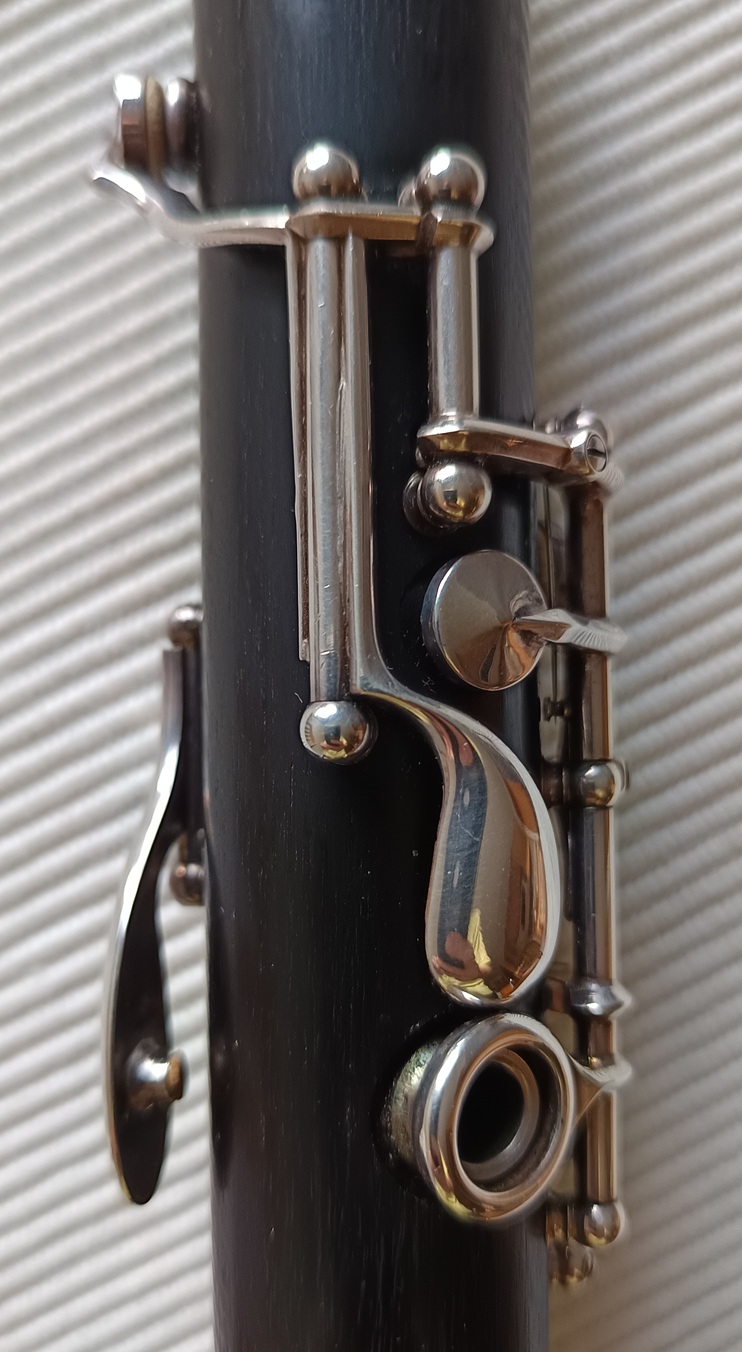
Attachment: Yamaha B-mechanism, Webbsize.jpg (241k)
Pictured is the Yamaha version of a Bb-mechanism, similar to that offered by Lohff & Pfeiffer in the above link. Similar versions of it are on almost all Reform Boehm clarinets, by such makers as Wurlitzer, Schwenk & Seggelke, Dietz, and Leitner & Kraus.
Through the years I've tried out them all, and it greatly improves the middle Bb while not restricting any other fingerings. In some cases the trill-fingering may still sound a bit better, but in others the pinch Bb is equally clear and full.
Post Edited (2026-01-04 01:04)
|
|
Reply To Message
|
|
Author: SecondTry
Date: 2025-12-31 18:38
Micke Isotalo wrote:
> Pictured is the Yamaha version of a B-mechanism..
Which Yamaha clarinet models have this design feature?
|
|
Reply To Message
|
|
Author: Philip Caron
Date: 2025-12-31 19:07
On my basic R13, the standard B4 fingering with the throat A key added, as suggested above and evidenced by Harold Wright, certainly sharpens that already sharp-tending note; additional resonance seems slight. Interesting, still. Throat G# key instead is similar.
|
|
Reply To Message
|
|
Author: Micke Isotalo ★2017
Date: 2025-12-31 19:15
SecondTry, it was the YCL-846 and 856 models, discontinued already about 20 years ago. By the time some considered them as more or less Wurlitzer copies, but they still had several mechanical differences and their tone was different.
Post Edited (2025-12-31 19:54)
|
|
Reply To Message
|
|
Author: Ebclarinet1
Date: 2025-12-31 20:54
I do use the fingered low Eb plus octave key for a decent Bb on quick passages. On my Buffet Prestige alto and bass clarinets that have a good vented bell. the note is even fairly in tune and blends better with the surrounding notes for timbre as well. Have even on one occasion used the low D fingering plus octave for the throat A. On the Selmer contra-alto the Bb sounds but is way out of tune, but the low Eb fingering itself is not that in tune either.
Just went and checked it on the Selmer basset horn and that fingering is not too bad on it too. Of course it has open tone holes to low C that allow for venting.
Eefer guy
|
|
Reply To Message
|
|
Author: donald
Date: 2026-01-01 00:10
This has been an ongoing issue since the clarinet existed- make the register key hole big enough for a decent Bb and the upper register 12ths get wider etc. My R13 A clarinet has a beautiful throat Bb with a wider bore reg tube, but then A, B and C above the stave are ridiculously sharp... a smaller bored tube brings the pitch down but kills Bb.
Of course, all acoustical designs not being equal... on my Bb clarinet the throat Bb is not too bad, and using resonance fingerings it sounds pretty much as good as the side key (not really possible in most fast passages, but certainly not restricted to "long held notes").
Over the last 150 years (to my knowledge, there could well be examples from earlier) clarinet makers have tried two approaches to fix this - "resonance vents" (that open the register key PLUS an extra vent) and "either/or" solutions that are either activated by the thumb ring OR the throat A key.
The either/or solutions I've seen as far back as 1900 on German clarinets from the stable of Oskar Oehler apprentices (may well be other examples), Leblanc also produced a number of clarinets like this. It's always been the case that the extra mechanism goes out of adjustment, or causes an extra problem, or tends to develop glitches etc. I've never quite understood how the Saxophone could have a double register key that is reliable, but the clarinet always seems to fail at this. The one "either/or" key that I've personally seen that was very reliable was by that Swiss fellow who does a lot of key customisation.... his name escapes me now, but his "register/Bb exchange" works just fine.
The "resonance vents" (so, either the reg key on its own OR reg key plus an extra vent) have been around for a while, most notably as the "SK mechanism" put on some Vito clarinets etc and not that hard to find.... In his book "The clarinet" Jack Brymer describes this inaccurately but does provide a useful picture- however it functions basically the same as the L+P key above. The Wurlitzer key variations I've seen (and OWNED at one point) had the same function but a slightly different design, and the Yamaha mechanism is only really done like that so that the register key can be wrap around for traditions sake.
Usually the "resonance vent" type mechanism works fine to improve Bb, with the added touch (mentioned above) that with a smaller register vent bore the upper register becomes a bit more easier to articulate and the 12ths tend to be smaller.
At least one well respected clarinet maker has mentioned to me over the years that this smaller vent also tends to make the altissimo lower in pitch- so not fabulous as an "after market" addition to clarinets where the altissimo register is a bit low, or even exactly in tune (as it will get flatter). Results may vary, but that's what I've been told and I'm passing it on.
Mazzeo- an amazingly innovative solution that never took hold due for reasons discussed at length in other threads.
My solution? Other than using resonance fingerings... I developed a key where the right hand Eb/Bb trill key also opens the throat Bb trill key when the thumb ring is open. The extra weight from double springing doesn't bother me as it's a "strong movement" from the whole hand to rock on to that key anyway. Downside- you can use the 2nd trill key for a high C to D trill. Other downside- my key making buddy is ridiculously busy and the times when he can commit to making/fitting the key is never at the same time that I have the $$$$$ set aside....
I also had an extra thumb key fitted to open the trill key on one of my former clarinets (that I no longer owned), but this turned out to be just a pain to use and not really very practical. Some people have this on modern/french bass clarinets to use as an extra register key - and there it's easier to use as the instrument is either on neck strap or stuck on the ground (and with the newer more complex register vents on bass clarinets, isn't really needed anymore). On a soprano clarinet it tends to make the instrument move in your mouth when playing, not helpful in many passages.
(more to say but run out of time)
Post Edited (2026-01-02 00:00)
|
|
Reply To Message
|
|
Author: David Spiegelthal ★2017
Date: 2026-01-02 05:43
Out of curiosity I recently purchased a Stubbins clarinet (a wood Noblet with the Stubbins-Kaspar mechanism added), and the throat Bb is excellent. No 'resonance' fingerings needed.
The S-K keywork is relatively simple and requires no operator action of any sort. The only drawback is that it requires two pads which close together to be perfectly seated and adjusted, which could become a problem over time.
Post Edited (2026-01-02 17:41)
|
|
Reply To Message
|
|
Author: 2cekce ★2017
Date: 2026-01-03 04:04
I also use the low Eb fingering with the register key on some passages with my full boehm Amati. It doesn't sound as airy.
|
|
Reply To Message
|
|
Author: donald
Date: 2026-01-03 16:33
David S - the "SK mechanism" was described in my post above as a "resonance vent" (not to be confused with a "resonance fingering") but I really only used that term because L+P did on their page. This type of mechanism- opening ONE PAD for register key function, TWO PADS for Bb key function, works quite well (as you say) and is used in slightly different variations (but working the same way) by the Yamaha, L+P vents AND Wurlitzer etc.
As I commented, it works well but MAY flatten the altissimo register. If you're already fighting a flat F and F#, there's a good chance this make it worse, which might not be too much of a problem on some clarinets, but disasterous on others.
|
|
Reply To Message
|
|
Author: David Spiegelthal ★2017
Date: 2026-01-04 01:20
donald - the altissimo on my Stubbins is fine; in fact the instrument plays remarkably in tune everywhere. I really like it.
|
|
Reply To Message
|
|
Author: Micke Isotalo ★2017
Date: 2026-01-04 02:23
First, just a correction to my post above about the effects of a Bb-mechanism on other fingerings: While not restricting any regular fingerings, it does restrict those alternate fingerings involving an open thumbhole together with an engaged register key (since also the Bb-vent would then open together with the register key).
At least this concerns all "regular" Bb-mechanisms, but an exception would be an added "Bb-connector" as offered by Schwenk & Seggelke - which keeps that Bb-vent closed also with an open thumbhole (with a connector between the left index finger ring key and the Bb-vent key).
Concerning the two pads closing together, as addressed by David S above, at least all the Reform Boehms I've seen has an adjustment screw for this purpose (as seen also on the Yamaha-picture attached to my first post above).
The "wrap-around" register key on the Yamaha RB's could be due to tradition, but with my experience of other versions with all three tubes in line (register tube, Bb-vent and thumb tube), there tend to accumulate gunk over time in the bore between those tubes - which I believe is happening to a lesser extent with only two tubes in line.
Post Edited (2026-01-04 13:55)
|
|
Reply To Message
|
|
Author: donald
Date: 2026-01-04 15:03
DS- that may well be, and Wurlitzer RB clarinets (that commonly have a variation of this key) have an altissimo so high in pitch that you don't need the little finger Eb/Ab key to sharpen them.
My interest in this key was to buy an SK and retro fit it to a Buffet with "R13 type bore" (in fact, like you, I was to get one off ebay. It used to be easy to find them, now it's a bit harder). The SK type mechanism isn't actually that hard for an experienced maker to make from scratch, but I had hoped to save a bit of time etc by cannibalizing the key off another instrument. Steve Fox advised me that this wouldn't work well for my instrument (for the reason given above).
I've played older Selmer clarinets with really high altissimo, so any lowering effect would obviously IMPROVE some clarinets.
|
|
Reply To Message
|
|
Author: kdk
Date: 2026-01-04 20:50
It's funny - I just played a New Year's Eve concert in which I once again discovered that on my 10G clarinets the Bb with RK and A-key is actually better in tune than my side Bb, which tends to be a little low. I can't play as loud with RK+A, but for centering the pitch (and generally for being in tune at all) my RK+A is more useable.
There's a very good mechanism on my Patricola C clarinet that I assume is also used on their other clarinets that involves a different tone hole opened by a linkage actuated by the RK when the A key is also depressed. It isn't linked to the RH rings (like Mazzeo) but directly to the RK.
Karl
|
|
Reply To Message
|
|
Author: donald
Date: 2026-01-05 16:40
The Patricolas I've seen had an extra vent, like the SK etc rather than an "either-or" register/tone hole exchange, so I'd be interested in seeing a photo of the mechanism if you've got time
|
|
Reply To Message
|
|
Author: SecondTry
Date: 2026-01-05 18:56
donald wrote:
> The Patricolas I've seen had an extra vent, like the SK etc
> rather than an "either-or" register/tone hole exchange, so I'd
> be interested in seeing a photo of the mechanism if you've got
> time
Have you seen this extra vent on any of the current Patricola offerings?
https://patricola.com/en/clarinets/
|
|
Reply To Message
|
|
Author: donald
Date: 2026-01-05 23:34
I played Patricolla clarinets with this vent in.... oh.... 1995/96? Then a friend of mine had it on her Patricolla Eb but she sold this at least 10 years ago (encouraged by a section principal who decided she "stuck out too much" on Eeefer can you believe it). They were the basic "one hole for register function, two holes for Bb" type- functioning the same as the SK/Wurlitzer/L+K keys discussed above. I didn't see any extra keys on the latest P website....
|
|
Reply To Message
|
|
Author: &*b6IU
Date: 2026-01-06 02:53
You can finger the normal pinch Bb fingering but add the left-hand 3rd finger to make a more resonant fingering.
|
|
Reply To Message
|
|
Author: donald
Date: 2026-01-06 14:13
@whatever, yep they are called resonance fingerings and there are dozens of combinations (that are better or worse depending on mouthpiece/clarinet etc). This has already been mentioned several times in this thread.
|
|
Reply To Message
|
|
Author: dorjepismo ★2017
Date: 2026-01-06 23:25
Mike,
My A has the "Bb connector" you mentioned, where the vent is closed by either the thumb or the index finger. He says it's for certain really high notes, but I haven't found any where it helps enough to want to memorize a fingering that would only work on one instrument. The altissimo Bb was helped the most, but that's not an especially difficult not with the regular full fingering. The regular Bb vent is also standard on his "1000+" instruments, which have a bore not dissimilar to an R13, or at least an R13 that was common at the time he designed his bores.
|
|
Reply To Message
|
|
The Clarinet Pages
|
 |
.jpg)
.jpg)
.jpg)
.jpg)
.jpg)
.jpg)
![[Eb3]](http://test.woodwind.org/clarinet/BBoard/smileys/eb3.gif) ...as found on an instrument like this Buffet
...as found on an instrument like this Buffet ![[Ab3]](http://test.woodwind.org/clarinet/BBoard/smileys/ab3.gif) / Eb/D#
/ Eb/D# ![[Eb5]](http://test.woodwind.org/clarinet/BBoard/smileys/eb5.gif) key found on some instruments (including the one linked) alternatively or, as on this linked instrument, as well
key found on some instruments (including the one linked) alternatively or, as on this linked instrument, as well