 The Clarinet BBoard The Clarinet BBoard
|
Author: m1964
Date: 2026-03-28 04:51
Attachment: image0(1).jpeg (508k)
Attachment: image1(2).jpeg (400k)
Attachment: image2(2).jpeg (649k)
Attachment: image3.jpeg (770k)
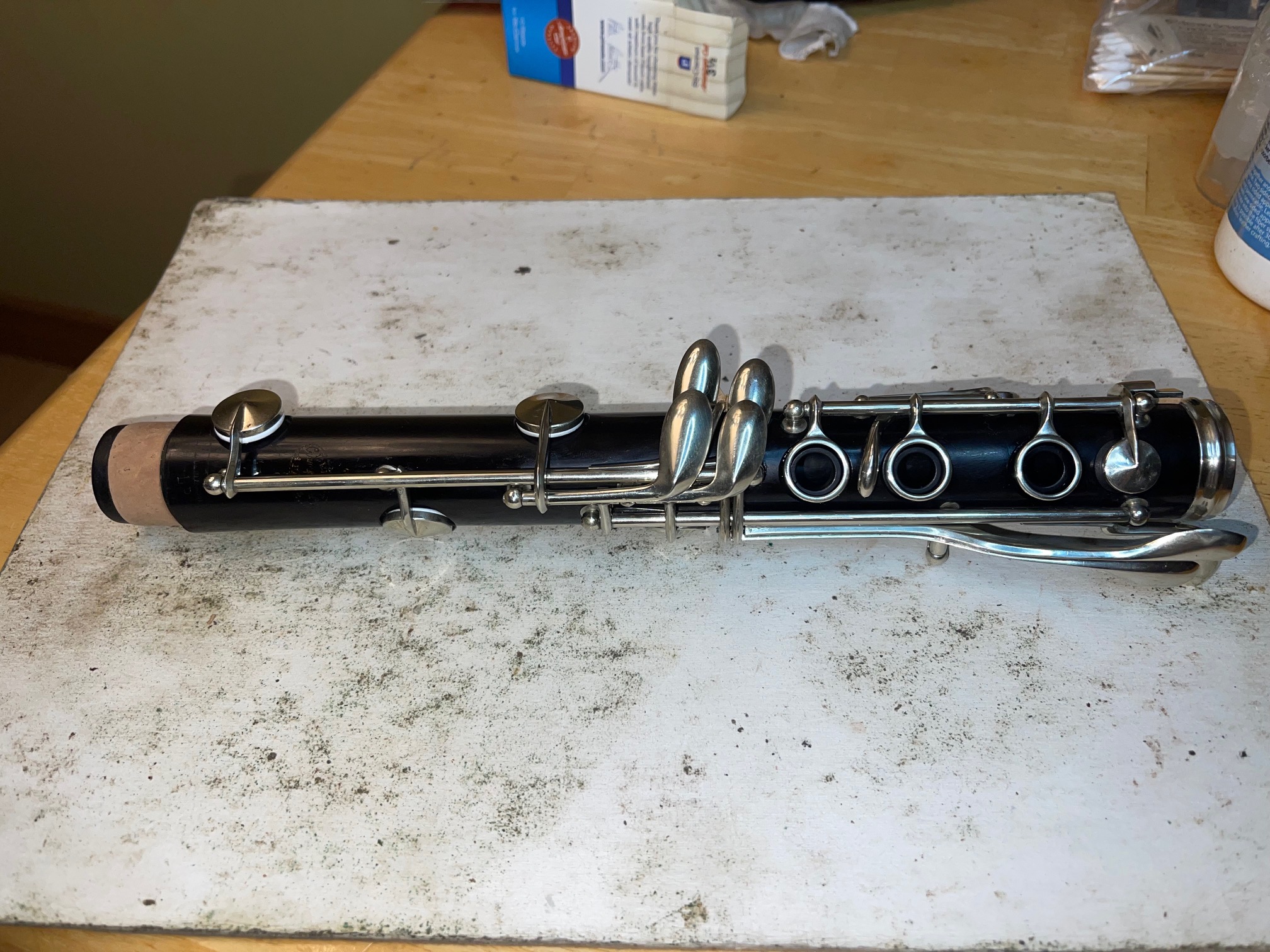
The saga with 1911 Buffet continues.
I resealed a bell crack and filled a small chip on the edge of the bell socket, and finished lower joint restoration. Interesting technical solution by Buffet is that the Left F/C lever spring is mounted on the key and goes into a cut-out in the body, but the F#/C# key has a leaf spring that works pretty well (bu
Started on the upper joint and found that the tea pot register key is leaking.
Does any one know how the tea pot register tube is fixed to the body? Is it threaded or glued?
The safest way to remove it?
I guess one could just go around with superglue hoping that it would seal the leak but I do not think it would be the best way to fix it.
Also, I'd like to know what pad to use on the tea pot.
Thank you
Post Edited (2026-03-28 05:11)
|
|
Reply To Message
|
|
Author: m1964
Date: 2026-03-28 05:22
please read the next reply- sorry for the duplicate
Post Edited (2026-03-28 05:30)
|
|
Reply To Message
|
|
Author: m1964
Date: 2026-03-28 05:29
Attachment: image0(2).jpeg (1985k)
Update: I got really impatient a decided to heat it up, then turned counterclockwise and it came out.
It is threaded into the body. I guess I need to clean it up really well, put some bee wax on the threads and and screw it back, then heat for the wax to melt.
|
|
Reply To Message
|
|
Author: kilo
Date: 2026-03-28 18:51
I realize that bee's wax will melt at a relatively low temperature but I wondered what you use to heat up a small area like that.
|
|
Reply To Message
|
|
Author: clarnibass
Date: 2026-03-28 21:06
>> I realize that bee's wax will melt at a relatively low temperature but I wondered what you use to heat up a small area like that. <<
I don't know what they use but I use an electric heater that relies on metal to connect he two ends. You basically grip the part to heat it.
A simpler but less convenient method that is similar is to use a wire end soldering gun. Cut the wire and shape for the part you need. It's only less convenient because the "hand piece" itself is a bit big and cumbersome and the wire shape is fixed (the electric heater I use has plier shape jaws).
Another way is a soldering iron. Just be careful because the tip usually remains tinned, so it can pass a tiny bit of the solder to the part (there are ways around it).
Maybe simplest as far as requiring almost no tools, and works mainly for parts with a hole like this one, is to heat a close fitting rod and put it in the hole. You can heat the "outside" area while it is in the hole too. Even something like a drill can work. If it's only shellac or wax it doesn't need that much heat and this should definitely work.
|
|
Reply To Message
|
|
Author: Chris P
Date: 2026-03-29 03:01
I usually heat up a tapered nickel silver rod and insert that into the speaker tube so it melts the wax or shellac, so they can be removed.
With threaded speaker tubes, I seal them with beeswax - heat the speaker tube in a flame and melt some beeswax on the threads and screw it in while it's still hot. Once cooled, clean up any excess beeswax and degrease the flat where the pad seats onto.
I use beeswax to seal oboe 8ve vents as well (the tops/inserts and not the threaded wells which are shellacked into the top joint), but use a needle spring to hold them while heating them in a flame and applying the wax to the threads.
On older Selmers with two part speaker tubes with the large diameter threaded cup and push fit speaker tube (Balanced Tone, etc.), I seal both parts of them with wax. Same with the hexagonal headed and threaded speaker bushes used on Centered Tone and Series 9/9* clarinets.
Former oboe finisher
Howarth of London
1998 - 2010
Independent Woodwind Repairer
Single and Double Reed Specialist
Oboes, Clarinets and Saxes
NOT A MEMBER OF N.A.M.I.R.
The opinions I express are my own.
|
|
Reply To Message
|
|
Author: m1964
Date: 2026-03-31 00:14
clarnibass wrote:
"A simpler but less convenient method that is similar is to use a wire end soldering gun. Cut the wire and shape for the part you need. It's only less convenient because the "hand piece" itself is a bit big and cumbersome and the wire shape is fixed (the electric heater I use has plier shape jaws)."
This is what I use- a soldering gun. Works well for me, no need to spend over $700 for the special pad cup heater.
I have beeswax but a very good tech suggested liquid shellac to seal the tea pot register tube. I feel that shellac would be more durable in the long run, comparing to beeswax.
So waiting for liquid shellac to be shipped, together with a 17mm Master pads for the doughnut key.
Also, not sure what pad to install on the tea pot - it is completely flat, so a leather or skin pad probably will work just fine. I may try a cork pad because it could be shaped for better venting. Or a Valentino master pad? I've never seen those in register keys.
|
|
Reply To Message
|
|
Author: Chris P
Date: 2026-03-31 00:45
No - your 'very good tech' is totally wrong there.
Beeswax is much better for any threaded fittings as it can easily be melted to create the seal with a much lower temperature than shellac needs to become molten, it will ensure the threaded fittings can be undone while still cold and won't turn hard and brittle like shellac.
Also beeswax can be used to seal around any edges in or around perforated cork pads (fitted in the LH1 fingerplate on altos, basset horns and basses), using a heated metal spatula to apply and spread the wax around the sides where they meet the edge of pad cup or around the inside edge of the perforation if there's a metal chimney in the pad cup.
Shellac is best used for push fit fittings that need to stay put (eg. smooth or grooved sided speaker tubes and thumb tubes), but can be undone with heat as and when needed - only it will need more heat to soften or melt it compared to wax.
With those wraparound speaker keys, you can use a leather pad on them, or a synthetic pad if you want.
Former oboe finisher
Howarth of London
1998 - 2010
Independent Woodwind Repairer
Single and Double Reed Specialist
Oboes, Clarinets and Saxes
NOT A MEMBER OF N.A.M.I.R.
The opinions I express are my own.
Post Edited (2026-03-31 02:51)
|
|
Reply To Message
|
|
Author: m1964
Date: 2026-03-31 03:01
Chris,
Thanks a lot for all the help.
The suggestion was to use liquid shellac, not the flakes. My understanding is that one would cover the threads with liquid shellac, screw the piece (tea pot register) in and maybe put some liquid shellac around the tube base after it is in.
|
|
Reply To Message
|
|
Author: Chris P
Date: 2026-03-31 15:39
Liquid shellac will harden over time as the solvent evaporates, so in the long term that's the same as using stick or flake shellac.
Liquid shellac is just flake shellac dissolved in either isopropyl alcohol or acetone, depending on the application - you wouldn't use the solvent (acetone) one with plastics, but both are safe with wood. I'd only use liquid shellac for installing socket rings.
With any fittings on clarinet joints, you want them to be able to be removed relatively easily as and when needed without damaging the fitting nor the joint.
Former oboe finisher
Howarth of London
1998 - 2010
Independent Woodwind Repairer
Single and Double Reed Specialist
Oboes, Clarinets and Saxes
NOT A MEMBER OF N.A.M.I.R.
The opinions I express are my own.
|
|
Reply To Message
|
|
Author: clarnibass
Date: 2026-03-31 15:42
>> The suggestion was to use liquid shellac, not the flakes. <<
There is no difference after it dries/cures. If you have flakes (or sticks) you can make liquid shellac by dissolving shellac in alcohol... that's what liquid shellac is. It hardens once the alcohol evaporates.
>> My understanding is that one would cover the threads with liquid shellac, screw the piece (tea pot register) in and maybe put some liquid shellac around the tube base after it is in. <<
Alternatively, if you're using shellac, you can just heat the part, melt a bit of shellac (or whatever you want) on it where you want it, then thread it while it is hot enough.
I agree with Chris that shellac isn't better than beeswax for this. I have specific reasons for using one over the other but maybe that's getting a bit off topic to get into...
|
|
Reply To Message
|
|
The Clarinet Pages
|
 |
.jpg)
.jpg)
.jpg)
.jpg)
.jpg)
.jpg)
.jpeg)
.jpeg)
.jpeg)
.jpeg)
