The Clarinet BBoard 
|
Author: m1964
Date: 2026-11-02 06:23
Looking for a suggestion from repair technicians:
On older R13s, the F/C pad is often sits very low above the tone hole.
So, if I use anything but a thinnest skin pad in that key, the clearance/venting is too little and the low G and long D do not speak.
The F/C key elevation is limited in three places:
1. Back F/C key arm resting on the left F/C lever
2. Rt. E/B key touch piece
3. Rt. F#/C# touch piece
1. For the left F/C lever (#1), I sometimes file the underside of the arm, that lifts Rt. F/C key.
2. In order to lift Rt. E/B touchpiece, I file the back leg of the key, and shape it concave to get better contact with the body.
3. To elevate the F#/C# touch piece, I carefully bend it using a screwdriver under the touch piece.
I feel that while bending it like that, I do not have good control over the amount of bending.
Is there any other/better way to elevate the F#/C# touch piece?
Thank you.
|
|
Reply To Message
|
|
Author: clarnibass
Date: 2026-11-02 11:51
I do it somewhat differently.
Statistically, older (or any) R13s weren't made with that key too low... usually. Maybe it's a one off (or a few... one offs...).
More likely that either at some point some keys got bent (or were purposely bent) or that bumper and linkage materials are too thick.
F/C and E/B move more or less together so by raising F/C it means you will almost certainly need to raise E/B too.
To raise E/B, bend the touchpiece (and the pad normally goes along with it) in comparison with the lever linkage arm which it rests on (after using thin material of course, if the material is thick just replace it).
For the left hand F/C lever linkage, first choose the correct material thickness under that lever arm. Then I do all other adjustments and choose the material for the F/C key to lever linkage arm last.
Depending on the exact adjustment you need to do, you can raise or lower the crow's foot and/or the F/C touchpiece itself. Check that the crow's foot doesn't change its angle too much and sits on the edge.
To raise the F#/C# touchpiece I usually either twist the key and touchpiece (compared with each other) or move the touchpiece up in comparison with the lever linkage arm, which usually moves with the key itself.
I do 90% of these adjustments with my fingers.
You can use some kind of tool/material under the lever linkage arms when doing this (I mostly use a pad slick for this).
Of course there are exceptions, but generally speaking I rarely need to file material for these adjustments. Exceptions aside, there are mainly two cases where I add and/or remove material in this area on R13 and similar clarinets (meaning professional clarinets with a decent design and quality).
One is when the Ab/Eb key rubs against metal and causes friction. This is caused by poor finishing in manufacture and isn't a problem on 99% of clarinets at least.
The other is when the linkage between the F/C key and lever is shaped poorly. Either a huge gap where I wouldn't want to use a very thick material, or a sharp corner that would quickly dig into any material and cause the linkage to bind, etc.
|
|
Reply To Message
|
|
Author: Chris P
Date: 2026-11-02 15:55
I usually bend keys and touchpieces around to gain more venting if everything's set too low instead of filing anything, unless the keys have previously been buggered about with when someone's made 'improvements' which have only created far more movement in the LH F/C touchpiece when you want the least movement and snappiest action on that key. Only then will I resort to filing things just to tidy them up or change/improve the profile of the linkage pieces.
Buffet themselves have royally buggered up the LH F/C action since they started fitting an adjusting screw on the linkage on the back of the RH F/C key as it makes contact on the LH F/C key foot far too near the key rod instead of having the contact point nearer the spring cradle on the RH F/C key.
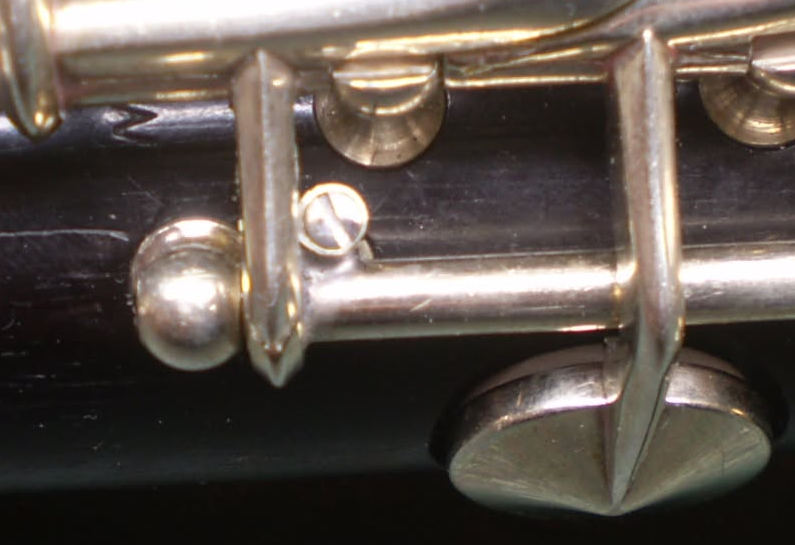
I've since been adding an adjusting screw to the LH F/C key foot with a nylon tip which makes it far more precise and snappy as the slop can be taken out. The adjusting screw pip is just soft soldered to the corner between the key foot and the key rod and uses a fairly industry standard M2x0.4 adjusting screw with a 2.4mm head (like the throat G#-A adjusting screw).
Howarth S3 clarinets had that adjusting screw fitted back in the late '90s and some other makers are starting to adopt it, only Howarth had the adjusting screw on the lower side of the LH F/C key foot using an L-shaped key piece with the adjusting screw pip soldered over the free end.
Having that adjuster on the key foot instead of on the overlever doesn't affect the contact point and create far too much movement if it's making contact in the wrong place as is the case with Buffet. That can be reduced on Buffets by using a wide flanged adjusting screw (inverted T) and also soldering a piece of metal to the end of the LH F/C foot to lengthen it.
Former oboe finisher
Howarth of London
1998 - 2010
Independent Woodwind Repairer
Single and Double Reed Specialist
Oboes, Clarinets and Saxes
NOT A MEMBER OF N.A.M.I.R.
The opinions I express are my own.
|
|
Reply To Message
|
|
Author: BobW
Date: 2026-11-02 20:12
I am having a hard time visualizing where you solder the pip. Do you have a picture Chris P ?
Thanks
|
|
Reply To Message
|
|
Author: Chris P
Date: 2026-11-02 23:57
Attachment: lhfleverpip.png (672k)
Let's see if this works:
Former oboe finisher
Howarth of London
1998 - 2010
Independent Woodwind Repairer
Single and Double Reed Specialist
Oboes, Clarinets and Saxes
NOT A MEMBER OF N.A.M.I.R.
The opinions I express are my own.
|
|
Reply To Message
|
|
Author: m1964
Date: 2026-11-03 00:14
Clarnibass and Chris,
Thanks a lot for your quick replies.
I will try bending the E/B key touch piece instead of filing off the foot.
I thought that bending the key would weaken the metal and make the key prone to getting misaligned the in the future.
Regarding the Lt. F/C key - I usually use the thinnest cork under the foot and recently started using thin synthetic material on the back foot of the Rt. F/C key which worked well.
Again, thanks for your suggestions.
|
|
Reply To Message
|
|
Author: Chris P
Date: 2026-11-03 01:18
I never use natural cork on clarinets except cork pads, the throat A stopper and a stopper to raise the LH2 linkage off the deck to reduce the long Bb linkage cork from getting mangled up during assembly.
Otherwise it's rubco for most stopper corks, ultrasuede or felt for open standing keys and some others (throat G# stopper, RH3 B/F# sliver key and crow's foot) and teflon laminated to rubco for linkages.
On the LH1 ring key and the RH F/C overlevers I use thin rubco (tech cork) with a top layer of thin teflon sheet glued to it as I want that linkage to be as low friction as possible.
As there's hardly much travel on the LH F/C foot, the nylon tipped adjusting screw makes hardly any noise and doesn't compress as much softer silencing materials will do over time and then create double action. And what with it being an adjusting screw, any lost motion can be removed dead easily with a simple turn of a screwdriver.
I fit the adjusting screw first to determine the correct length for it, then shorten it and drill into the tip and superglue in a piece of nylon monofilament which is then formed into a dome using a smooth file. I do that with the throat G# adjusting screw as well if the original is mangled up which is usually the case with nylon adjusting screws on Buffets, or just dome them if the slots are still good.
Former oboe finisher
Howarth of London
1998 - 2010
Independent Woodwind Repairer
Single and Double Reed Specialist
Oboes, Clarinets and Saxes
NOT A MEMBER OF N.A.M.I.R.
The opinions I express are my own.
|
|
Reply To Message
|
|
The Clarinet Pages
|
 |