The Clarinet BBoard The Clarinet BBoard
|
Author: JTJC
Date: 2026-09-11 18:08
Can people say which tools they find best for this?
If the interior could be moulded, it would make measuring much easier. Provided the substance used allowed the requisite level of accuracy when measured. Has anyone tried this, and if so which substance did they use.
Thanks
|
|
Reply To Message
|
|
Author: Mojo
Date: 2026-09-11 18:43
Attachment: IMG_5469.jpeg (925k)
Telescopic bore gauges and calipers do many internal measurements well. 2-part silicon can be used to mold a core you can pull out. Need to coat the inside with a release agent like petroleum jelly.
MojoMP.com
Mojo Mouthpiece Work LLC
MojoMouthpieceWork@yahoo.com
|
|
Reply To Message
|
|
Author: stevesklar
Date: 2026-09-15 21:57
as Mojo stated, the mold is the best method.
I show in a recent YT video measuring the throats of a few sax mpcs, AirFlow, S80 and Soloist with an inside caliper, if I recall correctly. As simple as it gets for measuring.
==========
Stephen Sklar
My YouTube Channel of Clarinet Information
|
|
Reply To Message
|
|
Author: JTJC
Date: 2026-09-17 01:23
Mojo and Stevesklar, thanks for the info.
Moulding the internals seems simplest. However, that seems to require using an appropriate material. It needs to fill all crevices of the chamber, flexible enough to remove yet firm enough to measure accurately. A mould also means the same caliper can be used for all measurements. As I'd be doing clarinet mouthpieces, the latitude for error is less than for larger mouthpieces like saxaphone.
Stevsklar, you mention calculating the volume ofva mouthpiece. I've heard that the internal volume of mouthpieces can be assessed by blocking off the lay and filling it with water and measuring the liquid. By doing this several times, collecting and measuring the total liquid and dividing by the number of times, the average volume provides a more accurate figure. I've never tried it, but there might well be issue measuring the liquid accurately.
|
|
Reply To Message
|
|
Author: stevesklar
Date: 2026-09-18 16:15
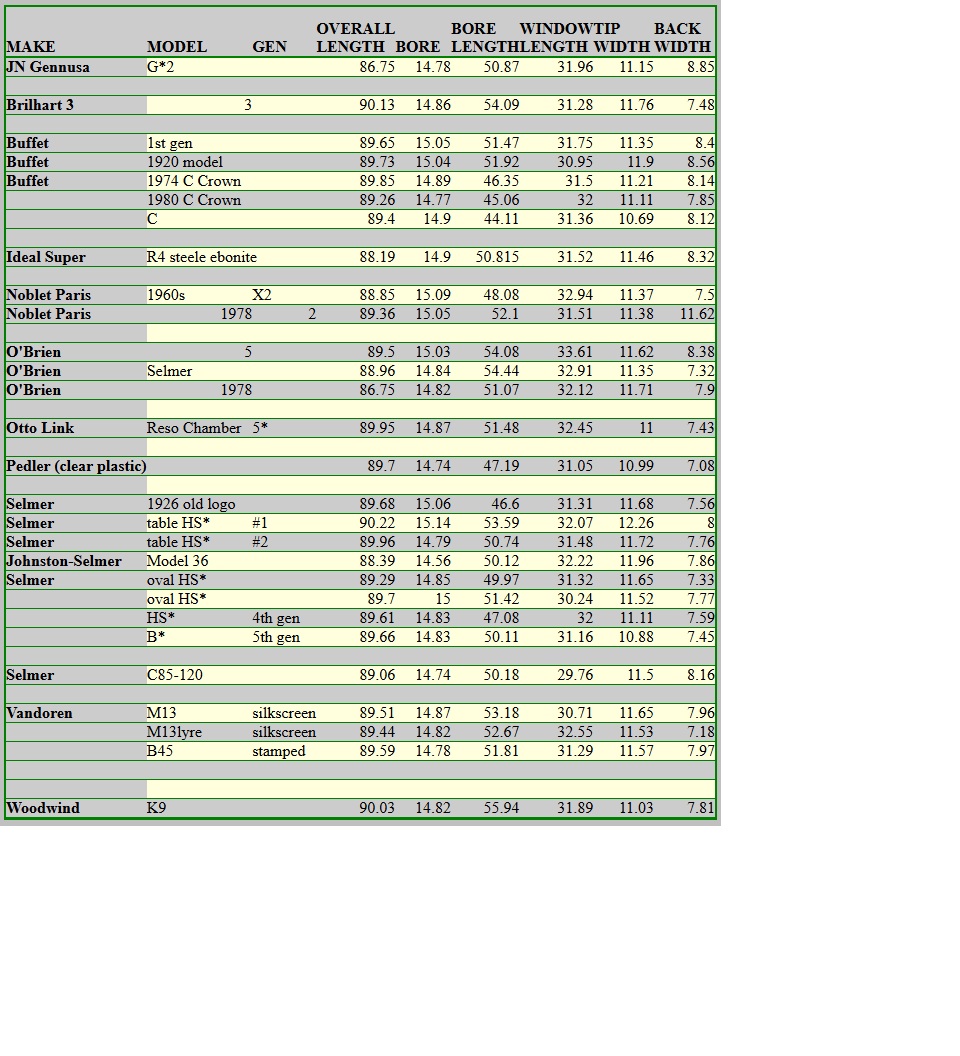
Attachment: Mpc Measurements.jpg (284k)
I've used the liquid measuring for a few, but then I was thinking, what am I trying to accomplish?
that most mpcs have similar volumes?
The important part of mpc design does include it's volume, as if you research Eaton / B&H mpcs they have a different volume and is defined as a large bore mpc. I have a few large bore mpcs for those instruments, this is where you'll see a difference in volume.
But the baffle design (no baffle to a more longer rollover), a shallow or wide H throat vs A throat design, side rails, tip rail, etc are very important factors which defines the tone chamber.
you can go overboard in measuring stuff to learn - see attachment I did years if not decades ago.
Then continue to add different measurements.
You'll then notice the intricate differences in mpcs and maybe start understanding how those various attributes affect the tone production. You'll be able to look at a mpc and determine how it will play once your experience and knowledge improves.
Somewhere I have a mpc map of intonation points from B&H, if I find it I'll post it.
But it is a continual learning process of everything about the mpc design.
==========
Stephen Sklar
My YouTube Channel of Clarinet Information
Post Edited (2026-09-18 16:23)
|
|
Reply To Message
|
|
Author: Mojo
Date: 2026-09-18 17:21
Subtle baffle changes near the tip rail can make a significant difference but cannot be easily measured. Other downstream dimensions can be easily measured and not have a significant effect. Measure, but have realistic expectations on their usefulness.
Water volume measurements can show if you are on the ball park of other mouthpieces or not. Repeatability is not great, even when averaging 3.
MojoMP.com
Mojo Mouthpiece Work LLC
MojoMouthpieceWork@yahoo.com
|
|
Reply To Message
|
|
The Clarinet Pages
|
 |
.jpg)
.jpg)
.jpg)
.jpg)
.jpg)
.jpg)