The Clarinet BBoard The Clarinet BBoard
|
Author: David Eichler
Date: 2026-04-16 04:22
I have two Buffet clarinets from the early 1950s, one with a 45,XXX SN, and one with a 48,XXX SN, which puts them as being made in 1953 and 1954, respectively, immediately before the formal release of the R-13 model. It is my understanding that Buffet was already releasing small-bore clarinets in the early 1950s, before formal introduction of the R-13, but it is unclear to me whether all of these early 1950s instruments are some kind of small-bore instrument and how similar they might be to the R-13 model. I have seen references to some of these early 1950s instruments as having a "Master Bore" design, but it is unclear to me what this means and whether it applies to all Buffet professional model clarinets from approximately 1950 to 1955. The clarinets I have seem to play broadly similarly to more modern R-13s I have owned, in the sense that they feel small-bore, as best I can tell (though the only real larger bore experience I have had, that I can recall, was with a Leblanc LL, which had generally lower resistance than small-bore instruments I have experienced). Can anyone shed any light on this. And, is there a model name or number I can use to accurately describe these instruments? I have already done a bit of research on this, including on this site, but can't seem to find the answers.
|
|
Reply To Message
|
|
Author: John Peacock
Date: 2026-04-17 00:06
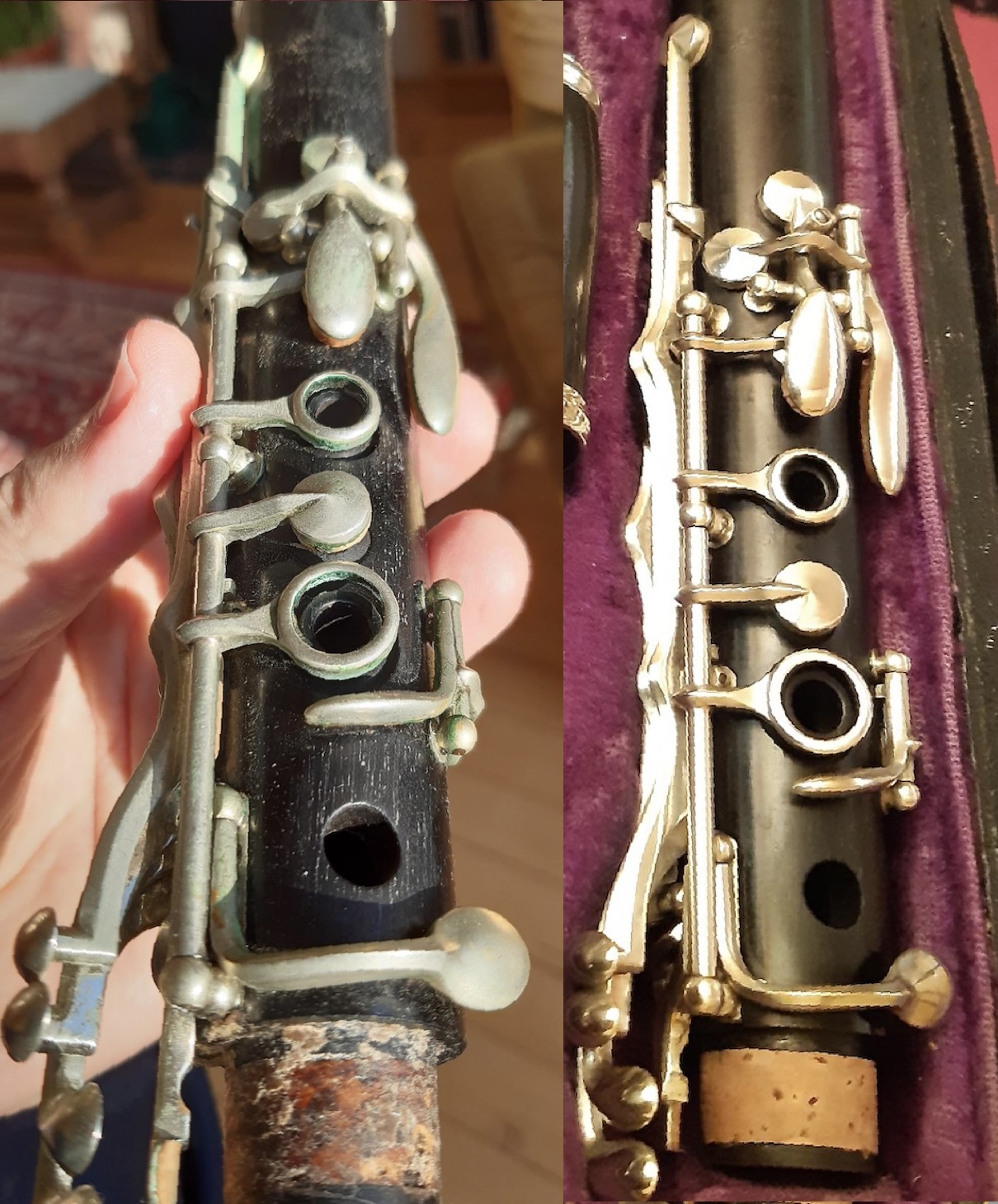
Attachment: R13_1953_restore1.jpg (515k)
According to https://www.woodwindforum.com/clarinetperfection/buffet/: From at least 1941 – 1955 Pro Buffets had a new “Master Bore”. During the 1950-1955 time frame Carree’s polycylindrical bore was used experimentally and evolved towards the introduction of the R-13 in 1955. Models from at least 1951 onwards had a tapered “Master Bore” bore.
If the Master Bore was tapered (i.e. conical, I presume), there's no easy way to tell it from polycylindrical: you can use calipers to measure the diameter at top and bottom of the upper joint, but not whether it tapers uniformly on in stages, without more specialised equipment.
But earlier Buffets were nearly cylindrical, and certainly some post-war instruments shared that character. Here are measurements for top and bottom in mm, including a later R13:
1938 14.69 14.74
1949 14.87 14.92
1959 14.90 14.69
You can see the difference in 1959 just by the taper. I recently finished restoring a 47,xxx (1953) instrument which has a similar taper: 14.88 to 14.73. It plays pretty nicely, though actually more like an RC than an R13.
The other way you're supposed to be able to tell the difference is by keys: allegedly proper R13's had a trill key guide that was domed rather than triangular, and separate posts for A and Ab keys. My 1953 instrument (picture attached) is transitional: separate posts for the throat keys but an old-style triangular guide. ClarinetPefection has a picture of a model that is mixed the other way. I guess there were a few years when they were using up old parts while introducing the new ones, and just used whatever came to hand.
|
|
Reply To Message
|
|
Author: m1964
Date: 2026-04-17 01:04
I tried a couple of pre-R13s from 1953-54.
Both felt more open and less resistant comparing to an R13, and had less "complex" tone.
Did not have the R13 "ring", but still were very nice instruments.
The difference was obvious when played back to back vs. an R13 from 60s
|
|
Reply To Message
|
|
Author: David Eichler
Date: 2026-04-17 04:39
m1964 wrote:
> I tried a couple of pre-R13s from 1953-54.
> Both felt more open and less resistant comparing to an R13, and
> had less "complex" tone.
> Did not have the R13 "ring", but still were very nice
> instruments.
> The difference was obvious when played back to back vs. an R13
> from 60s
>
The two early 1950s Buffets I have feel like they have about the same resistance as an R13. One of them has a rather mellow sound, but I its has had a lot of use and I wonder if that might have changed its characteristics somewhat. The 48,XXX instrument has not had much use and it has quite a bight of ring. In fact it is quite bright and would probably not be to the taste of many American classical players, though it is well suited for jazz.
Post Edited (2026-04-17 04:49)
|
|
Reply To Message
|
|
Author: David Eichler
Date: 2026-04-17 04:48
John Peacock wrote:
> According to
> https://www.woodwindforum.com/clarinetperfection/buffet/:
> From at least 1941 – 1955 Pro Buffets had a new “Master
> Bore”. During the 1950-1955 time frame Carree’s
> polycylindrical bore was used experimentally and evolved
> towards the introduction of the R-13 in 1955. Models from at
> least 1951 onwards had a tapered “Master Bore” bore.
>
> If the Master Bore was tapered (i.e. conical, I presume),
> there's no easy way to tell it from polycylindrical: you can
> use calipers to measure the diameter at top and bottom of the
> upper joint, but not whether it tapers uniformly on in stages,
> without more specialised equipment.
>
> But earlier Buffets were nearly cylindrical, and certainly some
> post-war instruments shared that character. Here are
> measurements for top and bottom in mm, including a later R13:
>
> 1938 14.69 14.74
> 1949 14.87 14.92
> 1959 14.90 14.69
>
> You can see the difference in 1959 just by the taper. I
> recently finished restoring a 47,xxx (1953) instrument which
> has a similar taper: 14.88 to 14.73. It plays pretty nicely,
> though actually more like an RC than an R13.
>
> The other way you're supposed to be able to tell the difference
> is by keys: allegedly proper R13's had a trill key guide that
> was domed rather than triangular, and separate posts for A and
> Ab keys. My 1953 instrument (picture attached) is transitional:
> separate posts for the throat keys but an old-style triangular
> guide. ClarinetPefection has a picture of a model that is mixed
> the other way. I guess there were a few years when they were
> using up old parts while introducing the new ones, and just
> used whatever came to hand.
None of that seems to confirm whether all Buffets from 1950 to 1955 were small-bore instruments and, if so, whether they were all some version of polycylindrical, or some mixture of that and conical in the upper joint.
|
|
Reply To Message
|
|
Author: John Peacock
Date: 2026-04-17 11:07
David: you haven't defined what you mean by "small-bore". Perhaps you're thinking of the distinction with somethng like a Selmer Centered Tone? I have one of these, which I measure as 15.24 15.03. So it tapers as much as an R13, but is larger overall. That's not at all the same as the archetypical big-bore instrument, the B&H 1010. That would be cylindrical, as something near 15.35 top and bottom.
I've never come across a Buffet with CT-like dimensions, though obviously I've only seen a limited number. If you quote just the diameter at the bottom of the upper joint, my 1949 instrument was quite close to the CT - but of course it doesn't taper.
|
|
Reply To Message
|
|
Author: David Eichler
Date: 2026-04-18 00:54
John Peacock wrote:
> David: you haven't defined what you mean by "small-bore".
> Perhaps you're thinking of the distinction with somethng like a
> Selmer Centered Tone? I have one of these, which I measure as
> 15.24 15.03. So it tapers as much as an R13, but is larger
> overall. That's not at all the same as the archetypical
> big-bore instrument, the B&H 1010. That would be cylindrical,
> as something near 15.35 top and bottom.
>
> I've never come across a Buffet with CT-like dimensions, though
> obviously I've only seen a limited number. If you quote just
> the diameter at the bottom of the upper joint, my 1949
> instrument was quite close to the CT - but of course it doesn't
> taper.
Bore size in this regard has traditionally referred to the size of the smallest dimension of the bore of the upper joint, regardless of whether the shape of that part of the bore is basically cylindrical or tapered in some way, such that truly small-bore instruments typically have noticeably more resistance than larger bore instruments.
|
|
Reply To Message
|
|
Author: ruben
Date: 2026-04-19 20:52
1964: Hi! I have a Buffet with no model inscribed, so it must be pre-R13 and from a time when Buffet just had one model. It is a fine instrument that has hardly ever been used. With a Fobes barrel, it is really good and I just may take this up as my principal instrument instead of my Selmer Recital, which is showing its age and is less even between registers.
rubengreenbergparisfrance@gmail.com
Post Edited (2026-04-20 09:16)
|
|
Reply To Message
|
|
The Clarinet Pages
|
 |
.jpg)
.jpg)
.jpg)
.jpg)
.jpg)
.jpg)