The Clarinet BBoard The Clarinet BBoard
|
Author: S.Takuto
Date: 2026-04-08 15:21
A few years ago, Vandoren changed the way they manufacture their mouthpieces.
I believe our manufacturing process has become more consistent than before.
However, I feel that they wear out much faster than the previous models.
I used to buy a new mouthpiece every 10 months to a year.
Since the current manufacturing method was introduced, the facing curve wears down particularly quickly; in my case, I’m already considering replacing it after just two to three months.
I’m aware that because my front teeth are slightly crooked, one side wears down more easily, so I have to replace my mouthguard more frequently than most people.
Are there any of you who, like me, feel that your mouthpiece wears out faster since the manufacturing process changed?
|
|
Reply To Message
|
|
Author: kdk
Date: 2026-04-08 16:51
What exactly is wearing out? I have been using the same Vandoren M13L for well over a year with no degradation of the facing that I notice. I use a rubber patch on the beak and play double lip, so beak wear is not an issue. Do the facing measurements actually change? What range of change are you finding?
Karl
|
|
Reply To Message
|
|
Author: Paul Aviles
Date: 2026-04-08 20:17
I had switched to a BD2 as soon as it was available. Not really seeing any appreciable wear to the rails (both sides and the front).
.............Paul Aviles
|
|
Reply To Message
|
|
Author: Tom H
Date: 2026-04-09 06:06
I've used my 5RV since about 2000. Not sure what that says about me.
Before that, from about 1975-2000 I used the V360.
The Most Advanced Clarinet Book -- Songburd Music (paper and digital)
Search title. Amazon.com (search Tom Heimer).
Boreal Ballad solo -- Songburd Music item -- search title.
|
|
Reply To Message
|
|
Author: JTJC
Date: 2026-04-09 16:13
I've heard at least two well known mouthpiece makers/refacers say a pro would need their mouthpiece lay touched up after about two years use. The main culprit is rail tilt, which occurs at the fulcrum where the reed flexes as it bend to follow the curve of the lay when vibrating. I'm surprised when people say they've played a mouthpiece for years, decades even, with no wear.
It's evident ebonite wears, even through handling (ligature marks etc), so what's going on? Do lays wear, or don't they?
I use D'Addario Reserve Evolution mouthpieces, and I'd say they wear and need replacing after around two years (their cost doesn't make relaying worthwhile). That mouthpiece is also CNC, so I'm wondering whether CNC machining requires an ebonite with different characteristics to the older types, which were moulded. Of course, manufacturers would always claim the newer ebonite is much better quality and is sonically superior to their old one.
|
|
Reply To Message
|
|
Author: lydian
Date: 2026-04-09 16:25
Yeah, my reeds last longer than my mouthpieces. Have to buy a new on every week. But I am travelling at near light speed relative to the rest of you. This message is from a distant galaxy in the future. Maybe I should just get a metal mouthpiece.
|
|
Reply To Message
|
|
Author: S.Takuto
Date: 2026-04-09 19:02
Attachment: S__291651614.jpg (33k)
Attachment: S__291651615.jpg (23k)
Thank you all for your responses.
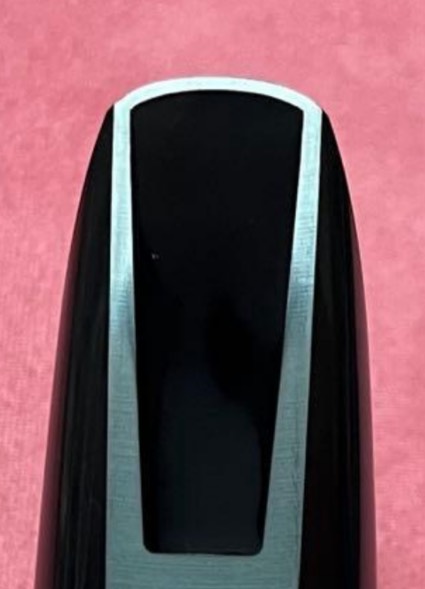
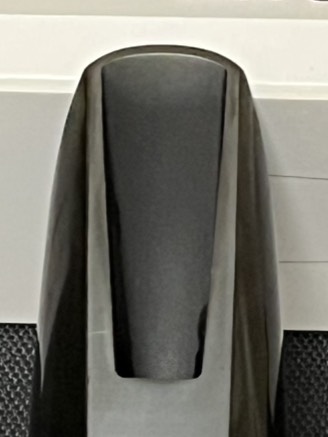
I’ve attached a photo of the mouthpiece I’ve been using for about two months.
Can you see the shadow in the center of the rail, especially on the left side?
Please don’t mind that the shadow on the right is higher up than the one on the left—it’s just because of my teeth.
The shaded area here is where wear on the facing curve can be visually confirmed.
In fact, when you press the glass against the table and measure it with a thickness gauge, you’ll find that the starting point of the curve has become less pronounced or that the left and right sides have shifted since the time of purchase.
At the very least, the condition of the facing curve changes significantly from the time of purchase.
I felt this was particularly common with recent Vandoren machining, but simply realizing that not everyone shares that view was a valuable insight in itself.
This happens with any mouthpiece.
I experienced this issue when using Fobes, BEHN, and Zinner mouthpieces as well, but with those, I was able to use them without any problems for at least a year.
|
|
Reply To Message
|
|
Author: Paul Aviles
Date: 2026-04-09 19:56
For me, the visual difference amounts to a "scuff mark." I have never found that to be an issue. However, if you draw the mouthpiece backward upon a piece of standard typewriter paper while tilting upward to accommodate the tip (light pressure and check after each iteration) that "scuff" will polish right out. But as with ANY polishing of ANYTHING with ANY material, you are removing very microscopic amounts of material. So don't do that too often.
..............Paul Aviles
|
|
Reply To Message
|
|
Author: lydian
Date: 2026-04-09 21:54
As someone who still plays 100 year old mouthpieces, I obviously cannot comprehend your issue. Significant wear should take decades in normal use. I have to ask how you maintain your mouthpieces. Surely this wear is due to excessive force or abrasion when cleaning or swabbing. It seems like any wear caused by air, saliva and reed could not possibly have any significant impact for many years.
|
|
Reply To Message
|
|
Author: kdk
Date: 2026-04-09 23:15
I assume you don't have pictures of the mouthpiece when it was new. I'd have to wonder whether the mouthpiece came that way.
Karl
|
|
Reply To Message
|
|
Author: S.Takuto
Date: 2026-04-10 05:18
First, let me clear up a misunderstanding: comparing the ebonite used 100 years ago—or even 30 years ago, for that matter—with the material used today is a completely pointless exercise.
This is because the manufacturing process for ebonite and the method used to shape the mouthpiece are completely different.
I know of an orchestra musician from the 1900s who played his entire career using just one mouthpiece.
Of course, the mouthpiece must have worn down, but I don’t think it was as noticeable as it is today.
With that in mind, I want to discuss whether Vandoren mouthpieces these days tend to wear out easily, so bringing up older mouthpieces is missing the point.
So, regarding cleaning, I try to be as careful as possible.
Basically, I don’t use swabs and I never touch the facing.
If calcium deposits build up, I use lemon juice to remove them.
I don’t have any photos of the item in new condition.
But do you really think there are people stupid enough to buy a damaged item every single time?
If it had been like this from the start, I wouldn’t have bought it.
|
|
Reply To Message
|
|
Author: JTJC
Date: 2026-04-10 13:11
You have to remember, that these days, manufacturers don't make anything to last. Quality standards have deteriorated. With large mouthpiece companies part of the discussion around a new model will be its longevity. It's not in the interest of their business for it to last.
The older 'forever' mouthpieces mentioned are no longer made.
I'm sure some players will experience more playing-based mouthpiece wear (as opposed to wear by handling) than others for a variety of reasons. For example, the lesser pressure (supposedly) applied by double lip players would, presumably, cause less wear. Assymetrical emboucher, must also potentially be a factor, as with S.Takuto.
|
|
Reply To Message
|
|
Author: kdk
Date: 2026-04-10 18:37
S.Takuto wrote:
> I don’t have any photos of the item in new condition.
> But do you really think there are people stupid enough to buy a
> damaged item every single time?
> If it had been like this from the start, I wouldn’t have
> bought it.
Unless the damage is more obvious to the naked eye than it is in your close-up with the lighting positioned to show the shadows clearly, most people might not notice. Besides, I wasn't suggesting the mouthpiece was made that way. I've had more than one "new" mouthpiece arrive from various online outlets that had subtle (in one case not so subtle) damage or deliberate attempts at small alterations, probably by someone who had previously had the mouthpiece on "trial." When they didn't like the result of their tinkering, they returned it to the vendor. Individual defective mouthpieces *can* come off an assembly line.
I'm not saying your mouthpiece isn't showing actual premature wear from use. Since you asked about a change in the material's being the the reason, I was only thinking of what other explanations might be available.
Karl
|
|
Reply To Message
|
|
Author: Luc
Date: 2026-04-10 18:37
Just a beginner here, but I been playing the same Daddario Reserve X5 mp for about 8 years (on and off mind you... mostly off). The rails are a bit shiny from the vibrating reed so I guess you could call it wear. But it still plays fine and has the same great tone. So I would ask the OP what issues are you having when playing? Is the tone off? I can't imagine that a mp needs to be replaced after a couple of months. Just my 2 cents.
|
|
Reply To Message
|
|
Author: kurth83
Date: 2026-04-10 20:52
I thought about this for a bit and can come up with a few possibilities:
Based on the scratch test, where a harder substance can scratch a softer material but not vice versa, and assuming the dark spots in the pic represent abrasion of the rail surface:
1) The cane reed is slowly abrading the MP surface. Seems like a good argument to sand the back of your reeds to glassy smooth as part of reed prep (I admit I do this).
2) Hard buildup on the back of the reed may be to blame as opposed to the cane itself. Allowing a reed to dry without cleaning can cause calcium deposits to build up, which almost certainly can abrade the plastic surface, and will not dissolve when the reed is re-wetted. This is an argument to always clean the back of the reed while still wet before putting it away. My process is to simply lick the reed clean and wipe it on a cloth (the backside is the important part here). I know of people who actually clean the reed with distilled water before putting away. Also this would be an argument against letting the reed dry while still attached to the MP.
3) If not using cane then you may have discovered something about that particular synthetic reed material, the above cleaning point still applies, and maybe the sanding one too.
I clean my MP surface after each play, wet it (lick), and wipe clean on a soft cotton cloth (I look for glassy smooth and clean).
Good luck.
Aging classical trumpet player learning clarinet as a second.
|
|
Reply To Message
|
|
Author: Paul Aviles
Date: 2026-04-11 07:07
Well, I would like others to comment on the citric acid. But it seems to me that regular use of acid might lead to compromising the material “somewhat.” Any comment from you guys?
………….. Paul Aviles
|
|
Reply To Message
|
|
Author: kdk
Date: 2026-04-12 06:27
I use undiluted kitchen vinegar (I think about 4%) to clean my mouthpieces. It hasn't caused damage to any mouthpiece in over 60 years.
KarlPaul Aviles wrote:
> Well, I would like others to comment on the citric acid. But
> it seems to me that regular use of acid might lead to
> compromising the material “somewhat.” Any comment from you
> guys?
>
>
>
> ………….. Paul Aviles
>
|
|
Reply To Message
|
|
Author: Paul Aviles
Date: 2026-04-12 15:49
Hey KDK,
Thanks for the response. However, are you doing that regularly, as in once a week (for example)?
.............Paul Aviles
|
|
Reply To Message
|
|
Author: Kalashnikirby
Date: 2026-04-13 11:25
Attachment: PXL_20260411_184556208.jpg (1535k)
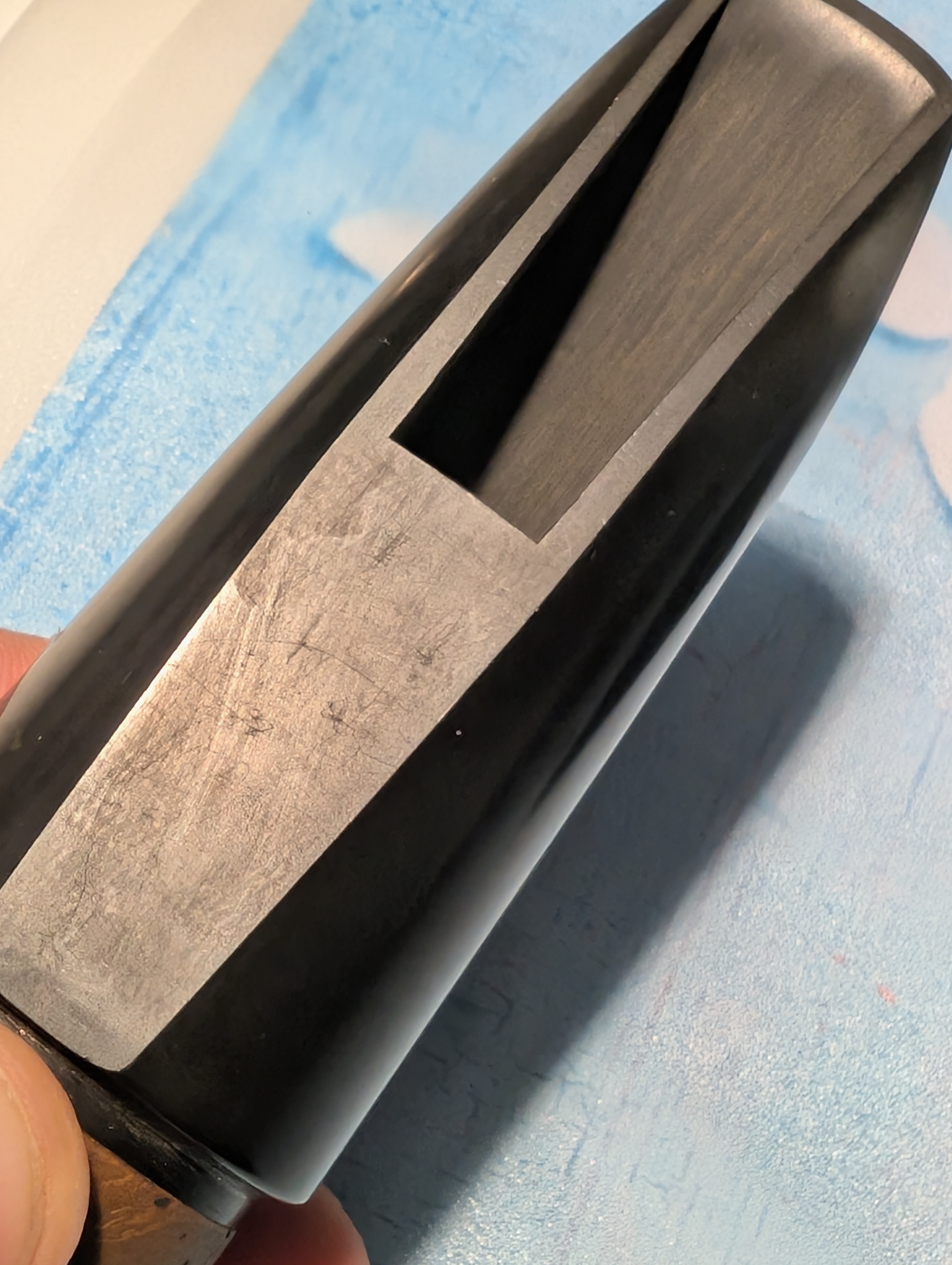
Re the mouthpiece wear and tear question. Here's an interesting photo. This Selmer Focus bass has been well loved... I've played it for years and it was one of my first mouthpieces to more or less only be used with synthetic reeds. So the table is all scratched, but can you spot this pattern? Also, the rails do seem blunt compared to a brand new mouthpiece
Now I cannot judge how this affects playability, but I haven't noticed any issues.
With my soprano mouthpieces, it's even easier to judge: I've got to Gleichweit B7-1, but one of them is designed for a slightly lower pitch bit higher (similar to the Vandoren 13 series).
Now the lower pitch model I had for years before realizing that the higher pitched version suits me a tad better. So there is visibly more wear on the older one - yet I've never noticed any issues.
Now as far as Vandoren is concerned, I just don't feel they're the best quality option anymore. Other manufacturers produced more consistent results, especially since synthetic reeds benefit from flat tables and precise rails immensely - more so than cane, I believe.
I'd give Gleichweit a try, and I can really understand their sucess they're having - though at this point, they've become a bit pricey. A testament to their quality might be that the ebonite seems extremely stable - it still hasn't developed any discolorization or tarnished my instrument's keys as opposed to some other brands. But that might just be anecdotical evidence.
Best regards
Christian
|
|
Reply To Message
|
|
Author: Klarnt
Date: 2026-04-13 11:29
For the last 7 years or so I've used a 5JB. It has gone through a lot of abuse and exposure to outdoor venues but I clean it weekly with diluted vinegar. The last two years I noticed that the left side of the mouthpiece doesnt seal quite right anymore. Its hard to describe but up until this post I never considered that mouthpieces could wear out
Makes me wonder why there arent more metal mouthpieces for clarinet, besides an old NY Meyer Bros or modern AM mouthpiece? Our saxophone friends have got plenty of options to choose from. Seems like they would be slightly more durable, correct?
Post Edited (2026-04-13 11:30)
|
|
Reply To Message
|
|
Author: lydian
Date: 2026-04-13 21:11
I just had a thought. Could be a planned obsolescence thing to push customers to upgrade to the new high density "black diamond" models. I still prefer my Hite to my Vandorens which are sitting in a drawer. I think my Hite is plastic, and I see no wear whatsoever even after years of hard playing.
Regarding metal. My metal sax mouthpieces aren't immune to damage and wear. In my 50 years of playing I've ruined several by dropping or rattling around in my case. Dukoff was by far the worst and Berg the best with Link in the middle. A bandmate of mine has a metal clarinet mouthpiece that's painful to listen to. He plays it to cut, but it's way too much. No thanks.
Post Edited (2026-04-13 21:16)
|
|
Reply To Message
|
|
Author: GoatTnder
Date: 2026-04-13 21:14
Hard rubber mouthpieces do change shape over time. I was using a refaced M14 since about 2004 until last year. I went to my mouthpiece guy (John Reilly - great work!) and asked him to take a look at it because I just didn't trust it the way I used to. The mouthpiece was so warped he had to reface it completely!
I'm debating asking him to make me half a dozen more mouthpieces that match my current one so I can swap it out every decade or so and have enough to last until I'm gone.
Andres Cabrera
West Coast Wind Symphony
https://WestCoastWindSymphony.com
sbwe@sbmusic.org
|
|
Reply To Message
|
|
Author: Paul Aviles
Date: 2026-04-14 04:53
Making people buy the HD mouthpieces is NOT part of the plan........I'm guessing. There are only a few BD sizes available in the HD and Vandoren is adamant about keeping it that way. Of course I'd get the BD2 in HD the second it would be available. That dense, heavy hard rubber DOES make a difference in feel and sound.
............Paul Aviles
|
|
Reply To Message
|
|
Author: David H. Kinder
Date: 2026-04-14 09:01
I just bought a couple of Ridenour mouthpieces off eBay last month. One was brand new, but old stock. Had to sand the cork down to make it fit. The other was the exact same model, but certainly used, but in decent shape.
I did the 'suck' test on both mouthpieces with a reed and the mouthpiece tenon against my palm. The new one held the reed for about 3-4 seconds. The old one... barely one second.
I only spent about $35 for the used one, so either I toss it as junk or I can do something on it. ChatGPT recommended a light polish sanding on the table, rail, and tip with 1,000-2,000 grit. I have the Earspasm reed polishing cloths and used the 1,200 grit cloth on it. Barely rubbed it on with a bit of hydrogen peroxide. I couldn't see anything being removed.
I did the 'suck' test on it afterwards... and it held for the same 3-4 seconds as my new one!
I'm not telling anyone to do their own mouthpiece work, but this was so low risk that it wouldn't matter. I wouldn't even call it 'mouthpiece work', but that one step really helped it.
Ridenour AureA Bb clarinet
Ridenour Artist MT36 mouthpiece
Vandoren Optimum black ligature (plate 1)
Vandoren Traditional #3.5 reeds
Brad Behn HR adjustable barrel
|
|
Reply To Message
|
|
Author: JTJC
Date: 2026-04-14 21:04
lydian - your 'plastic' Hite might be acrylic. Apparently, though looked down upon and why it's not used a lot, that material is as good or better than ebonite, and more hard wearing. I'd heard a lot of German pros prefer it. Can't say I've had the opportunity to try it. The Fobes Debut is made from it.
|
|
Reply To Message
|
|
The Clarinet Pages
|
 |
.jpg)
.jpg)
.jpg)
.jpg)
.jpg)
.jpg)