The Clarinet BBoard The Clarinet BBoard
|
Author: David H. Kinder
Date: 2026-04-04 09:46
I’ve been following a series of developments over the past few days that, taken together, feel like a real-time case study in how the clarinet market is evolving—particularly around Chinese-manufactured (often called “stencil”) instruments, dealer-branded lines, and premium manufacturers.
It started with Michael Lowenstern’s April Fool’s video on “faux bass clarinets.”
https://www.youtube.com/watch?v=39YSs39OgjU
While humorous on the surface, the underlying message was clear: many dealer-branded bass clarinets appear to share common factory origins, with limited original R&D, and are marketed under different names with varying claims of uniqueness. He contrasted that model with companies like Backun and Royal Global that have invested heavily in design and development.
Shortly after, Clarinets by Copeland announced they are no longer an authorized Backun dealer. In follow-up comments, they referenced being “extremely disappointed” in a video from a Backun representative and stated they would be working with partners aligned with their values. Their broader messaging emphasizes affordability, accessibility, and making instruments “play really well, regardless of brand.”
https://www.facebook.com/ClarinetsByCopeland/posts/
Lisa’s Clarinet Shop then posted a direct response pushing back on the video’s implications.
Their position, in summary:
- Chinese manufacturing is not inherently low quality—some factories are excellent.
- Dealer collaboration with factories can lead to meaningful product development over time.
- Royal Global itself was developed through outsourced manufacturing, per Lisa's Clarinet Shop
- Lower-cost instruments expand the market and make bass clarinet more accessible.
- The critique of “faux” instruments may be as much about protecting premium market share as it is about educating consumers.
https://fb.watch/GgnGgOtpWU/
What I find interesting is how this highlights a few underlying tensions:
R&D vs. Iteration:
Where do we draw the line between true instrument development and iterative improvement on existing factory designs?
Brand vs. Setup/Refinement:
Is the primary source of value the manufacturer’s design, or the dealer’s setup, selection, and adjustments?
Accessibility vs. Innovation:
Lower-cost instruments clearly expand access—but what impact does that have on long-term investment in new designs?
Positioning Shifts:
Dealers historically carried premium brands alongside their own lines. What does it mean when a dealer steps away from a premium brand and leans fully into their own model?
I’m not trying to take a side here—just laying out what’s been said and how it fits together. It seems like the market is actively debating what constitutes value, legitimacy, and transparency in instrument making and selling.
Curious how others here see it:
Is Lowenstern’s critique fair, overstated, or missing something?
Where do you personally draw the line between “development” and “rebranding”?
How much weight do you give to origin (factory vs. brand vs. dealer) when evaluating an instrument?
Ridenour AureA Bb clarinet
Ridenour Artist MT36 mouthpiece
Vandoren Optimum black ligature (plate 1)
Vandoren Traditional #3.5 reeds
Brad Behn HR adjustable barrel
Post Edited (2026-04-04 09:53)
|
|
Reply To Message
|
|
Author: David H. Kinder
Date: 2026-04-04 09:55
Btw, reportedly, Michael Lowenstern will ONLY be reviewing Backun bass clarinets and is an authorized spokesperson? Personally, I think 'spokesperson' and being a Backun Artist are two very distinct things.
Ridenour AureA Bb clarinet
Ridenour Artist MT36 mouthpiece
Vandoren Optimum black ligature (plate 1)
Vandoren Traditional #3.5 reeds
Brad Behn HR adjustable barrel
Post Edited (2026-04-04 09:57)
|
|
Reply To Message
|
|
Author: Kalashnikirby
Date: 2026-04-04 12:48
As Mr. Lowenstern himself stated, the number of different makers and models a
has grown immensely. Him "calling out" the competition might just be a PR move, but then again, I find critizising selling rebranded chinese instruments valid.
In fact, I'd absolutely recommend the eb clarinet you can for example get from Thomann for 750€, it's an astonishingly good instrument and even the keywork ist pretty decent, but does need some regulation.
Now if the US retailers of that same instrument were transparent about its origins and their lack of RND, I'd get it. But they do frame it as if it were their own creation. Take the "woodwind boutique" for example. They kicked out Uebel and RZ (a brand I don't fully trust, either) and now sell clearly overpriced stencils, maybe the priciest ones get some special attention.
But take a Max or the Backun Alpha, and you'll see they're superior instruments to that ubiquitous chinese bass (the one with the Yamaha style thumb keys, also sold by Thomann).
But it gets really weird if even that design is now "outdated" and there's now a Selmer...ish copy, as shown in the video. I've aleady spotted an european version from Adams Music.
It is then that I can understand Lowenstern's criticism - they keep pumping out instruments and no one really knows how much RND goes into them. Reselling them for the same price as a Max or Alpha (bass) does make it seem like they're at the same level, but they're not.
As far as I'm concerned, the recent developments have benefitted me. Love my max bass. Love my eefer. But if Royal made their own version, for example without the janky eb lever, or one with a seperate post - it'd probably be even better. There is little justification for a "non genuine" product if it's priced the same as a "brand" one.
Best regards
Christian
|
|
Reply To Message
|
|
Author: Reed B Chirpin
Date: 2026-04-04 20:24
It's tough to make a blanket claim about instruments since there are absolutely poor-quality instruments coming from China, but now there are also some high-quality instruments coming from China. Even the Backun Alpha bass has "Made in China Assembled in Canada" engraved on it, not to mention Royal Global products coming from a good Chinese factory. Having tried a couple of instruments from someone who uses a Selmer-inspired bass body that's been adjusted and set up properly, I actually would have preferred it over a Max or Alpha bass clarinet. Is it quite as good as a Selmer Privilege? No, but they are close while having their own "feel" and playing qualities altogether, and it's catering to a different market. Key work was very solid as well. I'm sure it's different if you're ordering one of the big box store low C bass clarinets, but a bass coming from a reputable source where a tech is doing adjustments and set up work, it can absolutely be a good horn at this price point. For what it's worth, the Kesslers that Mr. Lowenstern is going to bat for in the video were not very competitive in terms of playability compared to the other affordable low C basses I've tried, in my experience. I know Michael sells them, and being a Backun artist/seller who had a hand in designing the Backun basses that compete with these various models, maybe it's best to take some of these things with a grain of salt.
|
|
Reply To Message
|
|
Author: Kalashnikirby
Date: 2026-04-05 00:04
Did you refer to my post? If so, I wouldn't or couldn't possibly claim to know all chinese instruments. I'm just saying that a very common type of instrument - which is sold via different brands - doesn't deserve the *framing* of being something special. It's the literal pig with some lipstick. But a competent pig, I guess.
Sure enough, a Selmer...ish instrument is going to be very good too, if they make it right. No doubt. But again, I'd prefer the instrument to have it's own DNA.
|
|
Reply To Message
|
|
Author: Reed B Chirpin
Date: 2026-04-05 01:19
Sorry for the miscommunication, Kalashnikirby! I wasn't referring to your post, but rather Mr. Lowenstern's vague claim from the video. I agree with you about the sentiment of slapping a brand on a stock instrument from China. It does seem that some brands do exactly that, but then some others actually make enhancements/adjustments to a model based on a design, and offer much better key work than those "stock" instruments. I'm sure Backun and Royal used some "Selmer-ish" design traits to develop their designs, especially with them implementing the pivot style trill keys and low Eb (rather than low D) thumb key - the Royals doing so recently. I personally like how all of this is helping to make very good bass clarinets accessible to students, amateurs, and the like, besides the brands that are indeed slapping on the logo. My point after seeing the video was that there is a spectrum of Chinese-made instruments in terms of quality these days.
|
|
Reply To Message
|
|
Author: Chris P
Date: 2026-04-05 03:02
The keywork on Backun and Royal Global basses are both largely based on Rene Hagmann's post 1999 Buffet Prestige and more recent Tosca bass design, same with the Uebel Emperior bass which was the first Chinese made pro level bass to copy Buffet's design.
Former oboe finisher
Howarth of London
1998 - 2010
Independent Woodwind Repairer
Single and Double Reed Specialist
Oboes, Clarinets and Saxes
NOT A MEMBER OF N.A.M.I.R.
The opinions I express are my own.
|
|
Reply To Message
|
|
Author: Kalashnikirby
Date: 2026-04-05 17:04
@Reed B Chirpin: Much appreciated.
Well yes, Lowenstern doesn't really adress how the instrument he reviews is pretty good after all (and what to make of that fact). It's all morally ambiguous, and now that I think of it, you'd also have to criticise all the other that were "inspired" by Buffet.
The bass we're discussing is for example distributed by "Sunwin Music". There are others that sell these and it's never quite clear who the actual maker is, as you'll also find that ubiquitous eefer listed by Longkou (Jinming), etc.
But at this point, the entanglement of the european/american markets with chinese manufacturing is beyond any scope. When I checked the Sunwin FB page, out of all people I'd have expected, Walter Grimm (large swiss woodwinds store) commented under a mopane bass clarinet.... what? Now I wonder when they start selling their own brand...
Oh, and that one had a wooden bell. Just 10 years we couldn't have dreamed of such instruments, and now the market is getting flooded. Maybe even saturated, because where in this world do we need that many?
The biggest danger for european makers is, that slowly but surely chinese makers will gain their own knowhow and become fully indepent.
Briz horns is a prime example. And it took many years before they were taken seriously, now these horns win competitions.
Which is not to say some competition is bad. But I feel european manufacturing in particular has yet to find a standing where it's not all about high end, and the intermediate instruments suck. Almost nothing that leaves the Buffet Markneukirchen factory is worth looking into. The wood of an E11 is an insult. Better buy a royal max.
(And Hoyer horns are mediocre, and Schreiber bassoons too)
|
|
Reply To Message
|
|
Author: David H. Kinder
Date: 2026-04-07 01:42
I responded to Copeland with this:
I appreciate you taking the time to address this thoughtfully. There’s definitely a bigger conversation happening here, and I think it’s worth acknowledging a few nuances that often get lost when everything gets grouped together.
Part of the challenge is that when many people hear “Chinese-made instruments,” they don’t think of carefully specified, dealer-supported instruments with quality control—they think of the lowest end of the market.
For better or worse, that perception has been shaped by years of exposure to ultra-cheap, mass-produced instruments—what many repair techs would call “instrument-shaped objects.” In those cases, the issue isn’t geography, it’s lack of design oversight, quality control, and long-term support. However, they are all lumped in under the category of "Chinese-made instruments."
Each time I take my Ridenour AureA Bb clarinet to a technician who isn’t familiar with it, I end up explaining who made it, how it’s constructed, and that it isn’t a knock-off but a deliberately designed hard rubber instrument. Once they actually handle it, any skepticism tends to disappear—and no one has had any trouble working on it.
At the same time, there are also valid concerns around intellectual property and design replication that have contributed to that perception over time. Whether fairly or unfairly, that has influenced how people evaluate anything coming from that manufacturing ecosystem.
Where I think your point is important is in distinguishing between:
- instruments that are simply mass-produced and distributed, and
- instruments that are intentionally specified, refined, and supported by people who are deeply involved in the process.
Those are not the same thing—but they often get labeled the same way.
I do think the burden (and opportunity) for shops and brands working this way is to clearly communicate what makes their instruments different: design choices, acoustic intent, setup standards, and ongoing refinement. That level of transparency helps bridge the gap between perception and reality.
At the end of the day, I think most players just want to understand what they’re getting and why it performs the way it does—and that comes from clear information, not assumptions on either side.
Ridenour AureA Bb clarinet
Ridenour Artist MT36 mouthpiece
Vandoren Optimum black ligature (plate 1)
Vandoren Traditional #3.5 reeds
Brad Behn HR adjustable barrel
|
|
Reply To Message
|
|
Author: Chris P
Date: 2026-04-07 11:17
Oh dear - they lost me when they brought religion and bilious bible-bashing clap-trap into it.
Former oboe finisher
Howarth of London
1998 - 2010
Independent Woodwind Repairer
Single and Double Reed Specialist
Oboes, Clarinets and Saxes
NOT A MEMBER OF N.A.M.I.R.
The opinions I express are my own.
|
|
Reply To Message
|
|
Author: Kalashnikirby
Date: 2026-04-07 17:45
@David H. Kinder: I mostly agree with your more nuanced view. Ridenour is a c9ntroversial person too, but noone doubts that he offers his own designs. And he never made
but...
Oh the irony of claiming strong christian values while importing more or less generic instruments! Rather hypocritical, no? If they were fully transparent about that, I could appreciate their business model. Yes, one could argue that Copeland have some designing influence on their instruments, but I highly doubt that they alter the bore, tone hole placement or undercutting etc.
Compare that to Thomann's approach: An instrument gets the Thomann branding, everybody knows it's a chinese instrument, you get (surprisingly) decent customer service and a 30-day money back warranty (not sure about non-EU countries though) and they do actually have the instruments checked in their own workshop.
The difference being they don't make any grand claims about that. ("We strongly believe a good instrument can be affordable... bla bla", the stuff Lowenstern criticises in his video)
An interesting niche would be to overhaul these instruments completely and sell them as such. I mean not just adjusting/setting them up, but optimizing key heights and changing springs. For example on that eb clarinet with an eb lever, the flat springs are relatively thick and provide too much tension. I changed them and voilà, the side trills and a' are much nicer now. Some tone holes could probably use a bit of a chamfer, but I'm not knowledgeable enough for this stuff.
Post Edited (2026-04-07 17:51)
|
|
Reply To Message
|
|
Author: David H. Kinder
Date: 2026-04-07 19:54
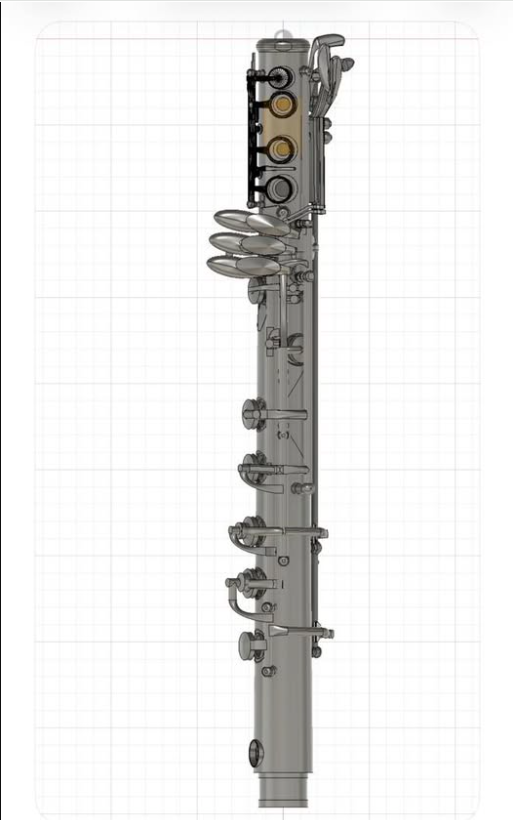
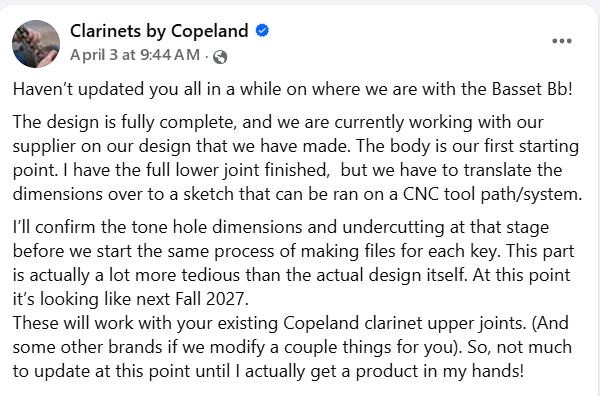
Attachment: Copeland Basset Bb 2.png (253k)
Attachment: Copeland Basset Bb 1.png (72k)
I haven't done business with Copeland and admittedly, their website has very generic descriptions on their instruments although the craftsmanship appears very nice.
He does showcase his own repair services and innovations (just recently offered a second register key for Bb clarinet), but I'll keep that as a separate category compared to manufacturing instruments.
They are currently designing a Basset Bb. I've never designed anything, but having this kind of CAD (I assume) design for implementation certainly seems to stand out to me. Ridenour showed a similar kind of software when he was first promoting his new Interchangeable Bore Barrel design.
Ridenour AureA Bb clarinet
Ridenour Artist MT36 mouthpiece
Vandoren Optimum black ligature (plate 1)
Vandoren Traditional #3.5 reeds
Brad Behn HR adjustable barrel
|
|
Reply To Message
|
|
Author: Kalashnikirby
Date: 2026-04-07 20:23
But then they shouldn't be too concerned by Lowenstern's criticism. Doing own R&D does set apart from others and I can respect that. I will say that there is no discernible features of their bass and eb clarinets that would suggest their own R&D went into these, but they'll have some benefit of the doubt, I guess.
But thanks for pointing that out, David.
|
|
Reply To Message
|
|
Author: Klarnt
Date: 2026-04-08 04:54
Just throwing in my two cents. It is interesting how the internet has greatly expanded the global Clarinet industry in the past decade. Clearly the market profitability is attractive enough to attract many firms to enter the market, and this includes stencils. The question that caught my attention was what impact do these cheap stencils have on long-term investments or R&D in new designs. Without some sort of quantitative analysis it’s hard to reach any conclusions, but I would like to throw some ideas at the wall and see what sticks.
The Selmer Privileges and Buffet Prestiges of the world do have some behavioral protections from copycats. For starters, they are credible brands that Clarinet professionals trust and recommend to their students and other players. Sometimes Clarinet players appeal to tradition and authority to an insufferable degree, but this is a good thing for the top brands. If a new brand called “Bordeaux” were to pop up tomorrow and was a stencil of the Selmer Privilege, most people would choose the authentic Selmer. In order to compete, Bordeaux would have to lower their price in order to entice some buyers to take a risk on them.
Which leads to my second point, people often use price as a shortcut for judging quality. The top line products are not competing on price, but rather product differentiation. The market segment consists of Clarinet professionals, who are willing to pay an arm-and-a-leg for the best of the best. Research and development is essential for makers to compete in this market segment. Since stencils use older models of established instruments, Selmer and Buffet may actually be incentivized to innovate their top horns in order to justify the price tags in consumer’s minds.
Will Selmer and Buffet make more profits focusing their efforts on price or differentiation competition? It depends on how buyers perceives the value of their instruments and their willingness to pay for improvements.
In theory, I’m optimistic. I think this will be good for consumers at least in the short run. The stencils copying high-end horns will make good designs (although maybe lousy execution) more accessible to students and casuals who don’t want to spend too much money on a horn. On the other hand, it may push the established makers to innovate better Clarinets. As for the long run, we’ll have to wait and see.
As for the other concerns, that’s outside of my wheelbarrow or interest.
|
|
Reply To Message
|
|
Author: David H. Kinder
Date: 2026-04-08 09:10
David, please post links rater than copy paste so autors have control on their output.
Ridenour AureA Bb clarinet
Ridenour Artist MT36 mouthpiece
Vandoren Optimum black ligature (plate 1)
Vandoren Traditional #3.5 reeds
Brad Behn HR adjustable barrel
|
|
Reply To Message
|
|
Author: bradfordlloyd
Date: 2026-04-08 19:05
So, I watched the video and read the social media posts and I think that this is all a tempest in a teacup (i.e., no big deal).
Stencil horns have existed for a very long time -- ever noticed that many older bass clarinets all have the same keywork? Yes, because they were all made by Malerne and stenciled with other makers' names -- I have seen the same horn from Malerne, Penzel Mueller, Marigaux, SML, Evette Schaeffer, Linton and dozens of others. It's not a great bass clarinet (I used to have one), but it is perfectly acceptable.
The same thing is happening now, which is what Lowenstern is basically pointing out. I agree with his concern that companies that do research & development and have premium-priced instruments might stop doing that if they see the market moving towards the less expensive stencilled horns.
However, there is room in the market for more affordable bass clarinets, as well as premium bass clarinets. Some of these stencils are like Hyundais, and the Selmers and Backuns are like BMWs and Mercedes. There are buyers for all of them and the market can decide.
I just think we're not used to seeing actual competitive language and dynamics in the world of bass clarinets. Companies will always find a way to tell you why they think that their products are better than their competitor's. It's okay -- the buyer still gets to choose what they think is best for them based on price, performance, etc.
Full disclosure: I own Backun Q and a Kessler Gen 2 bass clarinets.
|
|
Reply To Message
|
|
Author: Kalashnikirby
Date: 2026-04-08 22:44
Well, you guys have a point. I was about to mention the long tradition of stencils, but maybe they're a bit different from what we're seeing today: After all, most of these have been a sort of original design, but were rebranded many times.
Moreover, there have been TONS of bad instruments in the past. German instruments after the war, I believe, weren't always the greatest - heck, GDR Uebels were often crap.
It gets problematic when an instrument clearly copies a (somewhat) recent design. Again, I can't see why you would choose a Selmer copy when you can have an Alpha bass, but I've never played the Selmer copy. The "Yamaha" style one, let me tell you, is bested by the max in any way.
Also affordability isn't as revolutionary as Lisa's clarinet shop's post may suggest, because what about the long term durability? Some chinese rod screws concern me alot, I wouldn't want to mess with them too often. The Max is better in that regard, but doesn't reach Buffet quality. And what about spare parts? Time will tell if a 20 year old chinese instrument will have any resale value. Then again, older selmer/buffet basses aren't really a joy to repair either...
|
|
Reply To Message
|
|
Author: David H. Kinder
Date: 2026-04-08 23:42
Great points!
I'll make a quick analogy that sometimes there are car brands that almost outright copy others.
Hyundai did an almost outright copy of the Lexus LS - at least in South Korea.
https://www.youtube.com/watch?v=FtmNXC8iqR4
But like KalashniKirby mentioned is the quality of the keywork and parts for ongoing maintenance may be an issue - at least those that are priced far cheaper than those that are sold by dealer names.
To me, Hyundai cars may have a great warranty, but I'd prefer a car that doesn't necessarily need to use it.
Just my thoughts.
Ridenour AureA Bb clarinet
Ridenour Artist MT36 mouthpiece
Vandoren Optimum black ligature (plate 1)
Vandoren Traditional #3.5 reeds
Brad Behn HR adjustable barrel
|
|
Reply To Message
|
|
Author: JTJC
Date: 2026-04-09 16:34
Can anyone say how much genuine R&D is actually going on in the big clarinet manufacturers?
I tend to think it's not a lot. Most new models that come out seem to feature characteristics that previously existed. I feel there's just recycling of ideas, incorporating them into a 'new' model, then letting the marketing guys and 'artists' do the rest.
Of course, if you employ a clarinet 'designer', that person needs to come up with something, and it needs to have a use. That litte team that 'designs' and builds prototypes is going to try to keep their jobs for as long as possible.
If there really are a good number of people involved in clarinet R&D, they haven't really come up with anything that has moved the instrument significantly forwards, have they? Innovation has probably been more in manufacturing techniques (CNC etc), but those came from other fields and were applied to clarinets.
|
|
Reply To Message
|
|
Author: bradfordlloyd
Date: 2026-04-09 19:24
The new Backun bass clarinets have incorporated several features, some of which I have seen before and some more unique.
What I've seen before: adjustment screws, undercut tone holes (see below), adjustable thumbrest, extra sturdy keywork and plating, redesigned right thumb keys
The more unique ones: They have tone holes that are both undercut AND overcut, meaning that they are also shaped on the exterior of the instrument, which they say improves tone and intonation. They also have a complex 3-function register mechanism that makes even throat Bb sound amazing. And their right thumb keys are differently designed than other instruments (which is confusing at first, to be honest)
I'm not saying that they've reinvented the instrument, but it did take some R&D to figure these things out. This is how the instrument progresses and moves forward.
(BTW, I used to play a Selmer Paris bass and that was the same basic instrument for close to 100 years. A really good horn, but not especially innovative.)
|
|
Reply To Message
|
|
Author: David H. Kinder
Date: 2026-04-09 20:52
Yes, I would reference the Backun Q & Alpha (which copied the Q keywork) and the Fox clarinet.
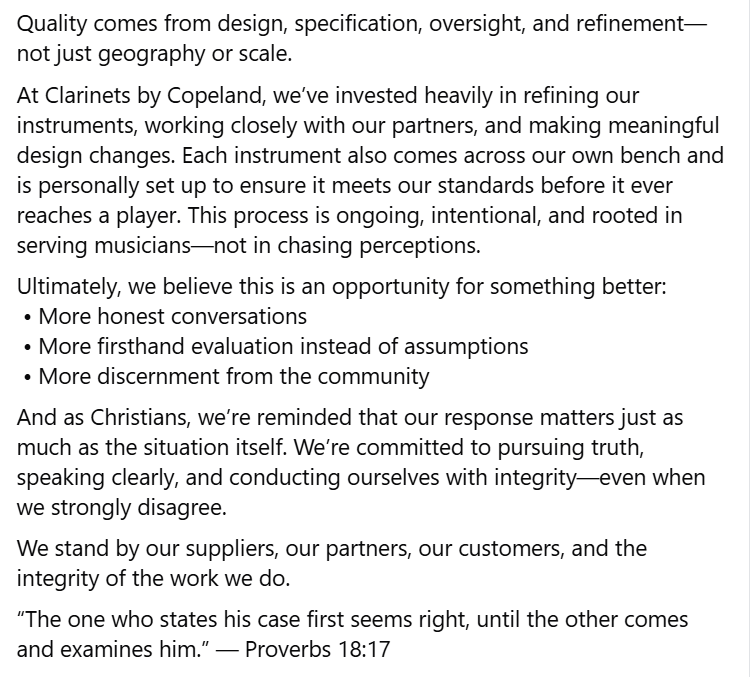
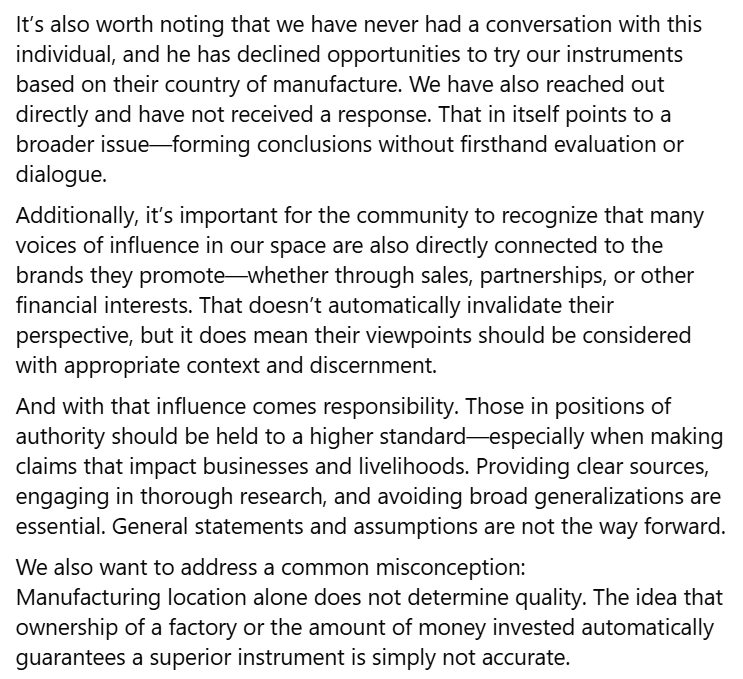
Conversely, Clarinets by Copeland posted this today:
David, please post links rater than copy paste so autors have control on their output.
I did comment that his time and expertise has a value.
Ridenour AureA Bb clarinet
Ridenour Artist MT36 mouthpiece
Vandoren Optimum black ligature (plate 1)
Vandoren Traditional #3.5 reeds
Brad Behn HR adjustable barrel
|
|
Reply To Message
|
|
Author: Kalashnikirby
Date: 2026-04-09 21:54
Again I wonder, what's the point of the pathos? Framing your business as "Serving the people" - I'm sorry, but such a narrative is ridiculous. It is true that large companies like Buffet seem to exist only for their private equity investors (while many of the marketing claims revolve around... having had some sort of great history).
But others might step forward and create some really brilliant stuff. While still needing a greater budget to do so. So a "us vs. them" narrative is reductionist to say the least.
Schwenk and Seggelke are rather small and keep on innovating, while making the instruments in Germany still. The result (necessarily so) are high-end, professional grade instruments in all kinds of flavors. Heck, there's many other small german makers, and some of them even make (relatively) affordable german system clarinets, like Martin Foag or Harald Hüyng (they wouldn't make "affordable" boehm instruments, as that market is fairly occupied).
This discussion would eventually lead to the question: Is outsourcing production morally right?
I think we've had this over and over again and I wouldn't comment on that in this thread, I will however say that framing your outsourcing as "serving the people, making instruments affordable etc." *while* criticising large companies and their strategies is hypocritical. You're in a modern market, using modern methods, don't act like you're better than everyone else.
PS: A large company I'll always appreciate, though they have innovated too little in the past years is Yamaha - they're yet to redesign their line of bass clarinets, among others... But nbody puts out consistent quality on a large scale like they do. The valve sections of their french horns for example are outstanding. And you all surely know about their clarinets!
|
|
Reply To Message
|
|
Author: David H. Kinder
Date: 2026-04-09 23:59
I just saw this and for the complete picture, here's Michael Lowenstern's Facebook post on April 6th:
***
***
David, please post links rater than copy paste so authors have control on their output.
Ridenour AureA Bb clarinet
Ridenour Artist MT36 mouthpiece
Vandoren Optimum black ligature (plate 1)
Vandoren Traditional #3.5 reeds
Brad Behn HR adjustable barrel
|
|
Reply To Message
|
|
Author: sonicbang
Date: 2026-04-10 01:09
Attachment: lower_top.jpg (201k)
Attachment: upper_top.jpg (207k)
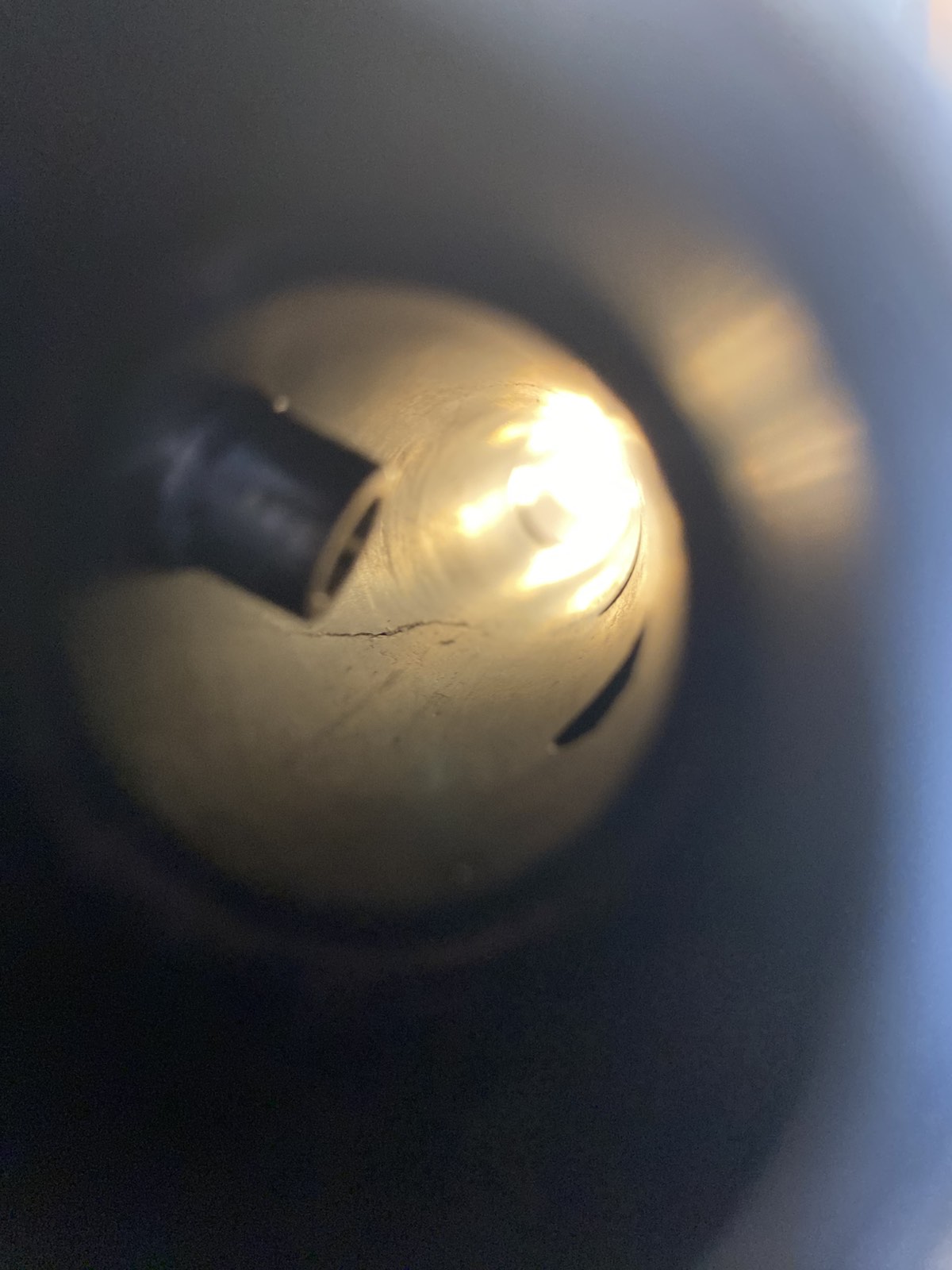
I recently had an unfortunate encounter with a bass clarinet of this origin. The upper joint had four cracks in the bore, the intonation was very problematic, and the bore itself was about 1 mm wider than specified by the seller.
Thankfully, I was able to recover most of my money—but it was still a valuable lesson.
I won’t name the dealer or seller. This is simply a friendly reminder: trying to save money by avoiding established makers can sometimes come with significant risks. Not always—but it’s something worth keeping in mind.
Mark Szavin
🎵mouthpiece specialist🎵
|
|
Reply To Message
|
|
Author: Fuzzy
Date: 2026-04-10 05:58
Of course, if the future holds up to our history, our clarinet communities and instructors will find a way to make all those who couldn't afford top-of-the-line name brand instruments feel as if they've been shorted, and will only truly make it big when they get the name-brand item.
I don't intend to be negative - it's just that this thread plays an interesting contrast to so many other threads pertaining to what Bb Soprano instruments should be obtained by/for students.
If IP isn't really a thing in the clarinet world...and every clarinet is basically the same open domain clarinet - then what are we doing? I suggest IP is still a thing. Perhaps it is in the methods of milling, the insets, the undercuts, etc. But it is there. I think a fair portion believe it is usually going in the wrong direction - but it's there.
While I admire and respect Lisa's take on it (it's a nice perspective), I can't fully embrace it. To me, it simply mirrors how IP is increasingly treated across all art and even property. Look at AI as it stands right now - it's mostly plagiarism/copyright violation by a million copy/paste cycles. It's not intelligence, and it's not creative...it's iterative theft of IP.
Attitudes have become lax regarding IP, because everyone wants the new toy - but that doesn't mean IP isn't still there waiting for someone to support it before the pirates steal it away piece by piece.
Fuzzy
;^)>>>
|
|
Reply To Message
|
|
Author: clarnibass
Date: 2026-04-10 11:06
>> I recently had an unfortunate encounter with a bass clarinet of this origin. <<
I haven't seen problems anywhere near that bad on any reputable brand of bass clarinet, but I could write a post longer than this thread about the issues the couple of last Privilege bass clarinets I've seen had. Completely unacceptable at its price and quality (they do play great generally).
|
|
Reply To Message
|
|
Author: Kalashnikirby
Date: 2026-04-10 13:06
Worst of all, they have some weird (glued in...?) nylon pins that break way too easily, besides a lousy setup, which makes a Max look like it had the "earspasm setup"
(if you buy a Privilige from a bigger store, that is).
There are, however some weird manufacturing errors on chinese instruments, even the better ones, like damage to the inner bore because a few posts have been drilled too deeply, debris from tone hole cuts and so on.
This is why I like brands like Royal or Uebel, where they seem to do relatively strict QR compared to these "no names".
Buffet and Selmer... especially their basses - best to view them as high quality pre-assembled DIY kits - or if you don't have the skills - better calculate with what your technician charges for a proper setup
|
|
Reply To Message
|
|
Author: m1964
Date: 2026-04-10 23:57
Kalashnikirby wrote:
>.... Buffet and Selmer... especially their basses - best to view
> them as high quality pre-assembled DIY kits - or if you don't
> have the skills - better calculate with what your technician
> charges for a proper setup
If you buy from a dealer, the shop will check the instrument before the sale and customize it for you.
If you buy from an internet outlet or a from a re-seller, it's another story...
|
|
Reply To Message
|
|
Author: Chris P
Date: 2026-04-11 19:44
Not all dealers will do what needs doing to get brand new Buffets to the standard they ought to be before they leave the factory, even if they claim they do a full set-up. Most of the time that's left to the buyer when they have it serviced or fully overhauled further on down the line.
Former oboe finisher
Howarth of London
1998 - 2010
Independent Woodwind Repairer
Single and Double Reed Specialist
Oboes, Clarinets and Saxes
NOT A MEMBER OF N.A.M.I.R.
The opinions I express are my own.
|
|
Reply To Message
|
|
Author: clarnibass
Date: 2026-04-12 09:04
>> If you buy from a dealer, the shop will check the instrument before the sale and customize it for you.
If you buy from an internet outlet or a from a re-seller, it's another story... <<
The two Privilege basses I mentioned...
One was bought directly from Selmer in France.
The other was bought from a real physical authorized Selmer dealer.
Post Edited (2026-04-12 09:12)
|
|
Reply To Message
|
|
Author: David H. Kinder
Date: 2026-04-22 22:39
Lowenstern just posted an updated video (since the first one got a 'copywrite strike' for showing their logo?).
https://www.youtube.com/watch?v=XNuAiGFS4Bo
Ridenour AureA Bb clarinet
Ridenour Artist MT36 mouthpiece
Vandoren Optimum black ligature (plate 1)
Vandoren Traditional #3.5 reeds
Brad Behn HR adjustable barrel
|
|
Reply To Message
|
|
Author: David H. Kinder
Date: 2026-04-23 02:57
David did a copy/paste of a Facebook post. Authors lose control of their posts when they're copied to other sites. I've asked David to post a link to the page on Facebook
Mark C
Ridenour AureA Bb clarinet
Ridenour Artist MT36 mouthpiece
Vandoren Optimum black ligature (plate 1)
Vandoren Traditional #3.5 reeds
Brad Behn HR adjustable barrel
|
|
Reply To Message
|
|
Author: David H. Kinder
Date: 2026-04-23 06:37
Michael Lowenstern just did a reply to Lisa:
***
David, please post links rater than copy paste so authors have control on their output.
Ridenour AureA Bb clarinet
Ridenour Artist MT36 mouthpiece
Vandoren Optimum black ligature (plate 1)
Vandoren Traditional #3.5 reeds
Brad Behn HR adjustable barrel
|
|
Reply To Message
|
|
Author: David H. Kinder
Date: 2026-04-23 08:36
Lisa has responded - quite complimentary too!
***
David, please post links rater than copy paste so autors have control on their output.
Ridenour AureA Bb clarinet
Ridenour Artist MT36 mouthpiece
Vandoren Optimum black ligature (plate 1)
Vandoren Traditional #3.5 reeds
Brad Behn HR adjustable barrel
|
|
Reply To Message
|
|
The Clarinet Pages
|
 |
.jpg)
.jpg)
.jpg)
.jpg)
.jpg)
.jpg)