The Clarinet BBoard The Clarinet BBoard
|
Author: wl24
Date: 2023-01-27 14:34
Attachment: IMG_6625.jpg (237k)
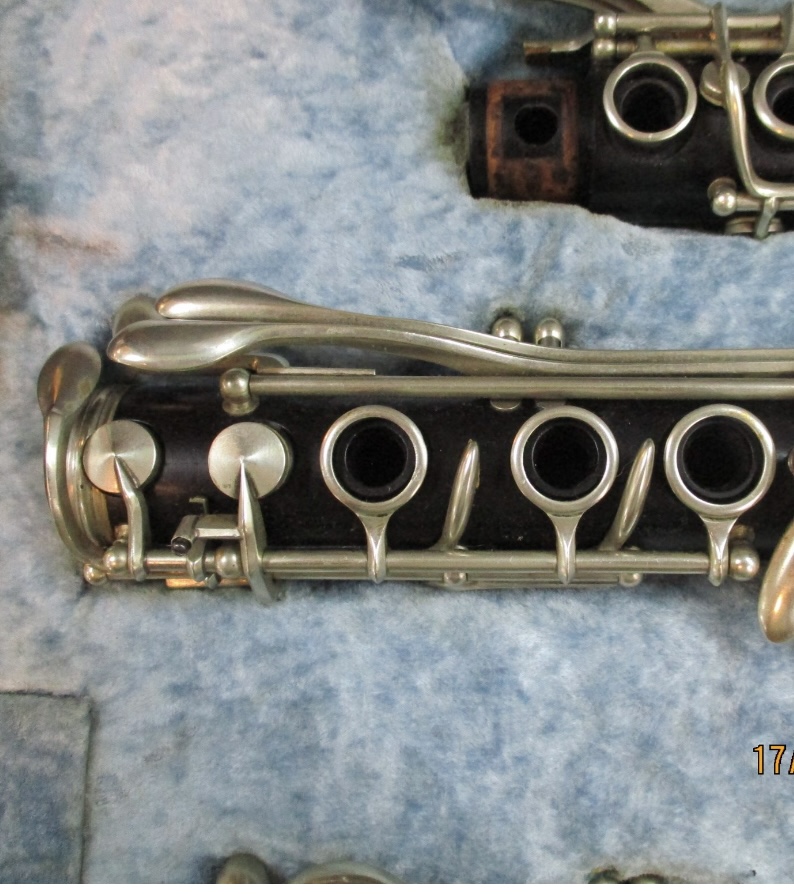
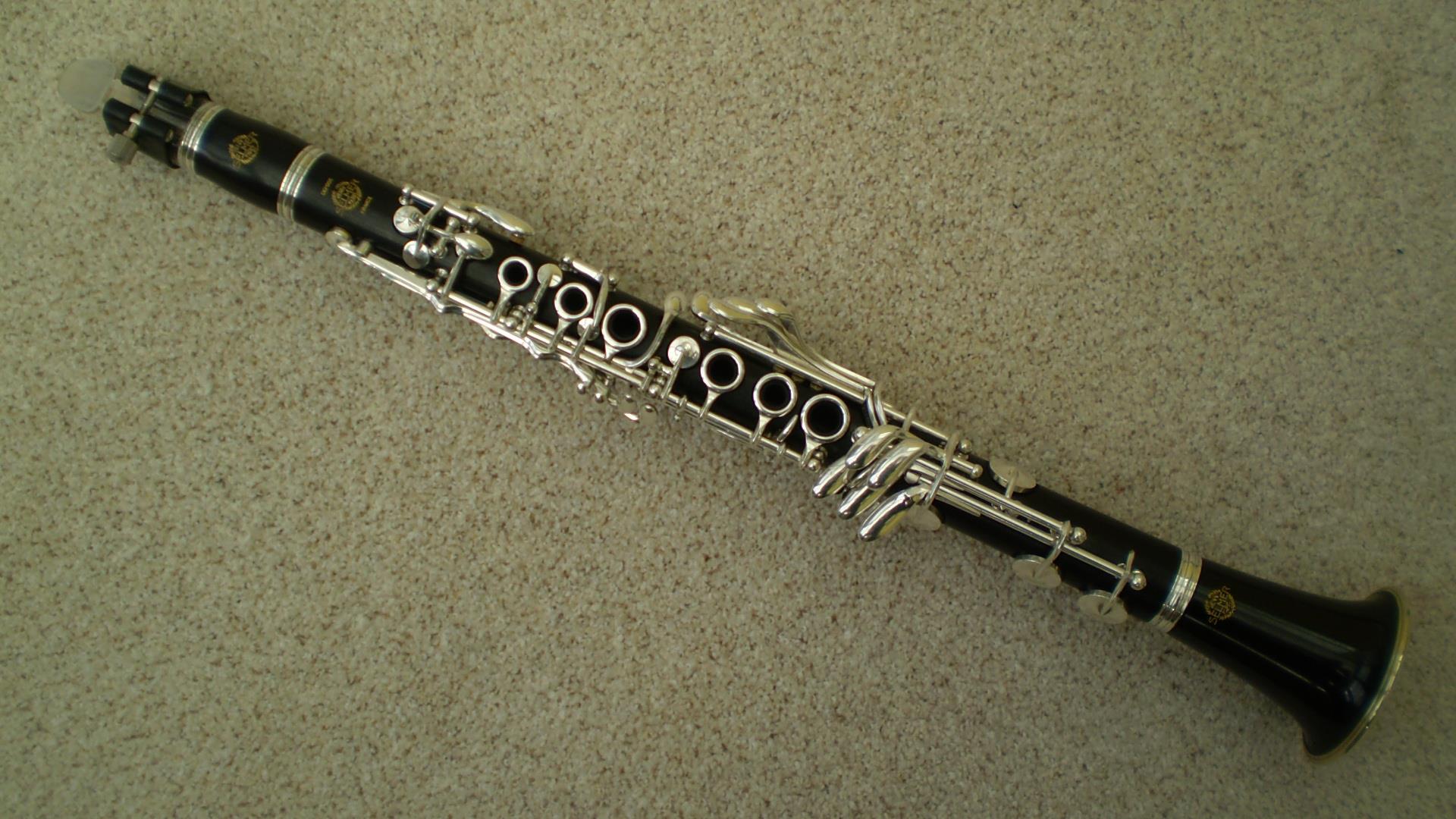
Noticed some weird keys on Selmer Centered Tones, what was the purpose and the effect.
Probably from the 1954/1955
Thanks,
|
|
Reply To Message
|
|
Author: paulyb
Date: 2023-01-27 16:07
It's a "full boehm" clarinet. These aren't very popular these days. These links might help you:
http://test.woodwind.org/clarinet/BBoard/read.html?f=1&i=324850&t=324779
https://www.thevintageclarinetdoctor.com/-blog/whatever-happened-to-the-full-boehm
https://en.m.wikipedia.org/wiki/Boehm_system_(clarinet) (see the short section on Full Boehm clarinets)
|
|
Reply To Message
|
|
Author: Chris P
Date: 2023-01-27 20:47
Attachment: r4430.jpg (330k)
Attachment: p9013.jpg (80k)
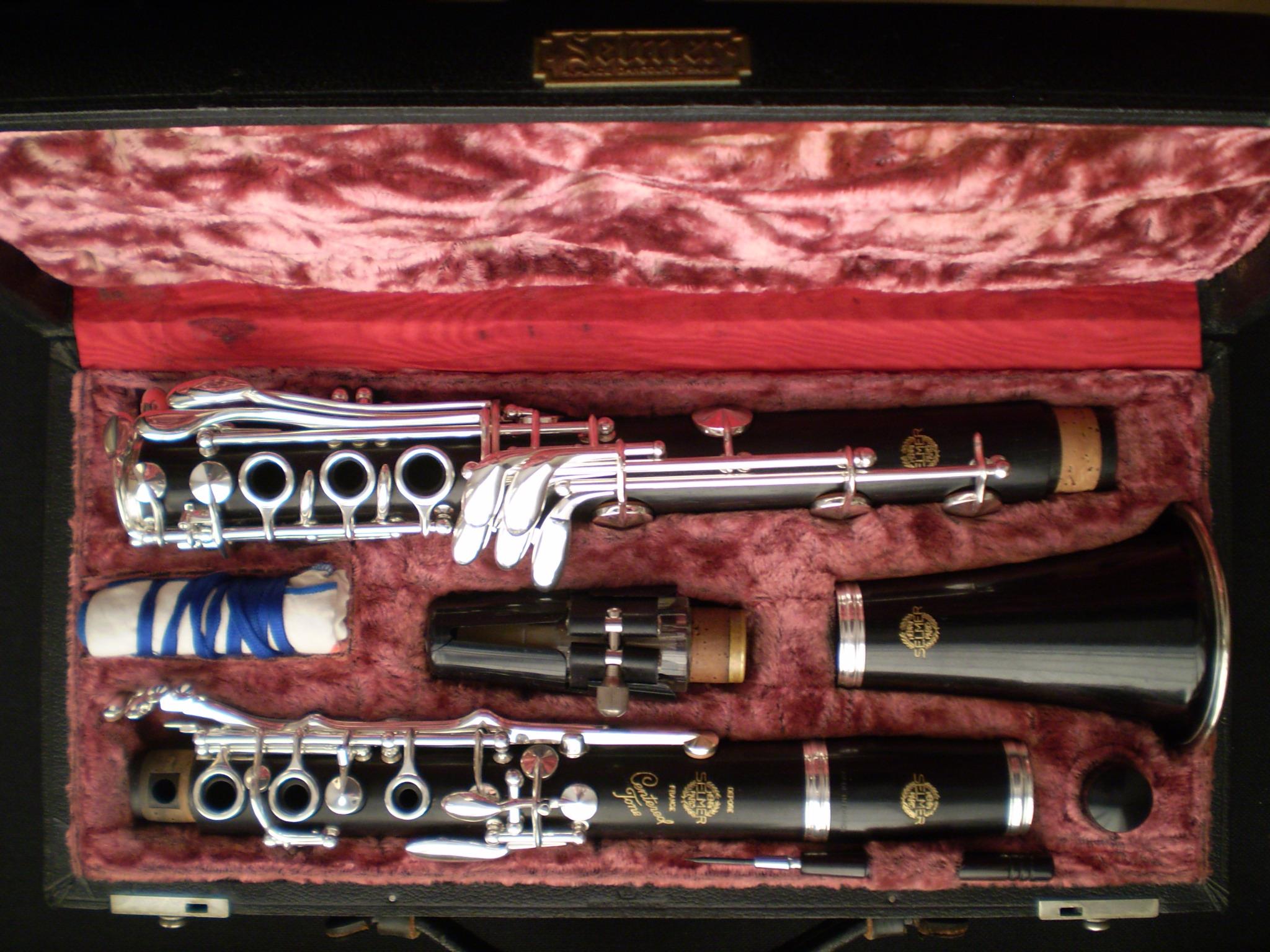
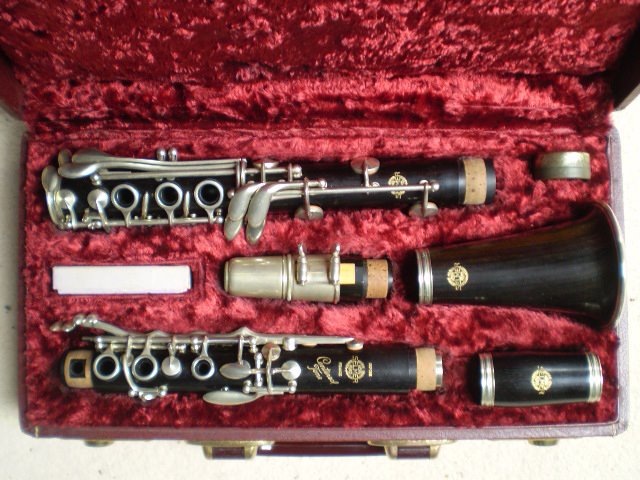
That's not a full Boehm as full Boehms (Selmer's model 808 or with N.8 spec keywork) have 20 keys and 7 rings with the range to low Eb (see 1st attachment).
It's Selmer's model 804 (or N.4 spec keywork - see 2nd attachment) which is the model fitted with the LH forked Eb/Bb mechanism and articulated C#/G# mechanism which make the following easier:
C-Eb/G-Bb can be played as C/G (xxx|ooo), then lift off LH finger 2 (LH middle finger) to give the Eb/Bb (xox|ooo) which unlike long Bb (xoo|xoo), is in tune as both a lower register Eb and upper register Bb.
B-C#/F#-G# trill is done by holding the C#/G# key down and trilling with RH finger 2 (RH middle finger) just as is done on saxes - the RH ring keys will automatically close the C#/G# pad cup when they're held down. Also the extra 'sliver' key for RH2 is to give an easy C/Db, G-Ab and altissimo E-F trill as that duplicates the LH pinky C#/G# key.
You will lose the full fingerings for altissimo F and Bb because of the articulated C#G# mechanism as the RH ring keys will hold it closed, but you can still use the short altissimo F fingering and altissimo Bb can be played as upper register C with the left thumb off/uncovering the thumb tube while still holding the speaker key open.
Here's a list of Selmer's keywork spec/CT model numbers:
N.1/801 - 17 keys, 6 rings (your bog standard Boehm system clarinet)
N.2/802 - 17 keys, 7 rings (with LH forked Eb/Bb mechanism only)
N.3/803 - 18 keys, 6 rings (with articulated C#/G# mechanism only)
N.4/804 - 18 keys, 7 rings (with both forked Eb/Bb mech and artic. C#/G#)
N.5/805 - 19 keys, 6 rings (with low Eb and artic. C#/G#)
N.6/806 - 19 keys, 7 rings (LH Ab/Eb lever, forked Eb/Bb and artic. C#/G#)
N.8/808 - 20 keys, 7 rings (full Boehm - low Eb, LH Ab/Eb, forked Eb/Bb and artic. C#/G#)
Current Selmers with just the LH Ab/Eb lever (18 keys, 6 rings) are N.1B
Former oboe finisher
Howarth of London
1998 - 2010
Independent Woodwind Repairer
Single and Double Reed Specialist
Oboes, Clarinets and Saxes
NOT A MEMBER OF N.A.M.I.R.
The opinions I express are my own.
Post Edited (2023-01-27 21:03)
|
|
Reply To Message
|
|
Author: wl24
Date: 2023-01-27 23:38
Thanks guys,
I have a pair, both Selmer's model 804, an A and a Bb. Comes in original double case with a B&H 926 mouthpiece.
Any idea of the value?
Thanks
|
|
Reply To Message
|
|
Author: Ed
Date: 2023-01-28 04:55
I remember when the Selmer catalogue had those number options as well as the Mazzeo system. I am not sure when they discontinued the various configurations. Maybe it was somewhere around the early 80s? Chris, you seem to know a lot of those historical details- any idea?
|
|
Reply To Message
|
|
Author: m1964
Date: 2023-01-28 08:26
wl24 wrote:
"...I have a pair, both Selmer's model 804, an A and a Bb. Comes in original double case with a B&H 926 mouthpiece.
Any idea of the value?"
I did a quick check on ebay for sold Bb clarinets- most of them sold for well under $1K.
All those were "basic" 17 keys/7 rings instruments in Bb.
|
|
Reply To Message
|
|
Author: Chris P
Date: 2023-01-28 18:57
"The Big 3" (Buffet, Leblanc and Selmer) used to offer a variety of keywork options from your standard 17 key 6 ring models right through to full Boehms (as well as Selmer offering Mazzeo and Marchi systems).
Selmer were the first to rationalise their lineup and drop the various options except the LH Ab/Eb lever in the 1990s. I think Buffet followed suit around the same time and finally Leblanc were the last and ditched the extras in the early 2000s.
While these extras are always useful to those who find them useful, the basic fingerings aren't any different to any other Boehm system clarinet - these keywork options just give you more choice and ease when playing in certain keys or doing certain trills, tremolos and intervals. Don't be afraid to use them as they were added for a reason.
Former oboe finisher
Howarth of London
1998 - 2010
Independent Woodwind Repairer
Single and Double Reed Specialist
Oboes, Clarinets and Saxes
NOT A MEMBER OF N.A.M.I.R.
The opinions I express are my own.
|
|
Reply To Message
|
|
Author: Ed
Date: 2023-01-28 19:11
While most of us have developed the techniques needed to play the basic system, the few times that I had the chance to use an instrument with the extra keys it was handy in certain passages. I don't really care for the articulated G# because I hate losing the long F fingering
|
|
Reply To Message
|
|
Author: Chris P
Date: 2023-01-28 20:17
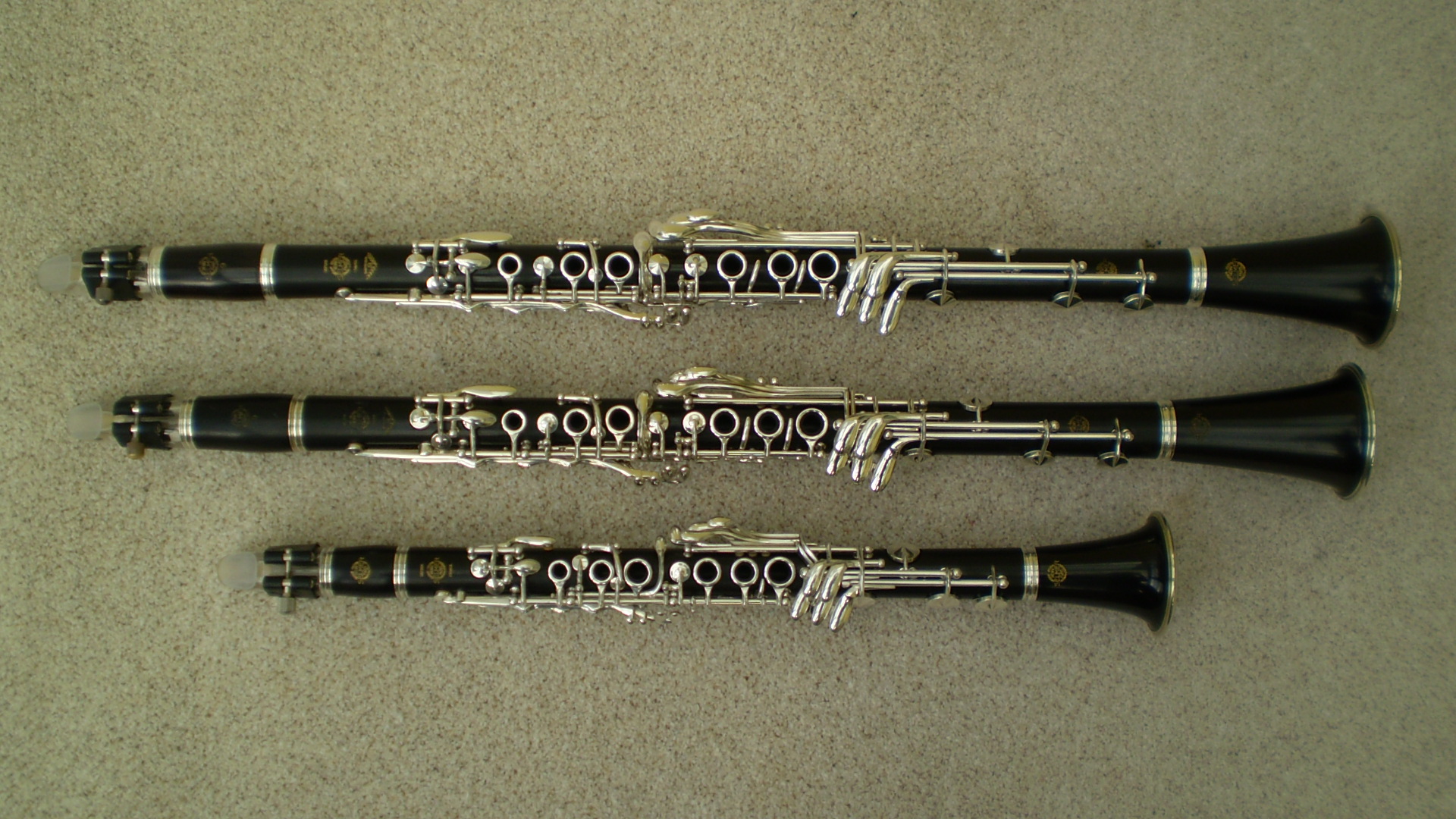
Attachment: selmerseries9clarinets.jpg (702k)
Attachment: series9eb.jpg (263k)
Being a sax player and also having found myself playing far more oboe than I was hoping, the articulated C#/G# isn't an issue as both saxes and oboes have that. I've even linked up the C#/G# pad cup on my Prestige bass to make it articulated and also had a request from another orchestral bass clarinettist to do that to hers as she too finds it a benefit rather than a hindrance. Only when I play a clarinet with a standard fixed C#/G# key do I have to stop myself holding the C#/G# key down too early.
And now I have a set of full Boehm A, Bb and Eb clarinets, that means I don't have to think when using any of them with the fingerings I want to use rather than fingerings I have to use. I still wouldn't mind a Selmer Series 9 full Boehm C clarinet to complete the set and I know they're out there.
Former oboe finisher
Howarth of London
1998 - 2010
Independent Woodwind Repairer
Single and Double Reed Specialist
Oboes, Clarinets and Saxes
NOT A MEMBER OF N.A.M.I.R.
The opinions I express are my own.
|
|
Reply To Message
|
|
Author: ISM
Date: 2023-01-28 21:53
Hey Chris,
Do you ever use the long Bb as an alternative to the throat Bb? What are the pros and cons of that?
Imre
|
|
Reply To Message
|
|
Author: Chris P
Date: 2023-01-29 02:15
I only use long Bb (xoo|xoo) in the upper register for F-Bb or similar intervals involving A#/Bb between the left and right hands.
Forked Eb/Bb (xox|ooo) is perfectly in tune for use in both registers (unlike xoo|xoo which is sharp as a lower register Eb) and makes some minor and diminished runs easier as well as not having to use the side or LH3 'sliver' Eb/Bb keys.
The low Eb can be used as an alternative to throat Bb (or A#) and will keep some things in the upper register, such as a smooth B-A# with a similar tone colour in Schumann's Fantasiestücke instead of dropping to a throat Bb which has a noticeable tone colour quality difference and resistance next to the upper register B which you'd have to do on a regular Bb clarinet (unless you play it on an A in which case it'll be just like playing upper register C-B). I tend to find I use low Eb as an alternative to throat Bb more often than not, especially if I'm already in the upper register and want to stay in the upper register.
Former oboe finisher
Howarth of London
1998 - 2010
Independent Woodwind Repairer
Single and Double Reed Specialist
Oboes, Clarinets and Saxes
NOT A MEMBER OF N.A.M.I.R.
The opinions I express are my own.
|
|
Reply To Message
|
|
Author: ISM
Date: 2023-01-29 08:08
Chris—Thanks for the info. I hope you find that Selmer C. I’m looking forward to seeing the photo with the rest of its siblings.
|
|
Reply To Message
|
|
Author: ghoulcaster
Date: 2023-01-29 13:32
After using clarinets with a forked Bb/Eb, I’ve really been questioning the necessity of the bridge key. To me it seems to be a much better solution for Bb/Eb than the bridge key which is more mechanically problematic for less return IMO.
I don’t know if going from clarion F to Bb as xoo/xoo is that much easier than Bb as xox/ooo. I don’t have a clarinet at hand but maybe there is a blip going from xox/ooo-> xxo/ooo that doesn’t happen with xoo/xoo -> xxo/ooo? I can’t think of any other reason to prefer that fingering.
I wonder of disconnecting the bridge key would allow one to keep the right hand down when crossing the break up from throat E, F, and F# in fast passages where intonation is less critical (If that is the case, I reckon it should be possible on Albert/German clarinets as they don’t have bridge keys).
That, as well as not having to worry about bending the bridge key and adjustment issues leads me to believe that the 7th ring obsoletes the bridge key, at least in theory, unless I’m missing something.
An articulated G#/C# is a great convenience but I understand the criticisms and concerns about losing fingerings like the long F. However, the 7th ring has the potential to greatly facilitate the playing of certain sequences with no drawbacks that I have found. Mechanical complexity is not a valid argument in my opinion because 1. it really is not that complicated and is very reliable and 2. the bridge key is a better target for that qualm.
Its a shame that attempts to improve the clarinet’s mechanism are a thing of the past. Rose gold plating and coccobolo?? not innovation
|
|
Reply To Message
|
|
Author: NOLA Ken
Date: 2023-01-30 00:08
Imre:
I've only been playing my Leblanc Symphonie 3 full Boehm for a few months, but have found the long Bb to be a godsend for a passage of five measures of fast repetitive sixteenth note runs in Omar Thomas's "A Mother of A Revolution!" for concert band. The runs start on throat G, up to Bb (I play it long), D, Eb, and back down. Everything except the open G (w/ Rt hand down) is done with my right hand pinky finger. I don't have the fastest fine motor speed, and this just reduces movement tremendously.
The long Bb on my instrument is just a bit stuffier than the pinch Bb, especially if I add resonance fingerings to the pinch Bb. So I don't use the long Bb for sustained notes. It did come in handy when one arranger inadvertantly wrote a low Eb into his arrangement. Perplexed all the clarinets for a while.
|
|
Reply To Message
|
|
Author: Chris P
Date: 2023-01-30 00:57
Some German clarinets made with a mix of both German and Boehm system don't have the long Bb link between the joints (the long Bb is why they're called Boehm system) and have the forked Eb/Bb mechanism so the forked fingering for upper register Bb can be used as well as for lower register Eb. German/Oehler systems can use the LH forked fingering as an upper register Bb, but not as a lower register Eb as it's far too sharp (just like long Bb on Boehms).
I can't remember what this hybrid system is called (it's named after its inventor), but it's definitely not reform Boehm, German Boehm, Oehler or any of the usual standard systems. Instead, these clarinets do look like German systems at a glance as they have similarly shaped keywork as German/Oehler systems, but have different tonehole positions and the keywork linked up plus some extra keys added (eg. LH F/C lever) to offer the best of both systems and not having to worry about aligning the bridge key as you'd have to on Boehms and reform Boehms.
Former oboe finisher
Howarth of London
1998 - 2010
Independent Woodwind Repairer
Single and Double Reed Specialist
Oboes, Clarinets and Saxes
NOT A MEMBER OF N.A.M.I.R.
The opinions I express are my own.
|
|
Reply To Message
|
|
Author: Ivan Kolev
Date: 2025-12-31 01:20
I am a wind instruments repairman from Bulgaria. I am searching for an upper joint for clarinet Selmer 10S full boehm and a full set of keys for clarinet Selmer Centered tone full boehm.
I have a lot of parts for Selmer and Buffet Crampon upper and lower joints.
I can make a barter of my parts for what I need.
Thanks, Ivan
|
|
Reply To Message
|
|
The Clarinet Pages
|
 |
.jpg)
.jpg)
.jpg)
.jpg)
.jpg)
.jpg)